
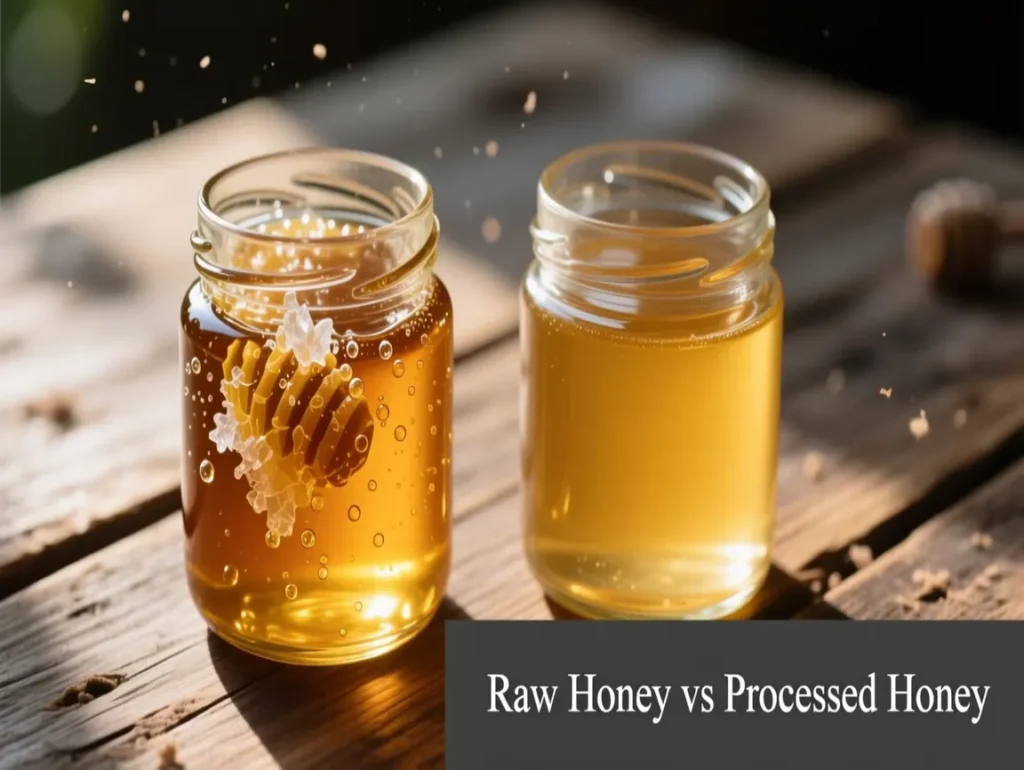
Raw vs. Processed Honey Through a Microbial Lens**
The distinction between raw and processed honey is often framed as a matter of preference—taste, texture, or appearance. In commercial settings, processed honey is frequently presented as cleaner, smoother, and more reliable, while raw honey is seen as rustic or inconsistent.
However, when examined through a microbial lens, the difference between raw and processed honey is not cosmetic. It is biological.
This distinction determines whether honey retains its microbial-mediated complexity or whether that complexity has been fundamentally altered.
What “Raw” Honey Actually Means (Biologically)
Raw honey is not defined by the absence of handling. All honey must be harvested, extracted, and stored. What distinguishes raw honey is minimal intervention.
From a microbial perspective, raw honey is honey that has:
- not been subjected to high heat
- not undergone ultrafiltration
- retained its natural enzymatic activity
- preserved pollen, particulates, and microbial residues
Raw honey therefore maintains much of the biological imprint left behind by plants, bees, and microbes.
It is not alive in the sense of active microbial growth, but it remains biologically expressive—a product that still carries the outcomes of microbial participation.
Processed Honey: A Controlled but Simplified Substance
Processed honey is designed to meet industrial expectations:
- clarity
- long-term fluidity
- uniform taste
- visual consistency
To achieve this, honey is typically:
- heated to delay crystallization
- filtered to remove pollen and particulates
- blended to standardize flavor and color
From a microbial lens, this process simplifies honey’s biological profile. While sugars remain intact, many of the microbial-derived signatures are reduced or eliminated.
What remains is honey as a nutritional substance, rather than honey as a biological outcome.
Enzymes as Microbial Traces
Enzymes in honey are among the clearest indicators of microbial-mediated processing. These enzymes—introduced and stabilized during nectar transformation—are sensitive to heat and filtration.
In raw honey:
- enzyme activity remains detectable
- enzymatic diversity reflects botanical and microbial origin
In processed honey:
- enzyme levels are often reduced
- activity may be inconsistent or negligible
This loss does not make honey unsafe, but it changes how honey interacts with biological systems during digestion.
Pollen, Particulates, and Biological Context
Pollen grains and microscopic particulates are frequently removed during processing to enhance visual appeal. Yet these elements serve as biological context markers.
Through a microbial lens, pollen:
- anchors honey to plant ecosystems
- carries chemical signals from floral sources
- interacts with enzymes and acids within honey
Removing pollen does not just clarify honey—it disconnects it from its ecological origin.
Microbial Legacy Versus Microbial Sterility
A critical misunderstanding is the assumption that microbial presence equals contamination. In reality, honey’s microbial legacy is not about live microbes, but about what microbial activity has already accomplished.
Raw honey preserves:
- microbial metabolites
- enzymatic balance
- biochemical diversity
Processed honey aims for microbial sterility, often at the cost of this legacy.
The result is not safer honey, but biologically quieter honey.
Stability Is Not the Same as Integrity
Processed honey is often praised for its stability. Yet honey is naturally stable even in its raw state, due to:
- low water activity
- acidic environment
- antimicrobial compounds
Processing does not create stability—it replaces biological stability with industrial predictability.
Through a microbial lens, this trade-off matters.
Human Interaction: A Subtle but Meaningful Difference
When consumed, raw and processed honey may appear similar in nutritional breakdown, but their biological behavior diverges.
Raw honey:
- interacts more dynamically with digestion
- presents greater enzymatic complexity
- reflects microbial-mediated conditioning
Processed honey:
- delivers energy efficiently
- behaves more like a refined carbohydrate
- lacks biological nuance
Neither is inherently “bad,” but they are not interchangeable from a biological perspective.
The Question Is Not Purity, but Preservation
Debates around raw versus processed honey often focus on purity. A microbial lens reframes the issue as one of preservation.
The key question becomes:
How much of honey’s microbial-mediated history has been retained?
This question shifts evaluation away from marketing labels and toward biological reality.
Choosing Honey as a Biological Substance
To choose raw honey is not to reject modern food systems, but to acknowledge that some foods carry value precisely because they are shaped by living systems.
Raw honey represents:
- ecological specificity
- microbial participation
- biological memory
Processed honey represents:
- standardization
- control
- scalability
Both have roles, but they serve different purposes.
A Microbial Perspective Clarifies the Difference
Through a microbial lens, raw honey is not superior because it is natural, but because it remains biologically intact. Processed honey is not inferior because it is processed, but because processing reduces complexity in exchange for uniformity.
Understanding this distinction allows honey to be evaluated honestly—not as a trend, not as a moral choice, but as a biological continuum.
Where This Leaves the Consumer
When honey is understood as a microbial-mediated food, the choice between raw and processed honey becomes clearer.
It is a choice between:
- complexity and simplicity
- biological legacy and industrial refinement
- ecological expression and standardized sweetness
Honey does not need to be romanticized to be respected. It needs only to be understood.
And through the microbial lens, the difference between raw and processed honey is no longer subtle—it is fundamental.