
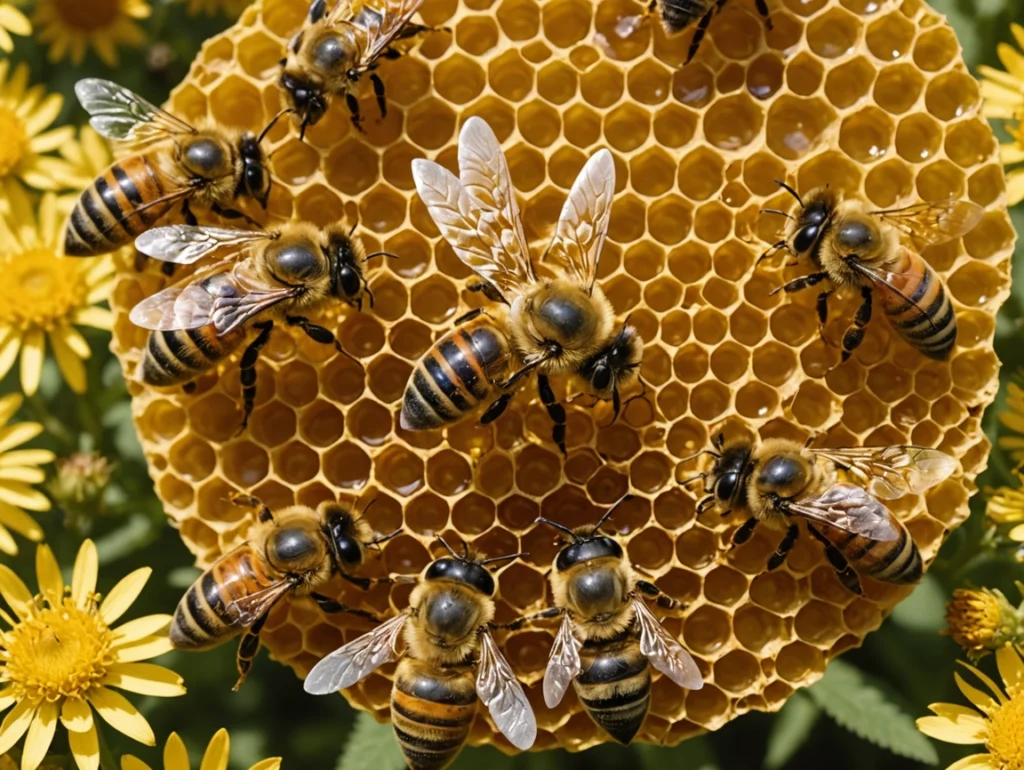
There is no doubt that honey has long been recognized as one of nature’s richest nutritional sources. It contains natural sugars, enzymes, organic acids, minerals, antioxidants, and bioactive compounds that have supported human health for thousands of years.
However, the true reality of honey does not end with its nutritional profile alone.
What is often overlooked is the role of microorganisms—particularly the microbes that originate from within the digestive system of the bee itself.
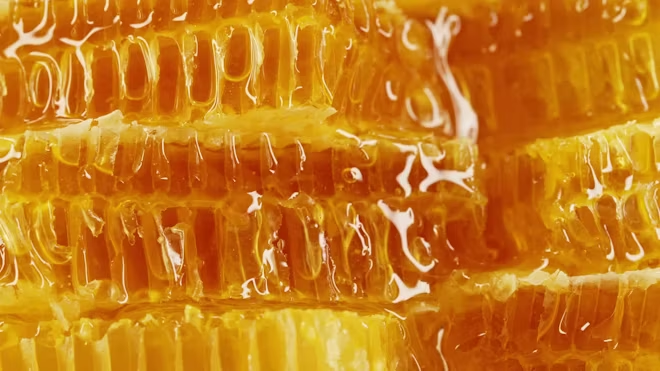
Microbes from the Bee’s Gut: The Origin of Life Within Honey
Bees are not merely collectors of nectar.
They are biologically complex organisms with a digestive system that hosts a distinct microbial community.
Modern research shows that:
Bees possess a unique and stable gut microbiome
These microbes help bees:
digest nectar
transform nectar into honey
produce enzymes and natural acids
This process cannot be fully replicated by humans or machines
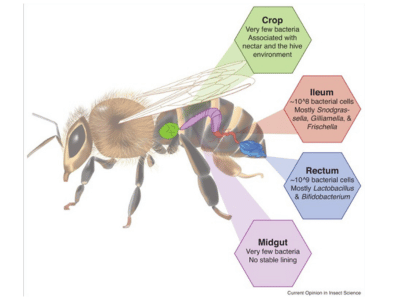
In other words, honey is not simply “sugar from flowers,” but the result of a biological transformation involving plants, bees, and living microorganisms.
This is why raw honey is fundamentally different from honey that has been pasteurized or industrially processed.
Honey as a Living Medium
From this perspective, honey can be understood as:
a medium that retains microbiological traces
a carrier of biological information
the outcome of an extremely delicate interaction within nature
However, it is important to understand that:
Microbes in honey are not always active in the same way.
Their activity depends on:
environmental conditions
temperature
time
and the processes the honey has undergone
A Cosmological Perspective: Traditional Understanding of Nature
Within certain traditional knowledge systems and cosmological understandings, there is a belief that the universe operates in rhythmic cycles, involving:
the movement of the Earth
lunar phases
the position of the Sun
In this context, it is understood that:
certain natural processes respond more strongly at specific times and conditions
microbial activity and fermentation may be influenced by natural factors such as light, temperature, and time cycles
⚠️ Important clarification:
This cosmological understanding is not a conclusive claim of modern science, but rather knowledge derived from observation, experience, and traditional learning, transmitted through guided practice.
It does not contradict science, but exists within a broader understanding of nature that requires:
guidance
discipline
and proper context
Why This Knowledge Is Not Shared Publicly
Knowledge related to: natural fermentation microbial care appropriate timing and conditions and cosmological understanding of nature is not suitable to be learned randomly or without guidance. Without proper direction: honey can be damaged microbes can die or the entire process may become ineffective For this reason, learning and guidance are provided only through a subscription-based system, ensuring that: knowledge is delivered progressively context is properly understood and practices are carried out responsibly
Subscription: Not Just Access, but a Learning Journey
Subscription is not about “buying secrets,” but about entering a structured learning process. Within the subscription, participants are guided to understand: the fundamentals of honey and microbial reality the distinction between scientific facts and cosmological understanding proper ethics and discipline in handling living substances responsibility toward nature and oneself This knowledge does not promise instant miracles, but offers a deeper understanding of the relationship between humans and the natural world.