
🧠 Stop Treating the Brain Like an Empty Glass: Why Rote Memorization Fails Deep Learning
 hikayatempat
MICROBA Editorial
hikayatempat
MICROBA Editorial
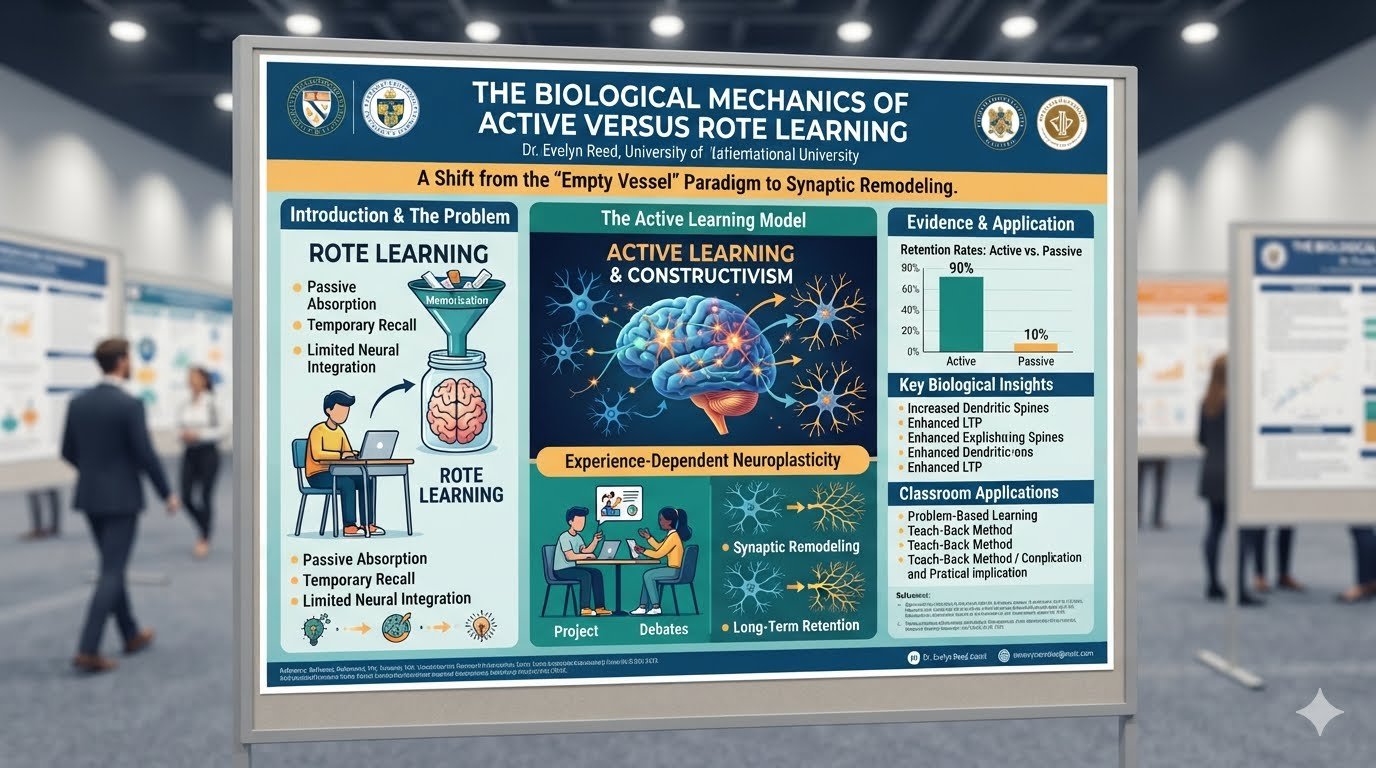
Imagine walking into a classroom or opening a book, and visualizing your mind as an empty glass waiting to be filled with water. In this traditional view of education, the teacher or text pours out information, and your only job is to sit still and collect it.
There is just one glaring problem with this analogy: the human brain is not a bucket.
When we treat our minds like passive storage containers, we fall into the trap of rote memorization. It feels like learning, but it is actually a temporary state. Just like water in an open glass, information acquired passively evaporates almost immediately after the exam or deadline passes.
True learning is entirely different. The potential for knowledge already exists around us and within our biological architecture. Learning is not about pouring anything in—it is about actively searching, connecting, and flipping through the internal “library of the brain” to construct permanent meaning.
⚠️ The Illusion of the “Empty Glass” (Rote Memorization)
When we cram facts, formulas, or definitions without deeper context, we are relying strictly on superficial memorization. This model fails because of three distinct cognitive bottlenecks:
- Temporary Storage: Data sits loosely in your working memory. It is entirely disconnected from your existing mental models and daily reality.
- Passive Consumption: The brain acts as a static, dead container. It simply accepts data without filtering, questioning, criticizing, or transforming it.
- Rapid Decay: Because no meaningful connections are made, the brain flags this data as useless. It actively purges the information within days or weeks to save metabolic energy.
⚡ True Learning: Flipping the Pages of the Brain
Real, lasting education happens when the learner shifts from a passive container to an active seeker. Neuroscience and educational psychology break this down into three core mechanics:
- Constructivism: You do not absorb knowledge; you build it. True learning happens when you actively link new incoming data to the foundations of what you already know.
- Experience-Dependent Neuroplasticity: Real learning physically rewrites your biology. It forces your brain to grow, strengthen, and reorganize synaptic connections between neurons. This structural change is what makes knowledge permanent.
- Active Retrieval: Reading or hearing a fact is merely a trigger. The actual learning occurs during the struggle to retrieve that data—when your brain actively searches its internal database to recognize patterns, solve problems, and build mental schemas.
📰 Related Articles & Contemporary Insights
- The Rapid Decay of Rote Learning: Educational analyses from Open Minds World highlight that information acquired through repetitive memorization is lost at a dramatic rate. Because the brain is not a static hard drive, it actively purges unutilized, disconnected data within a month.
- Neuroscience of Active Learning: Recent comparative reviews on ScienceDirect examine the biological mechanisms that separate active learning from direct passive instruction. The data reveals that agency, peer interaction, and active manipulation of content trigger specific reinforcement networks in the brain that vastly improve long-term retention.
- Constructivism as the Solution: Papers featured on ResearchGate reinforce that constructivism serves as the ultimate pedagogical alternative to traditional memorization. It forces the brain to assume a reflective role, shifting the student from a passive recorder to an active problem solver.
📚 Academic References
- On Constructivism and Active Learning Theory:
- Bada, S. O., & Olusegun, S. (2015). Constructivism Learning Theory: A Paradigm for Teaching and Learning.
- This framework establishes that meaning is created by the learner. True cognitive development relies on the transition from traditionalist, isolated data-absorption to contextual, real-world application.
- On How Learning Rewrites the Brain:
- Mundorf, A., et al. (2026). Neuroplasticity and Lifelong Learning. ResearchGate.
- This study highlights how experience-dependent neuroplasticity dictates knowledge acquisition across a lifespan. It integrates cognitive load theory with neuroscientific proof that structural brain changes rely heavily on experiential exploration rather than passive reception.
- On Memory Management and Cognitive Overload:
- OECD / PISA Frameworks & Cognitive Processing Assessments (2025/2026).
- Contemporary research into working memory emphasizes that over-relying on fragmented, instant data streams or superficial memorization alters the prefrontal-parietal networks, limiting the brain’s capacity to build comprehensive, long-term mental schemas.
Return to Origin
Explore the science behind nature’s intelligence.
Discover MICROBA research on microbiome ecosystems, controlled fermentation and personalised formulation.
Explore Research