
Beyond One-Size-Fits-All Supplements
 hikayatempat
MICROBA Editorial
hikayatempat
MICROBA Editorial
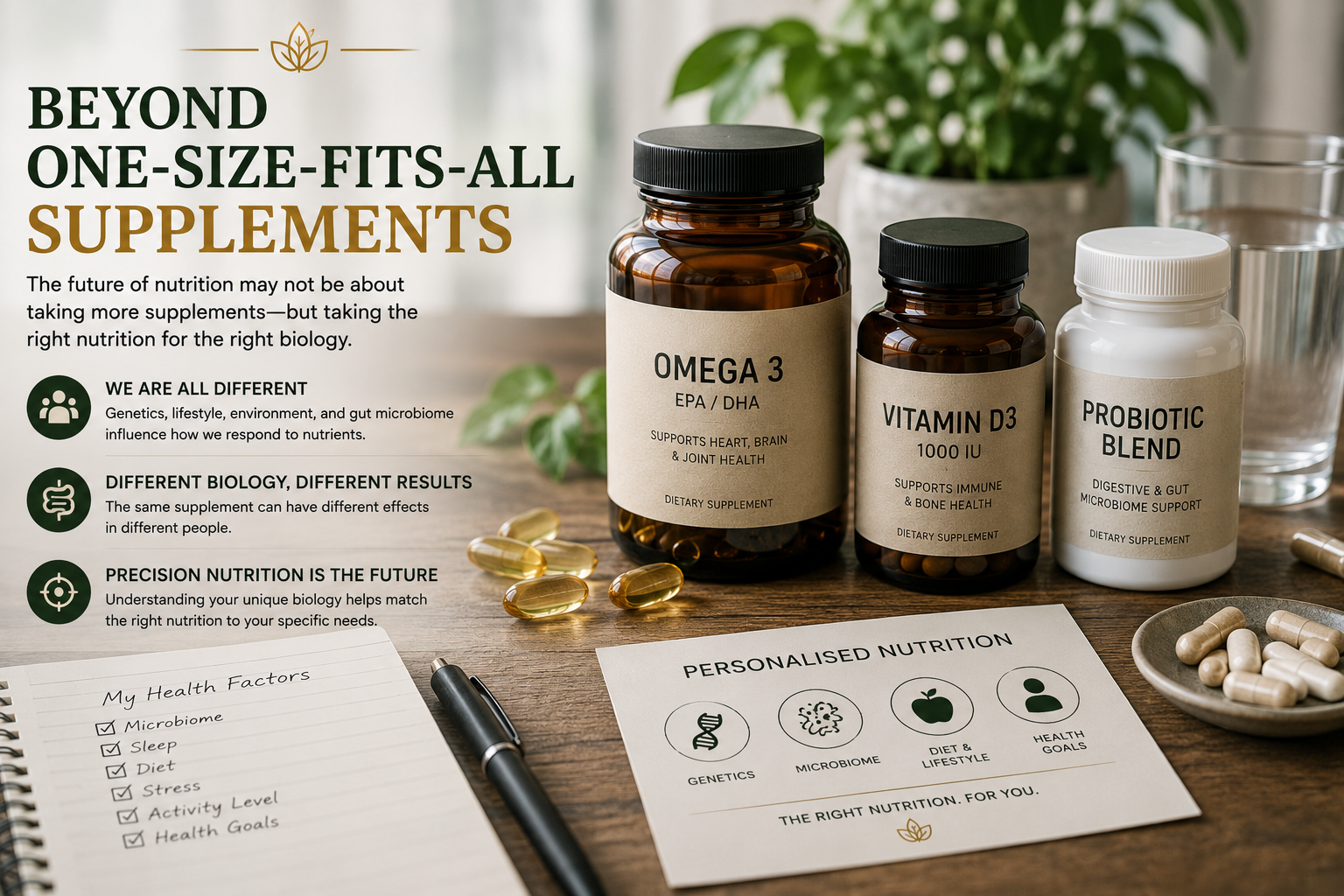
The future of nutrition may not be about taking more supplements—but taking the right nutrition for the right biology.
One Shelf. Hundreds of Supplements.
Walk into almost any pharmacy or health store.
Rows upon rows of bottles promise better health.
Energy.
Immunity.
Sleep.
Heart health.
Brain function.
Joint support.
Most are designed with one assumption:
The same formula can benefit everyone.
While many supplements can play an important role in supporting nutritional needs, modern science is revealing that human biology is far more individual than previously understood.
The Population Approach
Traditional supplements are usually developed using population-based nutritional research.
Scientists identify nutrients that many people require and formulate products that aim to benefit the average individual.
This approach has contributed significantly to public health.
For example:
- Vitamin D for those with low sun exposure.
- Folic acid during pregnancy.
- Iron supplementation for diagnosed deficiency.
- Vitamin B12 for certain dietary patterns.
These are valuable and evidence-based interventions.
However, they do not eliminate biological individuality.
Why People Respond Differently
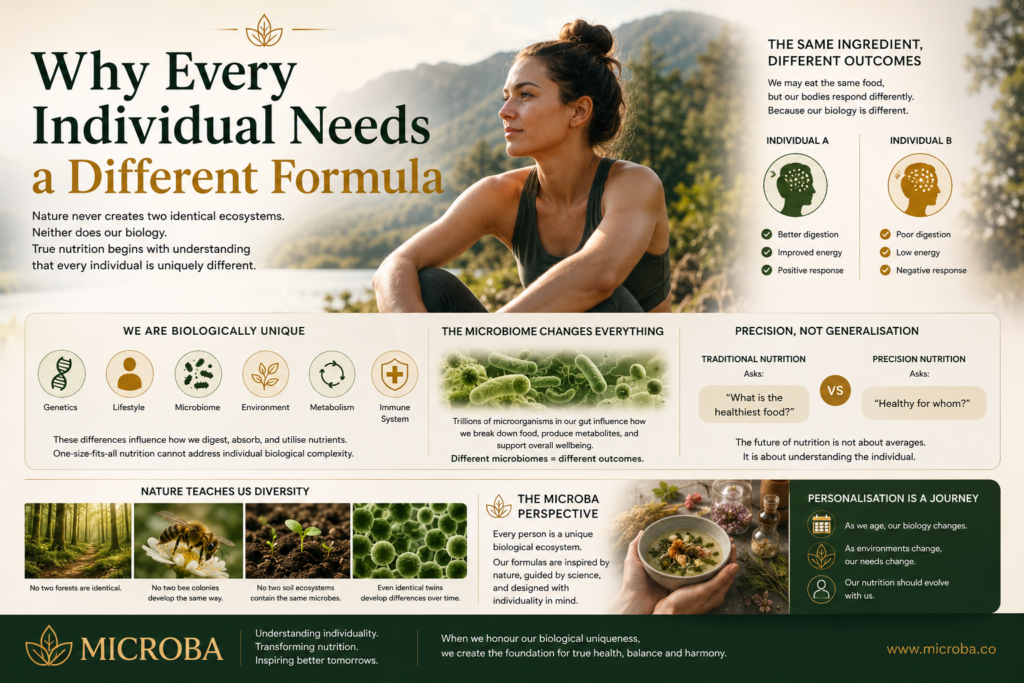
Have you ever noticed that two people can take the same supplement yet experience different outcomes?
One feels energised.
Another notices no change.
Occasionally, someone may even experience unwanted effects.
Why?
Because supplements interact with living biological systems.
Those systems differ from person to person.
Variables include:
- genetics,
- gut microbiome,
- digestive efficiency,
- metabolic pathways,
- age,
- medications,
- lifestyle,
- overall health status.
The supplement may remain unchanged.
The biology does not.
Your Microbiome Is Part of the Equation
Every supplement passes through an ecosystem before its nutrients are absorbed.
That ecosystem is the gut microbiome.
Microorganisms can influence:
- nutrient metabolism,
- vitamin production,
- bioactive compound formation,
- digestive efficiency,
- microbial competition,
- intestinal health.
Researchers increasingly recognise that the microbiome may contribute to the variation seen in nutritional responses between individuals.
More Is Not Always Better
Modern consumers often believe:
“If one capsule helps, two must be better.”
Biology rarely works this way.
Living systems depend on balance.
Too little may be ineffective.
Too much may be unnecessary.
Nutrition is not simply about increasing intake.
It is about providing what the body can meaningfully utilise.
Nature values balance over excess.
Nutrition Is a Relationship
Food and supplements do not work in isolation.
They interact with:
- enzymes,
- hormones,
- microorganisms,
- immune cells,
- metabolic pathways.
The outcome depends on the relationship between the nutrient and the individual consuming it.
This is why identical products can produce different results in different people.
The Rise of Precision Nutrition
Nutrition science is evolving.
Rather than asking:
“Which supplement is best?”
Researchers increasingly ask:
“Which approach is most appropriate for this individual?”
This shift has given rise to the field of precision nutrition, which aims to understand how biological differences influence nutritional needs and responses.
It is an emerging field that combines nutrition, systems biology, microbiome research, genetics, and metabolism.
Learning From Nature
Nature does not feed every organism in the same way.
A bee collects nectar.
A cow digests grass.
A bird consumes seeds.
Each species has evolved according to its biology.
Even within the same species, individual differences exist.
Nature reminds us that nutrition has always been personal.
Humans are no exception.
The MICROBA Perspective
At MICROBA, we believe supplements should be viewed as tools—not universal solutions.
The future of functional nutrition lies in understanding the individual behind the formula.
Our research explores how controlled fermentation, microbiome science, and biological transformation may contribute to more personalised nutritional strategies.
The objective is not simply to create another supplement.
It is to better understand the biological system receiving it.
Looking Ahead
As scientific knowledge continues to expand, nutrition may become increasingly personalised.
Future approaches may integrate information about:
- microbiome composition,
- lifestyle,
- dietary habits,
- metabolic characteristics,
- biological responses.
Rather than replacing conventional supplements, personalised strategies may help make them more relevant to the individual.
The future of nutrition is unlikely to be defined by a single formula.
It will be shaped by understanding the person.
Key Takeaways
- Population-based supplements remain valuable but cannot fully account for biological individuality.
- Nutritional responses vary because every person has a unique biological system.
- The gut microbiome plays an important role in nutrient metabolism and utilisation.
- Precision nutrition focuses on matching nutritional strategies to individual biology.
- The future of functional nutrition is moving from “one-size-fits-all” toward biologically informed personalisation.
Continue Reading
Next Article
➡ Bioactive Compounds and Human Health
Discover how nature’s hidden molecules—created through plants, microbes, and fermentation—are becoming one of the most exciting frontiers in modern nutrition science.
Continue reading
Related articles
Return to Origin
Explore the science behind nature’s intelligence.
Discover MICROBA research on microbiome ecosystems, controlled fermentation and personalised formulation.
Explore Research