
Building a Health Ecosystem
 hikayatempat
MICROBA Editorial
hikayatempat
MICROBA Editorial
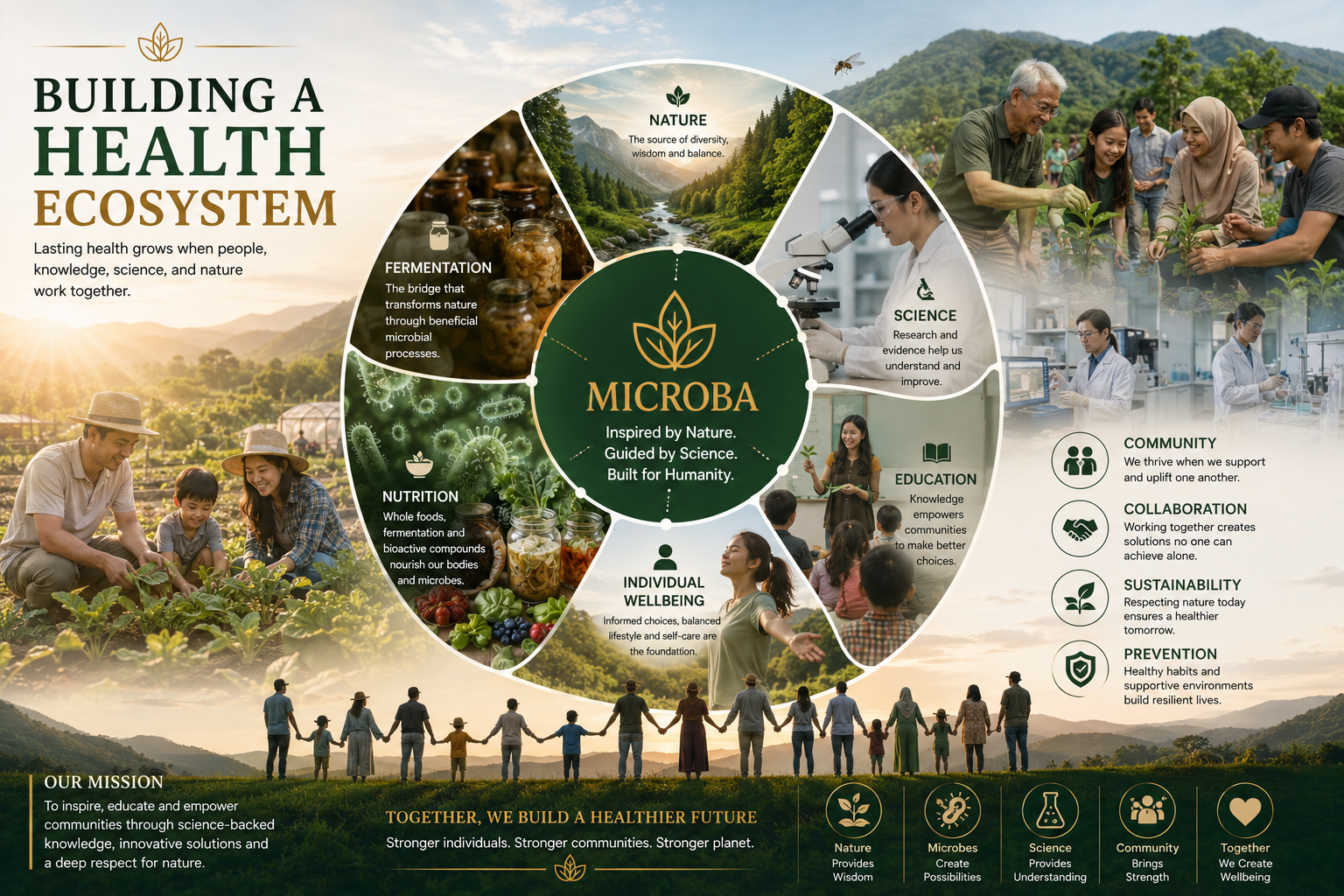
Lasting health is not built by one product, one expert, or one organisation. It grows through an ecosystem where people, knowledge, science, and nature work together.
Every Healthy System Is an Ecosystem
Look closely at any thriving natural environment.
A rainforest.
A coral reef.
A healthy beehive.
A fertile soil.
None succeed because of a single organism.
They succeed because every component supports the others.
Plants feed insects.
Microorganisms recycle nutrients.
Animals spread seeds.
Everything is connected.
Health follows the same principle.
Beyond Individual Health
For many years, health has often been viewed as an individual responsibility.
Eat better.
Exercise more.
Sleep well.
These choices remain important.
But they do not exist in isolation.
Our health is shaped by:
- the food we can access,
- the environment we live in,
- the information we trust,
- the communities we belong to,
- the habits we learn,
- the systems that support us.
Healthy individuals emerge more easily from healthy ecosystems.
What Is a Health Ecosystem?
A health ecosystem is a network of people, knowledge, environments and practices that work together to support long-term wellbeing.
It is not limited to hospitals or clinics.
It includes:
- families,
- educators,
- researchers,
- farmers,
- nutrition professionals,
- food producers,
- community organisations,
- and individuals who choose healthier lifestyles.
Every participant contributes to the whole.
Learning From Nature
Nature rarely depends on a single solution.
Instead, it creates resilience through diversity.
A healthy forest contains thousands of interacting species.
A healthy gut contains trillions of microorganisms.
A healthy bee colony depends on cooperation between bees, microbes and flowering plants.
The lesson is universal.
Strong systems are built through relationships.
Not isolation.
Science Is Part of the Ecosystem
Scientific research plays an essential role in improving health.
It helps us:
- understand biology,
- evaluate evidence,
- improve nutrition,
- refine agricultural practices,
- develop safer technologies.
Science does not replace nature.
It helps us understand nature more deeply.
Knowledge becomes meaningful when it benefits people and communities.
Education Creates Empowerment
Information alone is not enough.
People need knowledge they can understand and apply.
When communities have access to reliable, evidence-based education, they become better equipped to make informed decisions about:
- nutrition,
- lifestyle,
- environmental stewardship,
- preventive health,
- lifelong wellbeing.
Education transforms information into action.
Prevention Is a Shared Responsibility
Preventive health extends beyond medical care.
It involves creating environments where healthier choices become easier.
Examples include:
- access to nutritious foods,
- opportunities for physical activity,
- clean environments,
- supportive families,
- strong local communities,
- responsible food systems.
The healthiest societies are often those that make prevention part of everyday life rather than an occasional intervention.
Innovation With Purpose
Innovation should not exist simply because technology allows it.
Its purpose should be to improve life.
Whether through microbiome research, controlled fermentation, sustainable agriculture or functional nutrition, innovation becomes meaningful only when it contributes to healthier people and healthier communities.
Technology should strengthen nature—not replace it.
The MICROBA Perspective
At MICROBA, we believe that meaningful health begins with understanding living systems.
Our vision extends beyond products.
We hope to contribute to an ecosystem where:
- scientific research informs practice,
- communities share knowledge,
- nature inspires innovation,
- individuals make informed decisions,
- future generations inherit healthier environments.
Health is not a destination.
It is an ecosystem that grows stronger when every part contributes.
Looking Forward
The future of health will likely depend less on isolated breakthroughs and more on integration.
Nutrition.
Microbiome science.
Fermentation.
Environmental sustainability.
Community education.
Digital technology.
Together, these fields have the potential to create a more connected and resilient approach to wellbeing.
The strongest ecosystems are those where every element supports the others.
Perhaps human health is no different.
Key Takeaways
- Healthy societies are built through interconnected systems rather than isolated interventions.
- Families, communities, researchers and educators all contribute to long-term wellbeing.
- Science and nature are complementary partners in understanding health.
- Preventive health is strengthened by supportive environments and informed communities.
- A resilient health ecosystem depends on collaboration, education and respect for living systems.
The MICROBA Journey
This concludes the foundational knowledge series of MICROBA.
Our journey has explored:
- Why Nature Still Knows Best
- Understanding the Human Microbiome
- The Hidden World Inside a Bee
- Why Bee Microbiome Matters
- Microbial Communication in Bee Colonies
- Controlled Fermentation Explained
- Traditional vs Controlled Fermentation
- How Microbes Transform Natural Ingredients
- Why Every Individual Needs a Different Formula
- Beyond One-Size-Fits-All Supplements
- Bioactive Compounds and Human Health
- Natural Nutrition vs Synthetic Nutrition
- Returning to Origin Together
- Building a Health Ecosystem
These articles form the scientific and philosophical foundation of MICROBA.
From here, future articles can build on this foundation with deeper explorations, new research, practical applications, interviews, and scientific discoveries—always guided by the same principle:
Inspired by Nature. Guided by Science. Built for Humanity.
This provides a strong transition into the News, Research Updates, and Platform Updates sections, where new discoveries and community developments can naturally extend the story you’ve built.
Continue reading
Related articles
Return to Origin
Explore the science behind nature’s intelligence.
Discover MICROBA research on microbiome ecosystems, controlled fermentation and personalised formulation.
Explore Research