
Natural Nutrition vs Synthetic Nutrition
 hikayatempat
MICROBA Editorial
hikayatempat
MICROBA Editorial
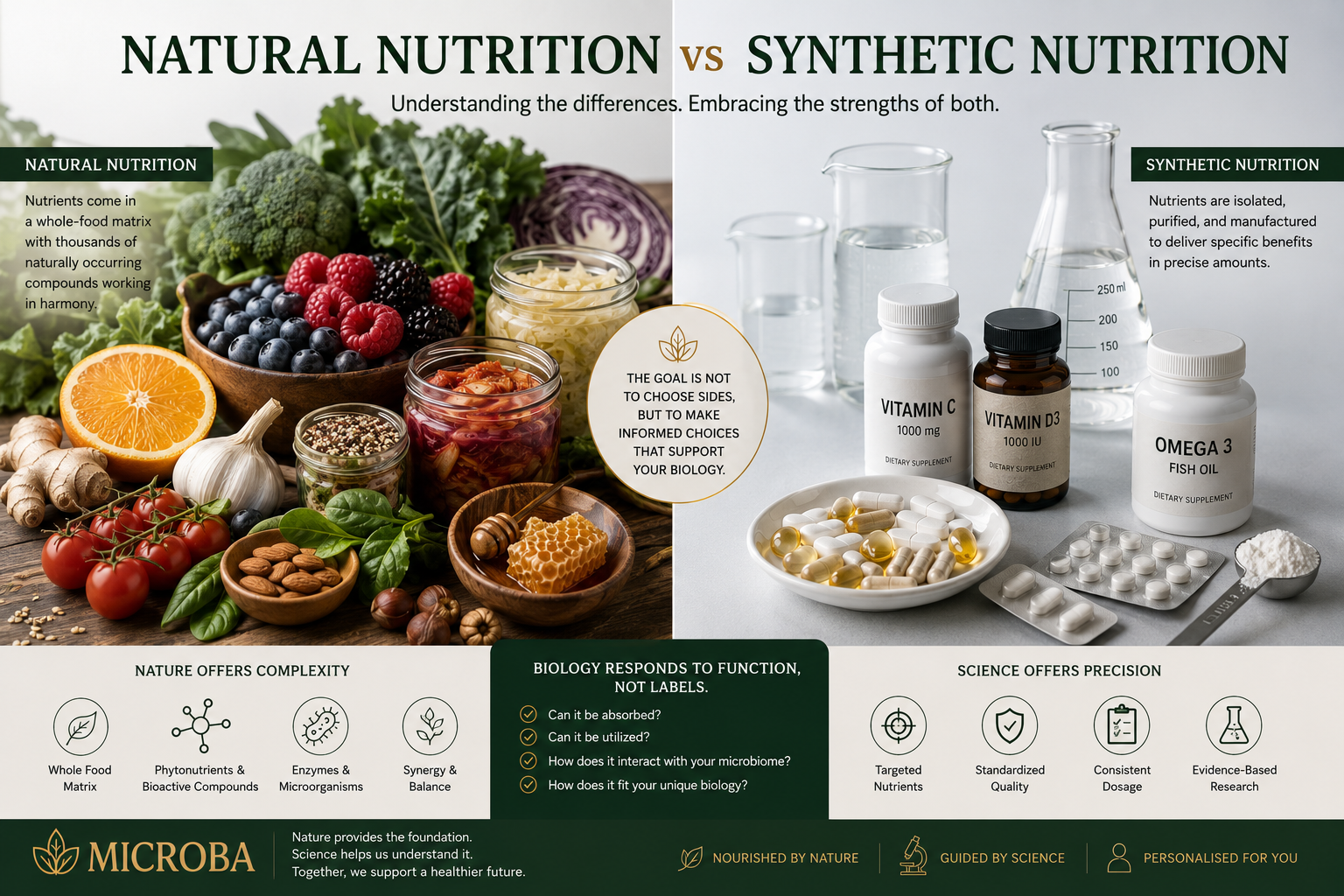
Nature and science are not opponents. Understanding how they differ helps us make more informed nutritional choices.
The Modern Nutrition Debate
Walk into any supermarket or pharmacy and you’ll encounter two broad categories of nutritional products.
Some originate directly from nature.
Others are produced or purified through modern manufacturing.
This has led to a common question:
Is natural always better than synthetic?
The answer is more complex than a simple yes or no.
Modern nutrition science suggests that the quality, purpose, safety, and biological context often matter more than the label alone.
What Is Natural Nutrition?
Natural nutrition refers to nutrients consumed as part of whole or minimally processed foods.
Examples include:
- Fruits
- Vegetables
- Herbs
- Seeds
- Nuts
- Honey
- Fermented foods
- Whole grains
These foods naturally contain:
- vitamins,
- minerals,
- fibre,
- enzymes,
- bioactive compounds,
- microbial metabolites,
- thousands of naturally occurring phytochemicals.
Rather than existing individually, these components function together within a complex biological matrix.
What Is Synthetic Nutrition?
Synthetic nutrition generally refers to nutrients manufactured, purified, or chemically produced for supplementation or food fortification.
Examples include:
- Vitamin C tablets
- Fortified breakfast cereals
- Vitamin D supplements
- Iron tablets
- Folic acid supplements
Many of these products have played an important role in reducing nutritional deficiencies worldwide.
Synthetic nutrients are valuable tools when used appropriately and under suitable guidance.
Whole Foods Are More Than Their Nutrients
Imagine an orange.
Most people think of vitamin C.
Yet an orange contains hundreds of naturally occurring compounds beyond vitamin C alone.
These include:
- flavonoids,
- carotenoids,
- fibre,
- organic acids,
- aromatic compounds,
- water,
- natural sugars.
Scientists increasingly study how these components interact rather than focusing on one nutrient in isolation.
Nature rarely delivers nutrients one at a time.
The Food Matrix
Researchers often use the term food matrix to describe the natural structure of whole foods.
This matrix influences:
- digestion,
- nutrient release,
- absorption,
- microbial fermentation,
- metabolic responses.
The body does not simply absorb isolated nutrients.
It responds to the complete biological package.
Fermentation Changes the Matrix
Fermentation adds another layer of complexity.
During fermentation:
- microorganisms modify nutrients,
- enzymes break down complex molecules,
- bioactive compounds may increase,
- new metabolites are produced,
- the food matrix itself changes.
This is why fermented foods often differ biologically from their raw ingredients.
The transformation is not only chemical.
It is biological.
Nature and Science Can Work Together
The discussion should not become:
Natural versus synthetic.
Instead, we should ask:
Which approach is most appropriate in a given situation?
For example:
- A healthy diet built around diverse whole foods provides the foundation for nutrition.
- Fortified foods have helped reduce population-wide nutrient deficiencies.
- Supplements can be useful when specific nutritional needs are identified.
- Functional fermented foods may provide additional biologically active compounds currently being investigated by researchers.
Each has a role.
The objective is not competition.
It is understanding.
Biology Responds to Function
Our bodies do not recognise marketing claims.
They respond to biology.
Whether a nutrient originates from food or supplementation, important questions remain:
- Can it be absorbed?
- Can it be utilised?
- How does it interact with the microbiome?
- How does it fit within the individual’s biology?
These questions increasingly define modern nutritional science.
Learning From Nature
Nature rarely isolates individual compounds.
Plants produce complete biological systems.
Microorganisms further transform them.
Animals consume them within complex ecosystems.
For millions of years, nutrition has existed as part of interconnected living systems rather than isolated chemicals.
Perhaps the greatest lesson from nature is not that natural is always superior.
It is that biological relationships matter.
The MICROBA Perspective
At MICROBA, we do not view natural and synthetic nutrition as opposing philosophies.
Instead, we recognise that both have contributed significantly to human health.
Our research focuses on understanding how nature, microorganisms, controlled fermentation, and biological transformation create functional nutritional systems.
The question is not simply where a nutrient comes from.
It is how biology responds to it.
Looking Ahead
The future of nutrition is likely to move beyond labels such as natural or synthetic.
Researchers are increasingly interested in:
- biological function,
- food matrices,
- microbial transformation,
- personalised responses,
- systems biology.
Understanding these interactions may prove more valuable than debating categories alone.
Nature provides the inspiration.
Science provides the tools to understand it.
Key Takeaways
- Natural nutrition provides nutrients within a complex biological food matrix.
- Synthetic nutrients have played an important role in preventing nutritional deficiencies.
- Fermentation transforms foods and may influence their biological properties.
- The body responds to biological function rather than marketing labels.
- Future nutrition research increasingly focuses on interactions between nutrients, microbiomes, and individual biology.
Continue Reading
Next Article
➡ Returning to Origin Together
Discover why lasting health is not only a personal journey but also a shared commitment—where communities, nature, and knowledge come together to create healthier generations.
Continue reading
Related articles
Return to Origin
Explore the science behind nature’s intelligence.
Discover MICROBA research on microbiome ecosystems, controlled fermentation and personalised formulation.
Explore Research