
Bioactive Compounds and Human Health
 hikayatempat
MICROBA Editorial
hikayatempat
MICROBA Editorial
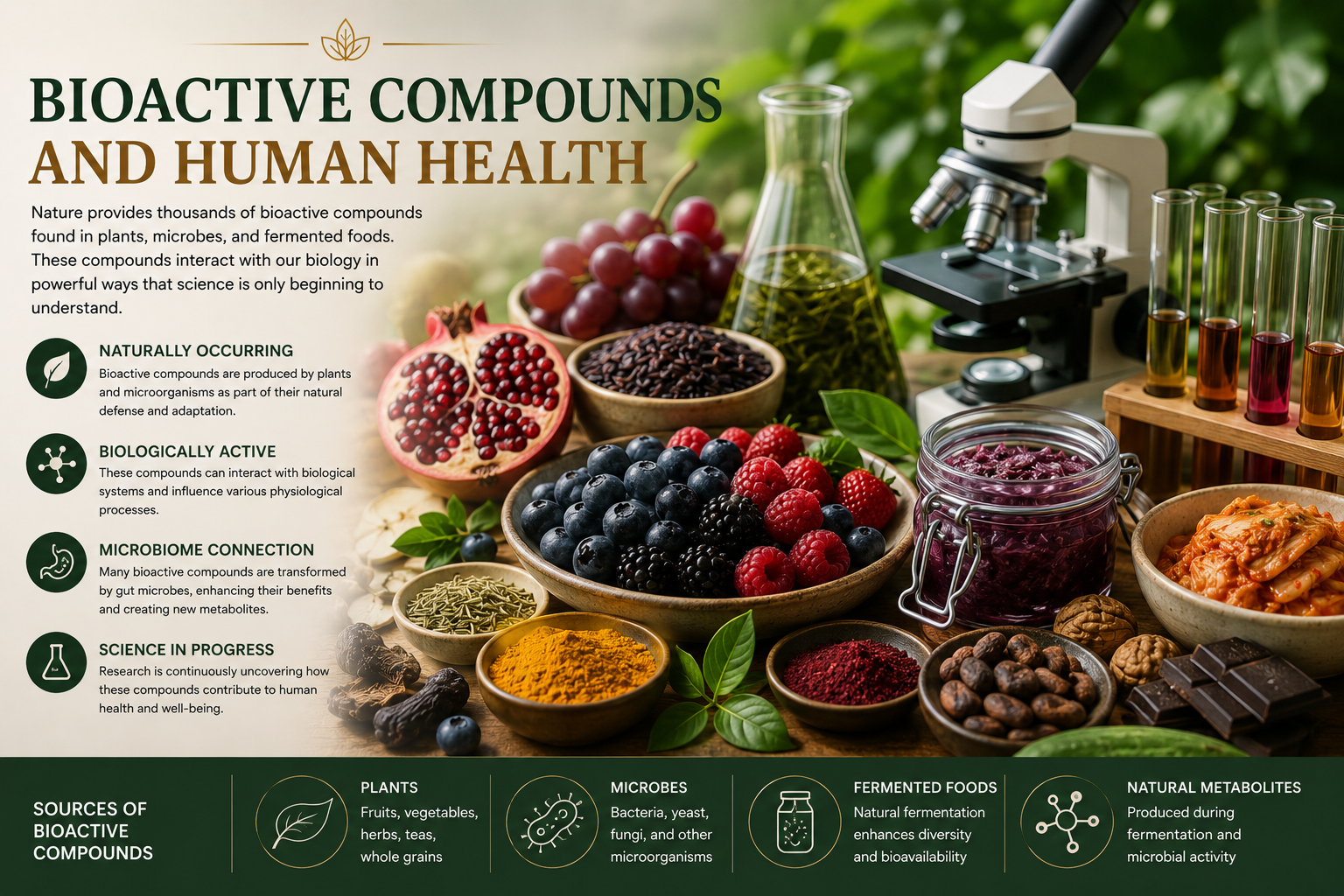
Nature offers more than nutrients. Hidden within plants, microbes, and fermentation are biologically active molecules that continue to reshape our understanding of human health.
Looking Beyond Calories
For much of the twentieth century, nutrition focused on a relatively simple question:
How much protein, fat, carbohydrate, vitamin, and mineral does the body need?
These nutrients remain essential.
Without them, life cannot be sustained.
However, scientists have increasingly discovered that foods contain thousands of other naturally occurring compounds that may also interact with biological systems.
These compounds are known as bioactive compounds.
What Are Bioactive Compounds?
Bioactive compounds are naturally occurring substances found in plants, microorganisms, fungi, and fermented foods.
Unlike essential nutrients, they are not required for immediate survival.
Instead, they participate in biological interactions that researchers continue to investigate.
Many plants produce these compounds as part of their own natural defence and adaptation strategies.
When humans consume plant foods, some of these compounds also interact with our biology.
Nature’s Hidden Chemistry
Walk through a forest.
Every leaf, flower, seed, root and fruit contains thousands of chemical compounds.
Plants continuously produce these molecules to:
- protect themselves from insects,
- defend against microbes,
- communicate with neighbouring plants,
- adapt to sunlight,
- survive environmental stress.
Nature is not simply growing food.
It is running one of the world’s largest chemistry laboratories.
Common Types of Bioactive Compounds
Scientists have identified thousands of naturally occurring bioactive compounds.
Among the most widely studied are:
Polyphenols
Found in berries, tea, cocoa, olives and many fruits.
Flavonoids
Natural pigments that contribute to colour while participating in numerous plant defence mechanisms.
Carotenoids
Pigments responsible for the yellow, orange and red colours of many fruits and vegetables.
Organic Acids
Produced naturally in fruits and during microbial fermentation.
Microbial Metabolites
Compounds produced directly by microorganisms during biological transformation.
Each group continues to be investigated for its interactions with human biology.
Fermentation Unlocks New Possibilities
One of the most fascinating aspects of fermentation is that microorganisms do not simply preserve food.
They transform it.
During fermentation microbes may:
- release plant compounds,
- modify existing molecules,
- generate new metabolites,
- increase bioavailability,
- create entirely new bioactive substances.
The final fermented product can therefore differ substantially from the original raw ingredient.
Research shows that fermentation can increase the availability and diversity of biologically active compounds in many foods.
Bioactivity Is About Interaction
The word bioactive does not automatically mean “better.”
Nor does it guarantee a specific health outcome.
It simply means the compound is capable of interacting with biological systems.
Scientists continue studying how different bioactive compounds influence:
- cellular signalling,
- oxidative processes,
- immune regulation,
- microbial ecology,
- metabolic pathways.
Many questions remain under active investigation.
The Human Microbiome Joins the Conversation
Interestingly, bioactive compounds do not act alone.
The gut microbiome often participates in their transformation.
Some compounds become more biologically available after microbial metabolism.
Others are converted into entirely different metabolites.
This means two people consuming identical foods may generate different bioactive profiles because their microbiomes differ.
Nature Rarely Works Through One Molecule
Modern medicine often focuses on single active ingredients.
Nature rarely does.
Instead, plants contain complex mixtures of interacting compounds.
Microorganisms contribute additional metabolites.
Fermentation introduces further biological changes.
The result is a dynamic network rather than a single isolated chemical.
Nature favours systems.
Not simplicity.
The MICROBA Perspective
At MICROBA, bioactive compounds represent one part of a much larger biological story.
Our interest extends beyond identifying individual molecules.
We seek to understand:
- how microorganisms create them,
- how fermentation transforms them,
- how biology responds to them,
- how personalised systems may influence their utilisation.
The journey from nature to nutrition is rarely linear.
It is biological.
Looking Ahead
The future of nutrition may involve more than counting nutrients.
Researchers are increasingly exploring how naturally occurring bioactive compounds, microbial transformation and personalised biology work together.
The next breakthrough may not come from discovering a new ingredient.
It may come from understanding how nature has always used them.
Key Takeaways
- Bioactive compounds are naturally occurring substances found in plants, microbes and fermented foods.
- Fermentation can transform ingredients and generate new biologically active compounds.
- Bioactive compounds interact with biological systems but do not guarantee specific health outcomes.
- The gut microbiome plays an important role in transforming many bioactive compounds.
- Understanding biological interactions is becoming a major focus of modern nutrition science.
Continue Reading
Next Article
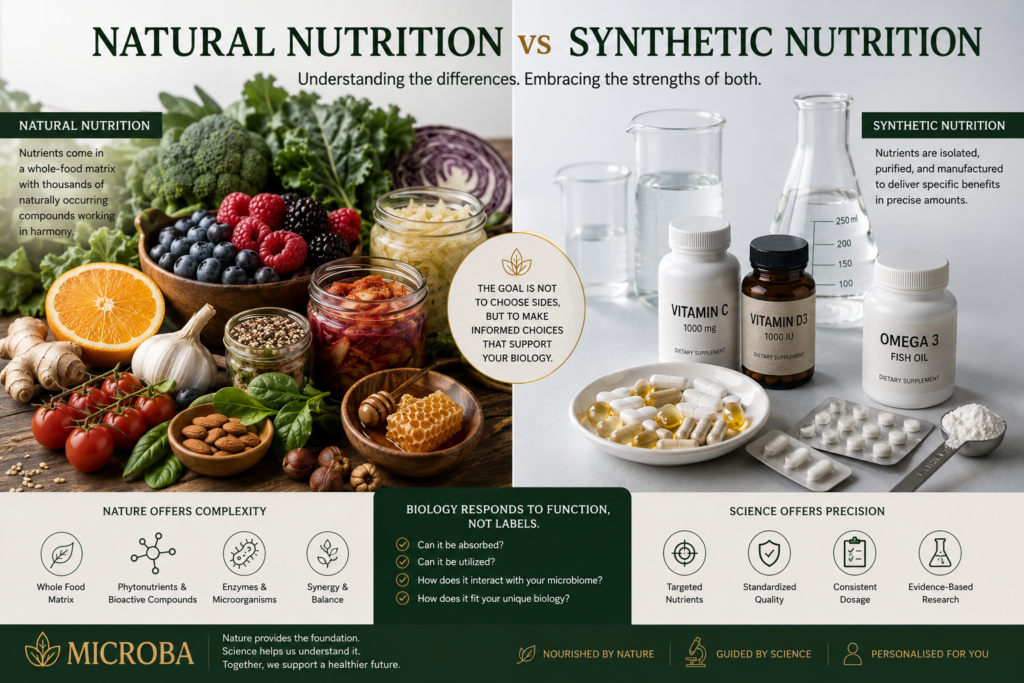
➡ Natural Nutrition vs Synthetic Nutrition
Explore the similarities, differences, and scientific perspectives behind natural and synthetic nutrients—and why biology may care more about function than labels.
Continue reading
Related articles
Return to Origin
Explore the science behind nature’s intelligence.
Discover MICROBA research on microbiome ecosystems, controlled fermentation and personalised formulation.
Explore Research