
How Microbes Transform Natural Ingredients
 hikayatempat
MICROBA Editorial
hikayatempat
MICROBA Editorial
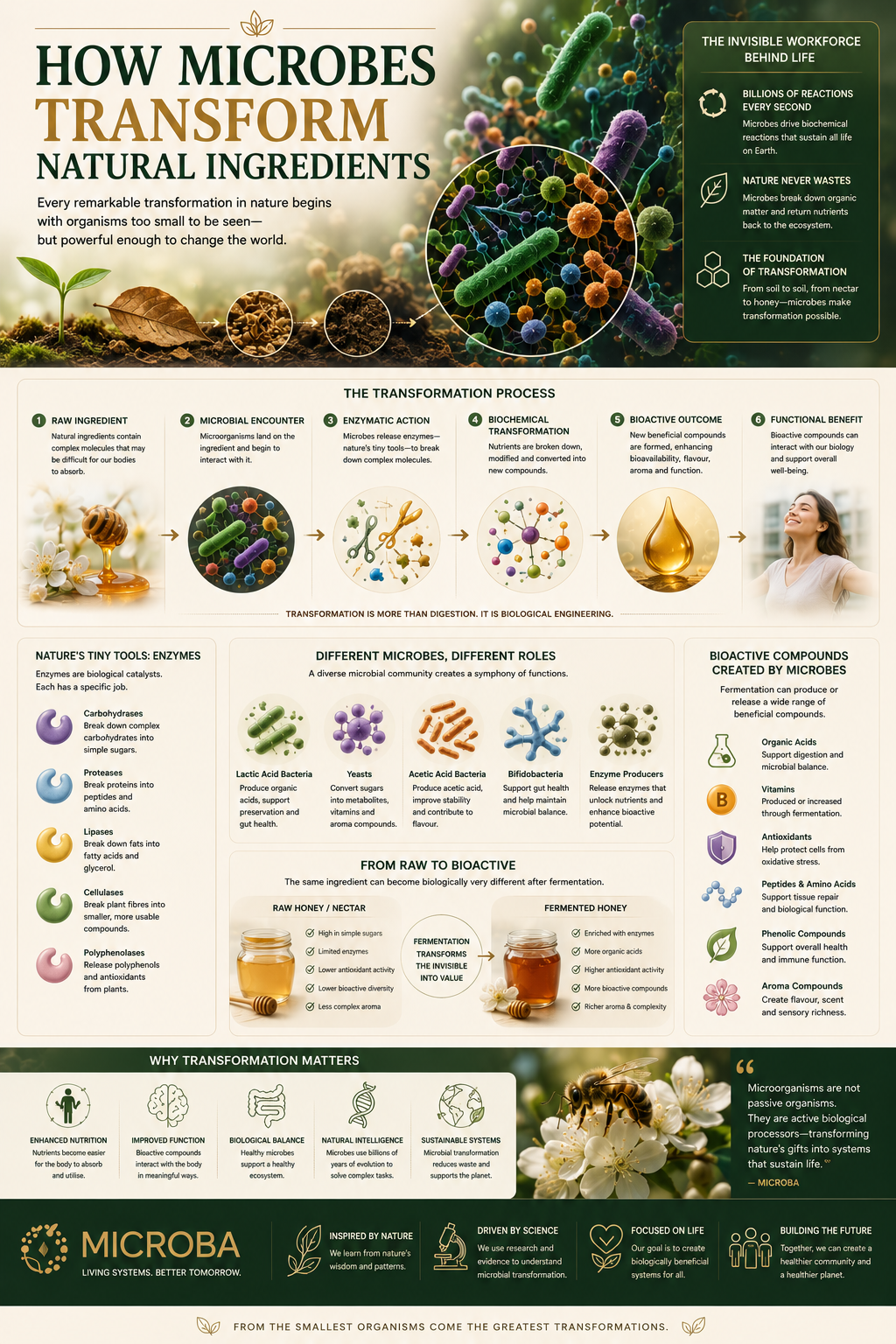
Every remarkable transformation in nature begins with organisms too small to be seen—but powerful enough to change the world.
The Smallest Workers in Nature
Look closely at a forest after rain.
Leaves disappear.
Branches slowly become soil.
Flowers bloom from what was once decay.
Nothing is wasted.
Nothing simply disappears.
Nature is constantly transforming.
Behind every one of these transformations is an invisible workforce.
Microorganisms.
Although impossible to see with the naked eye, microbes perform billions of biochemical reactions every second across the planet.
Without them, life as we know it would not exist.
Nature Doesn’t Create Waste
One of nature’s greatest strengths is efficiency.
A fallen fruit does not remain a fallen fruit forever.
It becomes food for microorganisms.
Microbes break it down.
Its nutrients return to the soil.
Plants absorb those nutrients.
Animals eat the plants.
The cycle begins again.
Nature does not discard.
Nature transforms.
Transformation Begins at the Microscopic Level
When microorganisms encounter natural ingredients, they immediately begin interacting with them.
Using specialised enzymes, microbes:
- break down complex molecules,
- release trapped nutrients,
- create new metabolites,
- modify plant compounds,
- produce entirely new biochemical substances.
The ingredient may appear unchanged to our eyes.
But at the molecular level, everything is changing.
More Than Digestion
Microbial transformation is not simply decomposition.
It is biological engineering.
During fermentation, microorganisms may produce:
- organic acids,
- enzymes,
- peptides,
- amino acids,
- vitamins,
- antioxidants,
- bioactive metabolites.
Many of these compounds were either absent or present only in small amounts before fermentation began.
Research shows that controlled fermentation can increase nutrient bioavailability, enhance antioxidant capacity, and generate biologically active metabolites.
Enzymes: Nature’s Tiny Tools
Microbes perform these transformations using enzymes.
An enzyme is a biological catalyst.
Think of it as a microscopic tool designed for a very specific task.
One enzyme may break apart complex carbohydrates.
Another may release phenolic compounds from plants.
Another helps create aromatic molecules.
Rather than forcing change, enzymes guide natural chemical reactions efficiently and precisely.
Every Microbe Has a Different Role
Not all microorganisms perform the same work.
Some bacteria specialise in producing organic acids.
Certain yeasts excel at converting sugars into valuable metabolites.
Others generate enzymes that unlock nutrients hidden within plants.
Just as every worker in a beehive has a different responsibility, every microorganism contributes differently to biological transformation.
Nature succeeds through specialisation.
From Raw Ingredient to Bioactive System
Imagine fresh nectar.
By itself, it is rich in sugars.
But when bees, enzymes and microorganisms begin interacting with it, something remarkable happens.
Simple nectar gradually becomes honey.
The same principle applies throughout fermentation.
Raw ingredients are only the beginning.
Their true potential emerges through biological transformation.
As described in the MICROBA research framework, microorganisms function as biological filters that determine how consumed substances are transformed into beneficial nutrients or other by-products.
Bioactive Compounds: The Hidden Outcome
One of the most exciting areas of modern nutrition is the study of bioactive compounds.
Unlike essential nutrients such as proteins or vitamins, bioactive compounds are substances that interact with biological systems in ways researchers continue to investigate.
Fermentation can influence the production or release of compounds such as:
- polyphenols,
- flavonoids,
- organic acids,
- microbial metabolites.
Their presence reflects not only the original ingredient but also the biological processes that transformed it.
Nature’s Chemistry Laboratory
A fermentation vessel is not simply a container.
It is a living ecosystem.
Inside it:
- microorganisms communicate,
- enzymes remain active,
- nutrients are transformed,
- metabolites accumulate,
- biological balance continuously shifts.
Every second, thousands of microscopic reactions occur simultaneously.
Nature has been running this laboratory for millions of years.
Why Transformation Matters More Than Ingredients
Modern consumers often ask:
“Which ingredient is best?”
Science is beginning to ask a different question:
“What happened to that ingredient before it was consumed?”
The answer may be just as important.
Two products made from the same plant can differ substantially if their biological transformation pathways are different.
This is why fermentation is increasingly recognised as more than preservation.
It is a process that shapes biological function.
The MICROBA Perspective
At MICROBA, we believe ingredients tell only part of the story.
The real story lies in transformation.
Nature demonstrates that microorganisms are not passive organisms.
They are active biological processors.
Understanding how microbes convert natural ingredients into biologically enriched systems forms one of the central pillars of our research philosophy.
Rather than asking:
“What is inside the ingredient?”
we also ask:
“What can biology create from it?”
Looking Ahead
As microbiome science advances, researchers are becoming increasingly interested in how microbial transformation influences food, agriculture and human biology.
The future of functional nutrition may not depend solely on discovering new ingredients.
It may depend on understanding how microorganisms unlock the hidden potential within the ingredients nature has already provided.
Key Takeaways
- Microorganisms drive biological transformation throughout nature.
- Fermentation changes ingredients at the molecular level through microbial activity and enzymes.
- Different microbes perform specialised biochemical functions.
- Fermentation can enhance bioavailability and generate bioactive compounds.
- Understanding microbial transformation may be one of the next frontiers in functional nutrition.
Continue Reading
Next Article
➡ Why Every Individual Needs a Different Formula
If microorganisms transform ingredients differently, could every human also respond differently to the same nutrition? Discover why biology suggests that personalised nutrition may be the future—not the exception.
Continue reading
Related articles
Return to Origin
Explore the science behind nature’s intelligence.
Discover MICROBA research on microbiome ecosystems, controlled fermentation and personalised formulation.
Explore Research