
Traditional vs Controlled Fermentation
 hikayatempat
MICROBA Editorial
hikayatempat
MICROBA Editorial
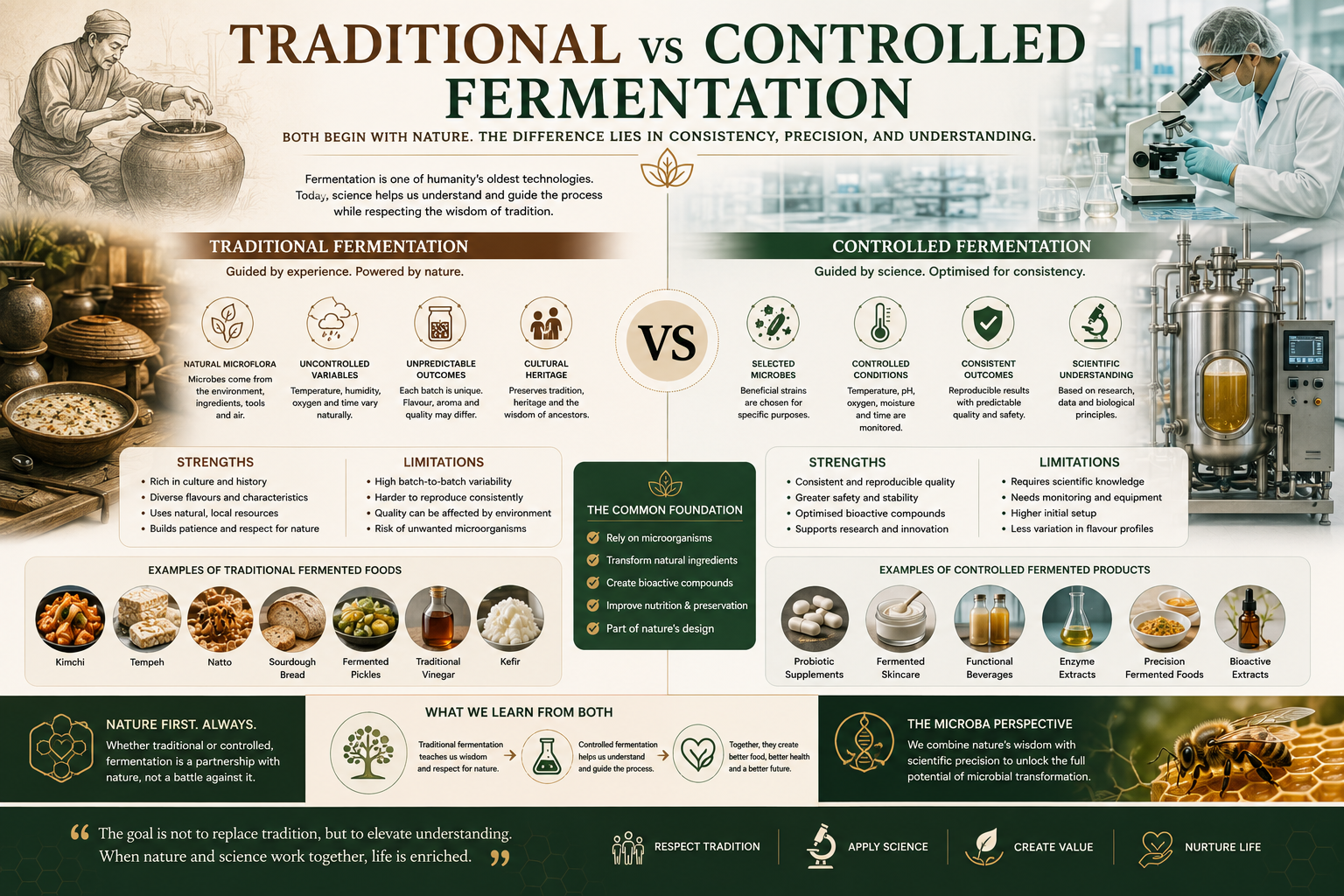
Both begin with nature. The difference lies in consistency, precision, and understanding.
Fermentation Is Older Than Civilization
Long before written history, humans were already fermenting food.
Ancient communities discovered that milk could become yogurt.
Grapes became wine.
Soybeans became miso.
Cabbage became kimchi.
Honey became mead.
At the time, no one understood bacteria or microbiology.
People simply observed nature.
Generation after generation, fermentation became part of human culture.
Today, science allows us to understand what those early communities could only observe.
The Same Process. A Different Level of Understanding.
Traditional fermentation and controlled fermentation are not opposites.
They share the same biological foundation.
Both rely on microorganisms.
Both transform natural ingredients.
Both depend on biochemical reactions.
The difference lies in how much of the process is understood and managed.
Traditional Fermentation
Traditional fermentation depends largely on naturally occurring microorganisms.
These microbes may come from:
- the surrounding air,
- raw ingredients,
- equipment,
- water,
- the environment itself.
For centuries this approach has produced remarkable foods enjoyed around the world.
Its greatest strength is its cultural richness.
Its greatest limitation is variability.
No two batches are ever exactly the same.
The Beauty of Tradition
Traditional fermentation deserves respect.
It represents thousands of years of human observation.
Many of today’s most celebrated foods exist because people learned to work with nature rather than against it.
Traditional methods teach us patience.
They teach us balance.
Most importantly, they remind us that nature has always been humanity’s first laboratory.
The Challenge of Variability
Nature is dynamic.
Microbial communities change constantly.
Small differences in:
- temperature,
- humidity,
- oxygen,
- microbial populations,
- ingredient quality,
- fermentation time,
can produce different biological outcomes.
Sometimes these differences are beneficial.
Sometimes they are unpredictable.
This natural variability is one of the defining characteristics of traditional fermentation.
Controlled Fermentation
Controlled fermentation begins with the same biological principles.
However, it introduces scientific understanding to improve reproducibility.
Instead of allowing every environmental factor to vary freely, important conditions are monitored and managed.
These include:
- microbial activity,
- temperature,
- pH,
- oxygen availability,
- moisture,
- fermentation duration.
The goal is not to replace nature.
The goal is to support nature under consistent conditions.
FAO and modern fermentation guidelines emphasise controlled microbial activity, environmental management, and substrate quality as the foundation of safe and functional fermentation systems.
Why Consistency Matters
Imagine producing medicine where every batch is different.
Or building an aircraft where every component varies.
Functional nutrition also benefits from consistency.
When biological systems behave predictably:
- quality improves,
- safety increases,
- research becomes reproducible,
- scientific evaluation becomes possible.
Consistency allows observation.
Observation leads to understanding.
Nature Already Uses Controlled Systems
Interestingly, nature itself rarely leaves important biological processes completely to chance.
Inside a healthy bee colony:
- microbial communities remain relatively stable,
- environmental conditions are carefully regulated,
- nectar is transformed through coordinated biological processes.
The bee does not eliminate microorganisms.
It creates the right environment for them to function efficiently.
Nature demonstrates controlled biology every day.
Science Learns From Nature
Modern fermentation is not an attempt to improve nature.
It is an attempt to understand nature more deeply.
Researchers now investigate:
- microbial ecology,
- biochemical pathways,
- microbial interactions,
- bioactive compound production,
- systems biology.
The better we understand these processes, the more consistently we can reproduce beneficial biological outcomes.
Neither Is Better—They Serve Different Purposes
It is tempting to ask:
Which is better?
Traditional fermentation or controlled fermentation?
The answer is neither.
Each serves a different purpose.
Traditional fermentation preserves culture, heritage and diversity.
Controlled fermentation supports precision, reproducibility and scientific investigation.
Rather than competing, they complement one another.
One teaches us where we came from.
The other helps us understand where we can go.
The MICROBA Perspective
At MICROBA, controlled fermentation is viewed as an evolution of understanding—not a rejection of tradition.
Traditional fermentation inspired the journey.
Modern microbiology provides the tools to study it more deeply.
By combining nature’s wisdom with scientific precision, we hope to better understand how microorganisms transform natural ingredients into biologically active systems.
Nature remains the teacher.
Science becomes the translator.
Looking Ahead
As microbiome science continues to evolve, fermentation will likely become increasingly precise.
Future systems may one day be designed to:
- encourage specific microbial pathways,
- optimise bioactive compound production,
- support microbial balance,
- improve functional consistency.
Yet every innovation will continue to rely on the same tiny organisms that have quietly worked for millions of years.
Key Takeaways
- Traditional and controlled fermentation share the same biological foundation.
- Traditional fermentation relies largely on naturally occurring microbial communities.
- Controlled fermentation manages environmental conditions to improve consistency and reproducibility.
- Neither approach replaces nature; both depend on microbial transformation.
- Modern science builds upon traditional knowledge rather than replacing it.
Continue Reading
Next Article
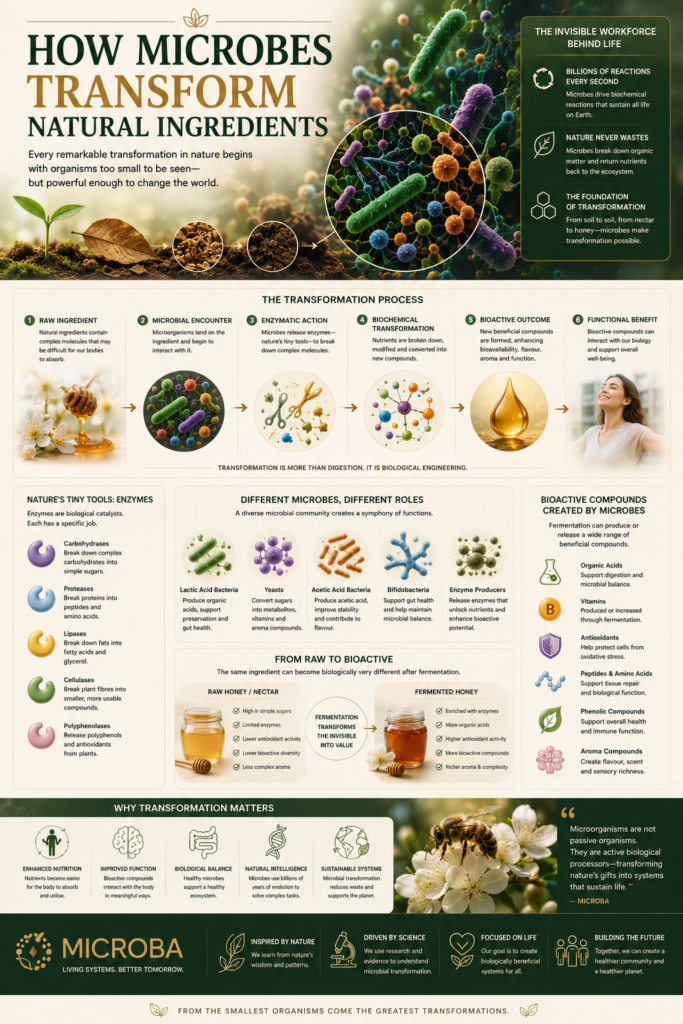
➡ How Microbes Transform Natural Ingredients
Discover what actually happens during fermentation—how invisible microorganisms convert simple natural ingredients into complex bioactive systems that nature has perfected over millions of years.
Continue reading
Related articles
Return to Origin
Explore the science behind nature’s intelligence.
Discover MICROBA research on microbiome ecosystems, controlled fermentation and personalised formulation.
Explore Research