
Understanding the Human Microbiome
 hikayatempat
MICROBA Editorial
hikayatempat
MICROBA Editorial
The invisible ecosystem that quietly shapes your health every single day.
Category: Research
Reading Time: 10–12 minutes
Keywords: human microbiome, gut microbiome, beneficial bacteria, health, microbiology, digestion, immunity
We Are Never Truly Alone
When most people think about the human body, they imagine organs, muscles, bones, and blood.
Few realise that every person also carries an invisible community of microscopic life.
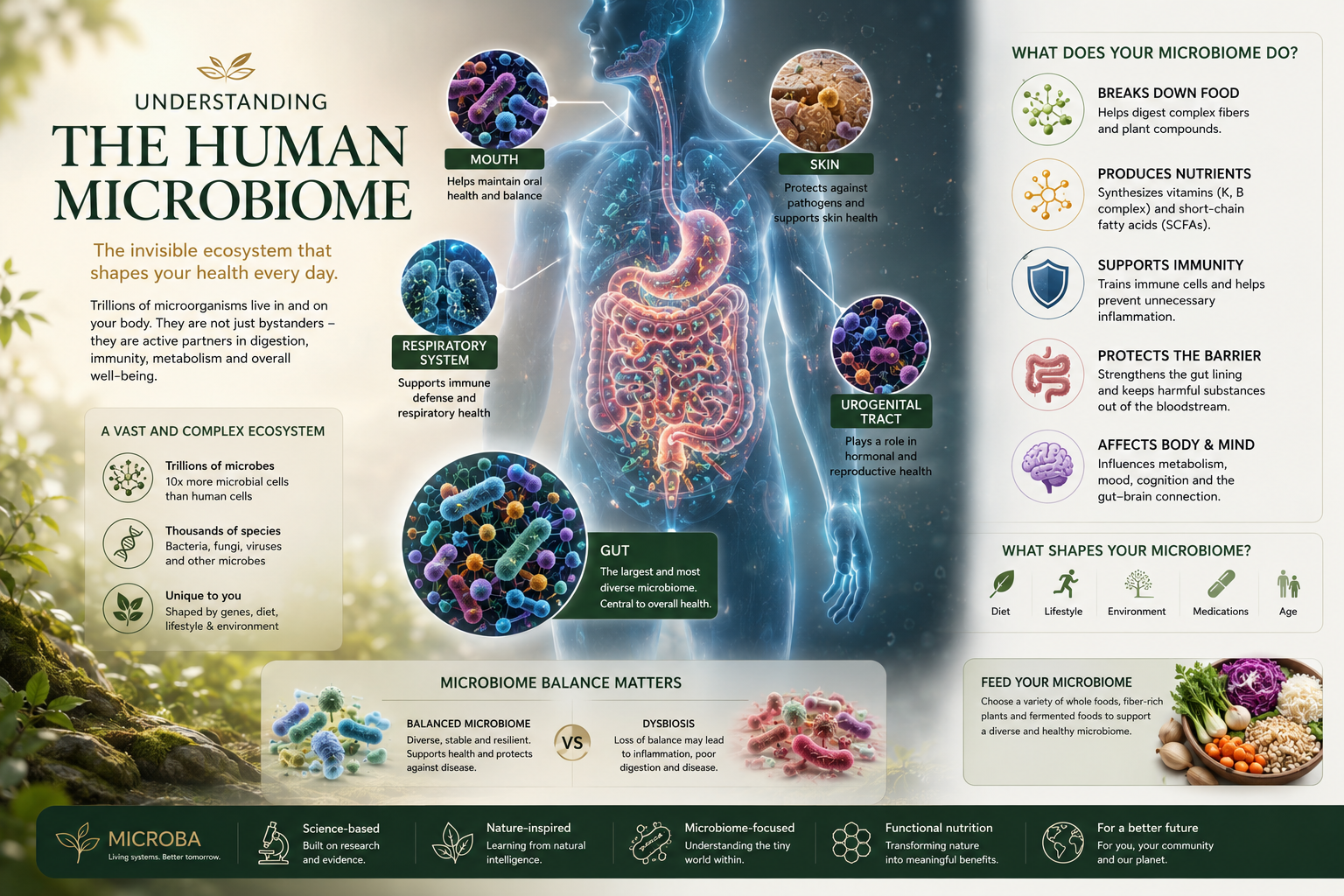
Trillions of bacteria, fungi, viruses, and other microorganisms live on and inside us, forming what scientists call the human microbiome.
Far from being unwanted passengers, these microbes help regulate many of the biological processes that keep us alive.
In fact, modern research increasingly recognises the microbiome as a fundamental component of human health rather than a collection of harmless bacteria.
What Is the Human Microbiome?
The human microbiome refers to the collective community of microorganisms living throughout the body.
These microorganisms inhabit several environments, including:
- The digestive tract
- The mouth
- The skin
- The respiratory system
- The reproductive tract
Although microbes exist throughout the body, the gut microbiome is by far the largest and most influential.
Within the human intestine lives one of the most complex biological ecosystems ever studied.
A Living Ecosystem, Not an Infection
For generations, microbes were viewed primarily as threats.
Medical science understandably focused on bacteria that cause disease.
However, this represents only a tiny fraction of microbial life.
Most microorganisms living within healthy individuals are beneficial—or at the very least, harmless.
Together they form a balanced ecosystem where different species cooperate, compete, and regulate one another.
Like a rainforest, diversity contributes to resilience.
When balance is maintained, the ecosystem functions efficiently.
When balance is disrupted, problems begin to appear.
What Do Gut Microbes Actually Do?
Scientists have discovered that gut microorganisms participate in numerous essential functions.
These include:
Breaking Down Food
Many dietary fibres cannot be digested by human enzymes alone.
Gut bacteria ferment these fibres into useful compounds.
Producing Essential Molecules
Certain microbes synthesise nutrients including vitamin K and several B vitamins while also generating short-chain fatty acids (SCFAs), which help nourish intestinal cells.
Supporting the Immune System
Around 70% of immune activity is associated with the gastrointestinal tract.
Beneficial microbes help educate immune cells, maintain tolerance, and prevent unnecessary inflammation.
Rather than constantly attacking, the immune system learns when to respond—and when not to.
Protecting the Gut Barrier
The intestinal lining acts as a protective border between the outside world and the bloodstream.
Healthy microbial communities strengthen this barrier, helping reduce unwanted passage of toxins and harmful microorganisms into circulation.
When Balance Is Lost
Scientists use the term dysbiosis to describe an imbalance within the microbiome.
Dysbiosis does not necessarily mean dangerous bacteria suddenly appear.
Often it simply means that beneficial microbes become less abundant while less desirable species gain influence.
Research has associated dysbiosis with conditions including:
- Inflammatory bowel disease
- Obesity
- Type 2 diabetes
- Cardiovascular disease
- Allergies
- Certain neurological disorders through the gut–brain axis
Although dysbiosis alone does not prove causation, evidence increasingly suggests that microbial balance plays an important role in long-term health.
Your Microbiome Is Unique
No two people have exactly the same microbiome.
It is shaped by many factors, including:
- Birth method
- Early nutrition
- Diet
- Geography
- Environment
- Lifestyle
- Antibiotic exposure
- Age
This individuality helps explain why identical diets may produce different outcomes in different people.
The body is not processing nutrients alone.
Each person’s microbial ecosystem also participates.
Food Does More Than Feed You
Every meal feeds two living systems simultaneously.
The first is you.
The second is your microbiome.
Some foods encourage microbial diversity.
Others may reduce it.
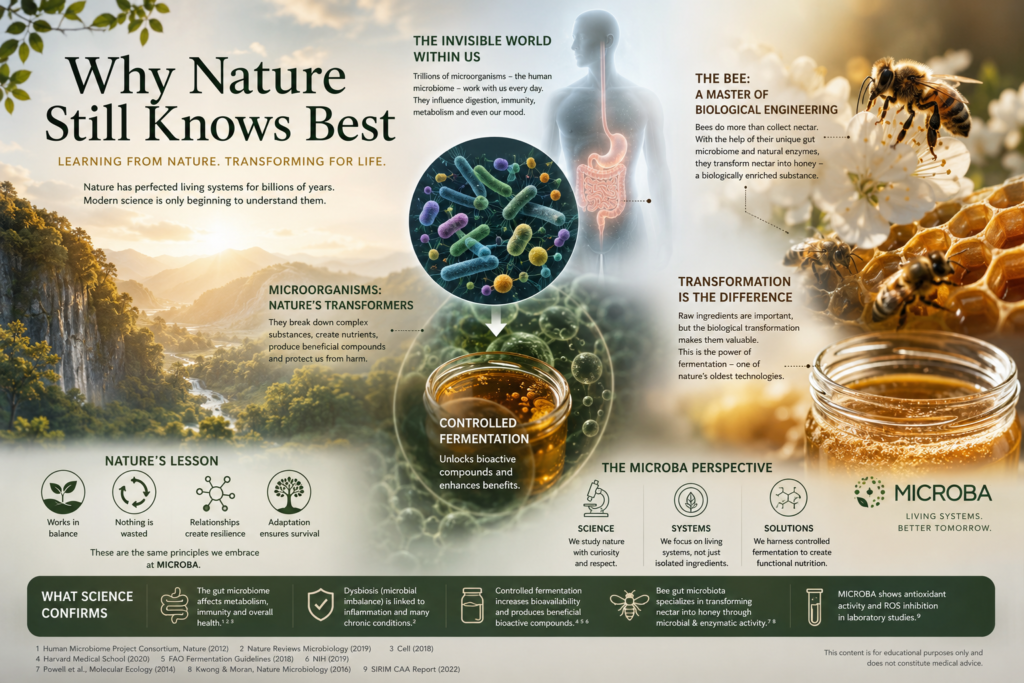
Fermented foods have attracted growing scientific interest because they introduce biologically active compounds and, in some cases, living microorganisms that may influence microbial communities.
This does not mean every fermented product is identical.
The microbial composition, fermentation process, and quality of control all matter.
The MICROBA Perspective
At MICROBA, we view the microbiome not simply as bacteria living inside the intestine.
We see it as part of a living biological network.
Understanding how microorganisms transform nutrients—and how controlled fermentation influences that transformation—forms the foundation of our research philosophy.
Rather than asking only:
“What nutrients are present?”
we also ask:
“How does biology transform them?”
The Future of Nutrition
Nutrition science is gradually moving beyond calories and vitamins.
The next frontier is understanding biological interactions.
Instead of focusing only on individual nutrients, researchers increasingly investigate:
- microbial ecosystems,
- host–microbe communication,
- bioactive metabolites,
- and personalised biological responses.
This shift represents one of the most exciting developments in modern life science.
Key Takeaways
- The human microbiome consists of trillions of microorganisms living throughout the body.
- The gut microbiome plays major roles in digestion, metabolism, immune regulation, and barrier protection.
- A balanced microbiome supports health, while dysbiosis has been associated with numerous chronic conditions.
- Every person’s microbiome is unique, contributing to individual differences in nutritional responses.
- Understanding microbial ecosystems may help shape the future of functional nutrition.
Continue Reading
Next article:
➡ The Hidden World Inside a Bee
Discover why one of nature’s smallest creatures may hold remarkable insights into microbial cooperation, biological transformation, and the future of functional nutrition.
Continue reading
Related articles
Return to Origin
Explore the science behind nature’s intelligence.
Discover MICROBA research on microbiome ecosystems, controlled fermentation and personalised formulation.
Explore Research