
The Hidden World Inside a Bee
 hikayatempat
MICROBA Editorial
hikayatempat
MICROBA Editorial
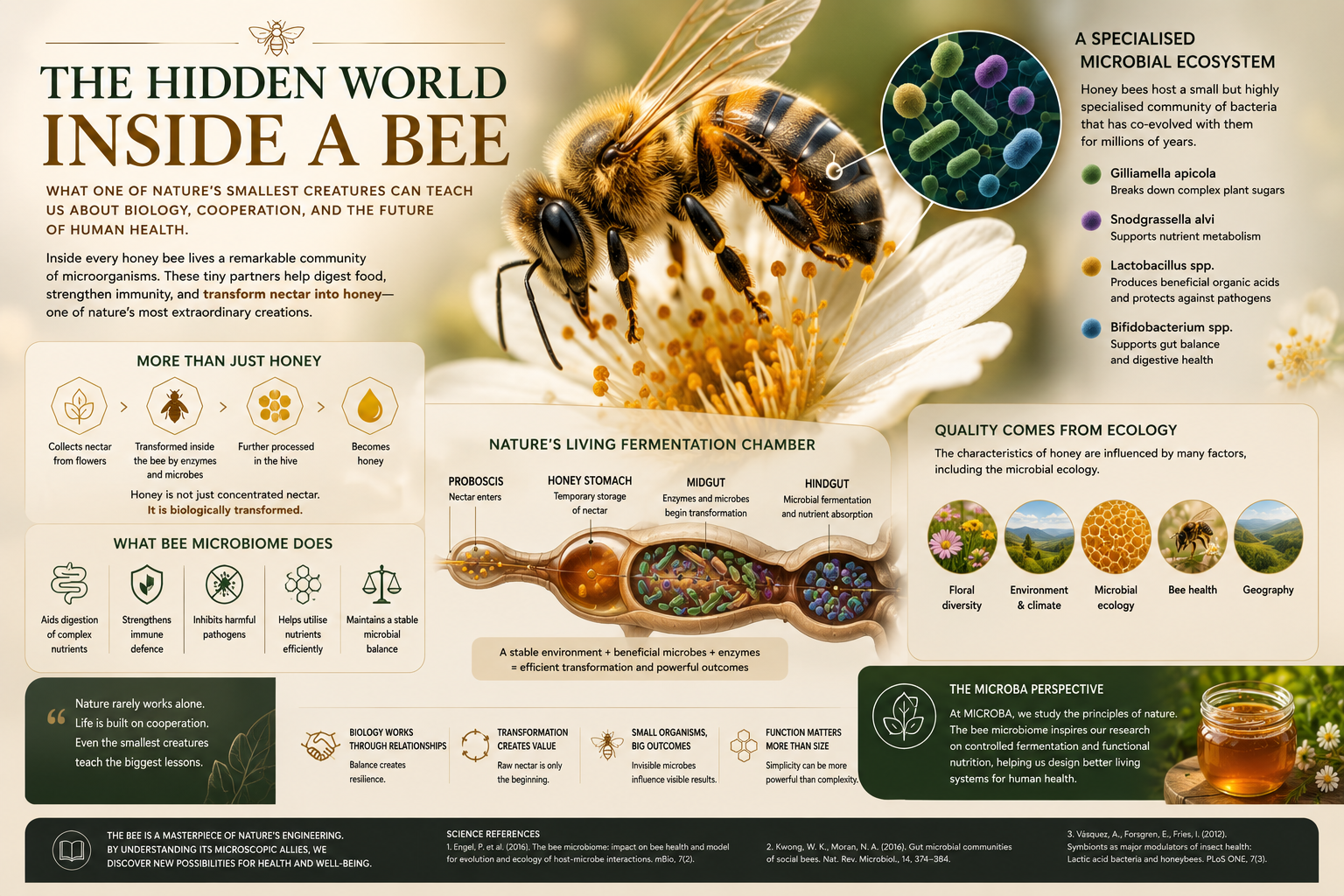
What one of nature’s smallest creatures can teach us about biology, cooperation, and the future of human health.
More Than Just Honey
When most people think of bees, they think of honey.
Some think of pollination.
Others simply see another insect flying from flower to flower.
But hidden inside every healthy honey bee is one of nature’s most remarkable biological systems.
A highly specialised microbial ecosystem.
Scientists now recognise that honey bees possess a unique gut microbiome that plays a central role in digestion, immunity, protection against pathogens, and the transformation of nectar into honey.
Understanding this invisible world may not only change how we view bees—it may also change how we think about human health.
A Tiny Animal With Extraordinary Intelligence
A honey bee weighs less than one gram.
Its brain is smaller than a sesame seed.
Yet together, a colony can build intricate honeycombs, regulate hive temperature, communicate food locations, defend against disease, and collectively sustain tens of thousands of individuals.
This extraordinary success is not driven by the bee alone.
It is supported by countless microorganisms working in partnership.
Nature rarely works alone.
Life is built on cooperation.
The Bee Gut Microbiome
Inside the digestive tract of every healthy honey bee lives a stable microbial community.
Unlike the human microbiome, which contains thousands of bacterial species, the bee microbiome is relatively simple.
Yet it is remarkably specialised.
Researchers have identified several core bacterial groups including:
- Gilliamella apicola
- Snodgrassella alvi
- Lactobacillus
- Bifidobacterium
Each performs specific biological functions essential to the bee’s survival.
Nature favours function over complexity.
More Than Digestion
These microorganisms do much more than digest food.
They help:
- metabolise complex plant sugars,
- produce beneficial organic acids,
- support immune defence,
- inhibit harmful pathogens,
- assist nutrient utilisation,
- maintain microbial balance inside the bee.
Without this invisible ecosystem, healthy bee colonies would struggle to survive.
The Journey From Nectar to Honey
Many people assume honey is simply concentrated nectar.
The reality is far more fascinating.
When a bee collects nectar, the journey has only just begun.
Inside the bee, nectar encounters enzymes and microorganisms that begin transforming its chemical composition.
The bee then returns to the hive, where further biological processing continues.
Honey is therefore not merely collected.
It is biologically transformed.
Scientific studies increasingly describe this process as a naturally occurring biotechnological system driven by microbial and enzymatic activity.
Nature’s Living Fermentation Chamber
The bee’s digestive system functions like a miniature biological reactor.
It provides:
- a stable environment,
- controlled microbial populations,
- continuous biochemical transformation,
- efficient nutrient conversion.
Everything operates in harmony.
Nothing is wasted.
Nature has refined this process over millions of years.
Quality Comes From Ecology
People often ask:
“Which country’s honey is the best?”
Science suggests the answer may be more complex.
The characteristics of honey are influenced by many factors, including:
- floral diversity,
- surrounding environment,
- climate,
- microbial ecology,
- bee health.
Research indicates that microbial communities vary according to habitat, influencing metabolic activity and ultimately affecting the biological characteristics of honey.
The origin matters.
But so does the living system behind it.
Lessons Humans Can Learn
The bee microbiome offers several powerful lessons.
Biology Works Through Relationships
No microorganism functions in isolation.
Balance creates resilience.
Transformation Creates Value
Raw nectar is only the beginning.
Microbial transformation creates something entirely different.
Small Organisms Can Produce Big Outcomes
Invisible microbes influence visible results.
Function Matters More Than Size
The bee’s microbiome is relatively simple compared with the human microbiome.
Yet it performs highly specialised tasks with remarkable efficiency.
Nature values effectiveness—not excess.
The MICROBA Perspective
At MICROBA, the bee is far more than a producer of honey.
It represents a living model of biological intelligence.
Its microbiome demonstrates how carefully balanced microbial ecosystems transform simple natural substrates into biologically enriched products.
This insight inspires one of our central research questions:
Can controlled microbial systems help us better understand biological transformation and functional nutrition?
Rather than copying nature, we seek to learn from its principles.
Looking Beyond Honey
The future of bee science may extend well beyond agriculture.
Researchers are increasingly studying bee microbiomes to better understand:
- microbial cooperation,
- ecological resilience,
- fermentation,
- host–microbe interactions,
- functional biological systems.
Tiny insects continue to teach us lessons with enormous scientific value.
Key Takeaways
- Honey bees possess a specialised and stable gut microbiome.
- Bee-associated microorganisms assist digestion, immunity, and nectar transformation.
- Honey is biologically transformed through enzymatic and microbial processes.
- Environmental ecology influences microbial communities and honey characteristics.
- The bee microbiome provides valuable insights into microbiology, fermentation, and functional nutrition.
Continue Reading
Next Article
➡ Why Bee Microbiome Matters
Discover why the smallest microbial ecosystem inside a bee may hold important clues for understanding biological resilience, fermentation, and the future of microbiome-based nutrition.
Continue reading
Related articles
Return to Origin
Explore the science behind nature’s intelligence.
Discover MICROBA research on microbiome ecosystems, controlled fermentation and personalised formulation.
Explore Research