

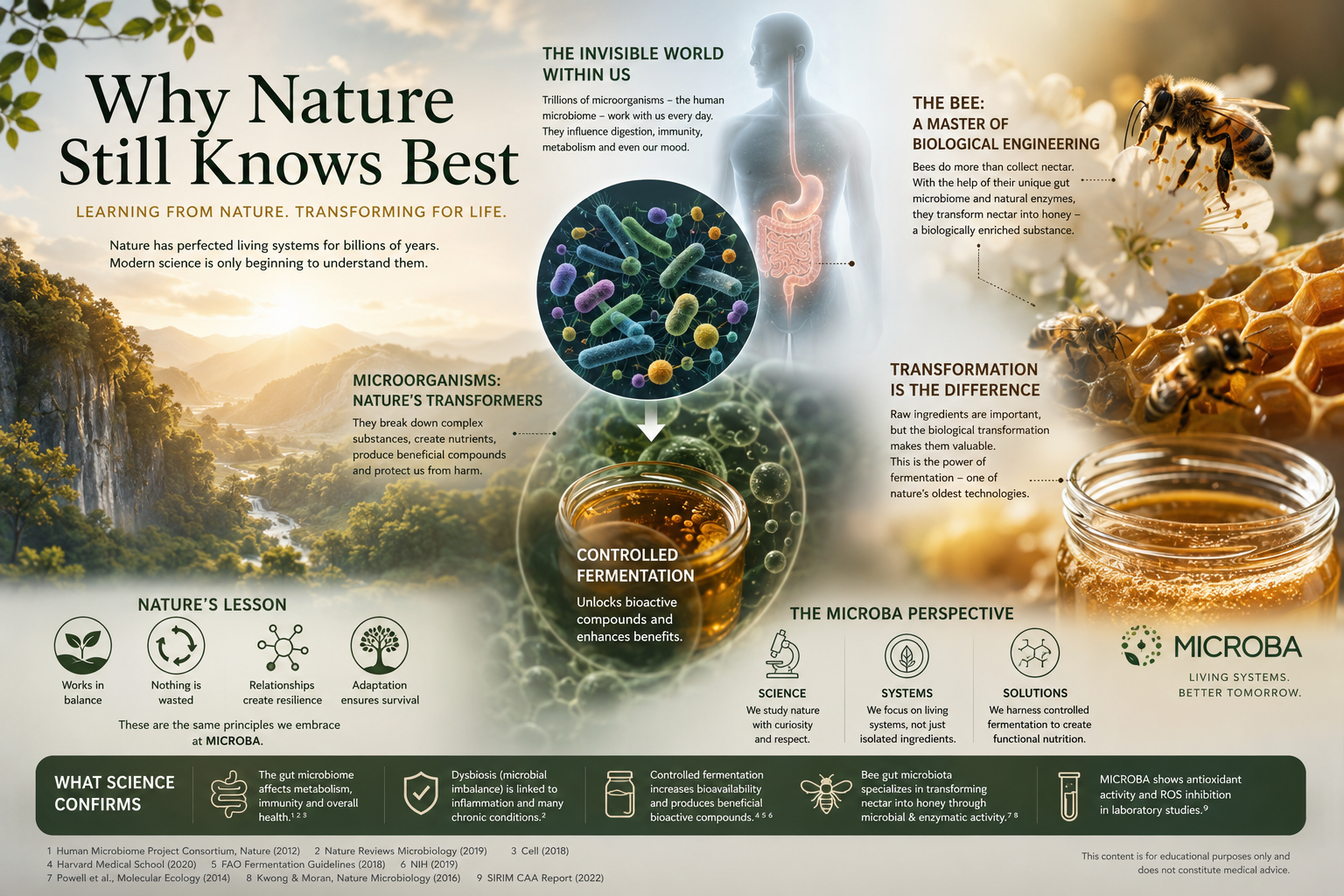
For billions of years, nature has been solving problems long before humans learned to observe them. Perhaps the future of health is not about inventing something entirely new—but understanding what nature has already perfected.
Category: Research
Reading Time: 10–12 minutes
Keywords: microbiome, natural health, microbiology, fermentation, bee microbiome, functional nutrition
Nature Is the Original Scientist
Long before laboratories, microscopes, and scientific journals existed, nature had already developed elegant systems for sustaining life.
Forests recycle nutrients without waste.
Coral reefs maintain complex ecosystems through cooperation.
The human body repairs itself after injury.
A beehive coordinates tens of thousands of individuals with remarkable efficiency.
None of these systems rely on synthetic chemicals or rigid control. Instead, they operate through relationships, balance, adaptation, and billions of microscopic interactions.
Modern science increasingly confirms what nature has demonstrated for millions—even billions—of years: the most resilient systems are living systems.
Rather than asking how we can improve upon nature, perhaps the better question is:
What can nature teach us?
Health Is More Than What We Consume
For decades, nutrition focused primarily on identifying essential nutrients—proteins, carbohydrates, fats, vitamins, and minerals.
The assumption was straightforward:
Better nutrients create better health.
While nutrients remain essential, modern research has revealed a more complex reality.
Two individuals may eat the same food, consume the same vitamins, and follow the same diet, yet experience very different health outcomes.
Why?
The answer often lies not in the food itself, but in how that food is biologically transformed inside the body.
This shift has become one of the defining discoveries of modern biology and is central to the growing field of microbiome research.
The Invisible World Within Us
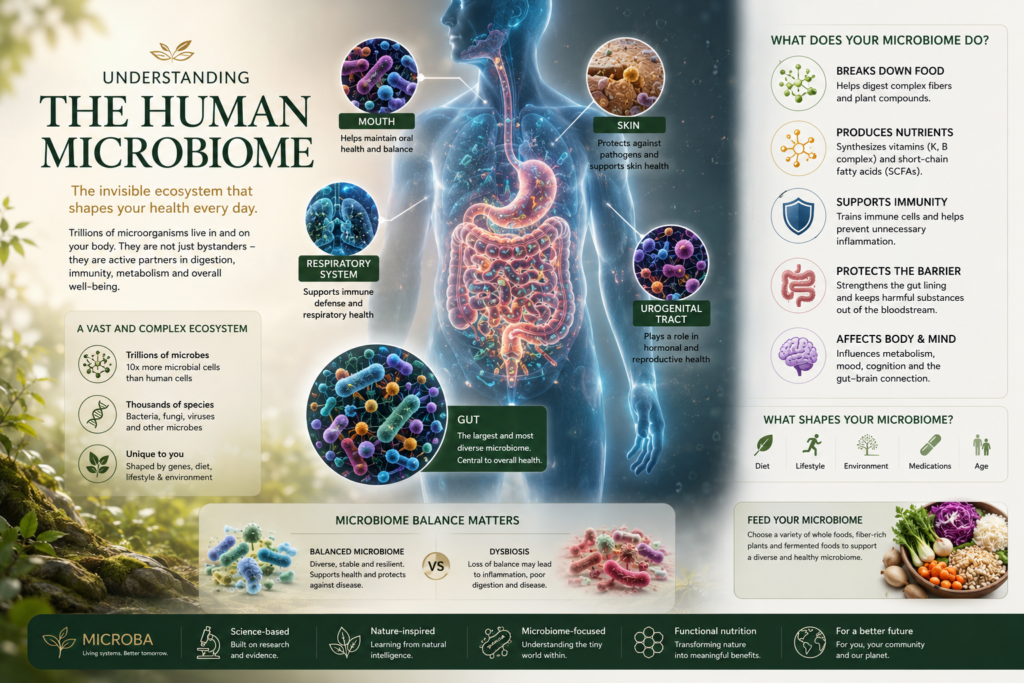
Every human carries a vast ecosystem of microorganisms.
Collectively known as the human microbiome, these bacteria, fungi, viruses, and other microbes inhabit our digestive tract, skin, mouth, and other tissues.
Rather than existing as passive passengers, they actively participate in essential biological processes, including:
- Breaking down complex nutrients
- Producing vitamins such as vitamin K and several B vitamins
- Supporting immune function
- Maintaining the intestinal barrier
- Producing signalling molecules that influence metabolism
Modern science increasingly regards the microbiome as a functional organ that contributes to overall health.
This understanding changes a fundamental assumption about nutrition.
The question is no longer simply:
What did you eat?
Instead, science increasingly asks:
How was it transformed?
Nature Has Always Worked Through Microbes
Microorganisms are often associated with disease.
Yet the overwhelming majority of microbes are not enemies.
They are builders.
Nature depends on them.
Without microorganisms:
- leaves would not decompose,
- soil would lose fertility,
- plants could not efficiently access nutrients,
- fermentation would not exist,
- and many biological cycles would simply stop.
Microbes quietly drive the processes that make life possible.
Their greatest contribution is not their presence—but their ability to transform.
Transformation Is the Real Difference
Nature rarely creates value instantly.
Instead, it transforms.
A grape becomes wine.
Milk becomes yogurt.
Soybeans become miso.
Cocoa beans become chocolate.
Fresh leaves become compost.
Raw nectar becomes honey.
The raw ingredient matters.
But the process determines the outcome.
Controlled biological transformation can generate entirely new molecules, increase bioavailability, produce bioactive compounds, and alter the functional properties of food. Scientific literature consistently recognises controlled fermentation as a process that enhances nutritional and functional characteristics.
The Bee: A Master of Biological Engineering
Few organisms demonstrate biological transformation as elegantly as the honey bee.
To most people, bees simply collect nectar.
Science tells a more fascinating story.
Bees possess a specialised and remarkably stable gut microbiome.
As nectar passes through the bee’s digestive system, microbial and enzymatic processes begin transforming it.
The result is not merely concentrated plant sugar.
It is a biologically processed substance created through coordinated microbial activity. Research into bee gut microbiota highlights the specialised roles of microbes in carbohydrate metabolism, nutrient processing, and nectar transformation.
Nature offers a profound lesson here.
The value does not arise solely from the flower.
It emerges from the biological system that transforms the flower’s nectar.
The Rise of Microbiome Science
Only in recent decades has modern science begun to appreciate the importance of microbial ecosystems.
Large international research initiatives have demonstrated that microbial communities influence:
- metabolism,
- immune regulation,
- inflammation,
- gut barrier integrity,
- and overall physiological balance.
Rather than viewing health as a collection of isolated organs, researchers increasingly describe the human body as an ecosystem in continuous dialogue with trillions of microorganisms.
This represents one of the most significant shifts in biological science during the twenty-first century.
Learning From Nature, Not Competing With It
Human innovation has achieved remarkable advances.
Yet many successful technologies have emerged by first observing nature.
Velcro was inspired by plant burrs.
Aircraft wings borrow principles from birds.
Robotics learns from insects.
Medicine has long studied natural compounds for therapeutic development.
Nutrition should be no different.
Nature has spent billions of years refining biological systems through adaptation and selection.
Understanding these systems may prove more valuable than attempting to replace them.
The MICROBA Perspective
At MICROBA, we believe the future of functional nutrition begins with understanding biological systems rather than isolated ingredients.
This perspective is built upon three observations:
- Microorganisms play a central role in biological transformation.
- Controlled fermentation can unlock functional properties that are not present in raw materials alone.
- Natural systems—particularly those found in bee biology—offer valuable models for designing microbiome-centred nutritional approaches.
This philosophy reflects a broader scientific movement that places biological processes, rather than individual nutrients, at the centre of health. The concept of microorganisms as biological filters and controlled fermentation as a transformative mechanism underpins the MICROBA framework.
Returning to Nature Through Science
Returning to nature does not mean rejecting science.
It means allowing science to deepen our understanding of nature.
Modern microbiology, systems biology, fermentation research, and microbiome science increasingly reveal that many of nature’s oldest processes remain among its most sophisticated.
The more we discover, the clearer one message becomes:
Nature was never primitive.
We simply had not yet learned how to see.
Key Takeaways
- Nature has developed resilient biological systems over billions of years.
- Health depends not only on nutrients but also on biological transformation.
- The human microbiome plays a central role in metabolism, immunity, and overall health.
- Microorganisms drive many of nature’s most important processes, including fermentation.
- Bees demonstrate how microbial ecosystems can transform simple natural substrates into biologically enriched products.
- Studying nature through modern science may offer new directions for functional nutrition.
Further Reading
Continue your journey with:
- Understanding the Human Microbiome
- The Hidden World Inside a Bee
- Controlled Fermentation Explained
- The Science Behind Personalised Nutrition
“Nature does not simply provide ingredients. It provides living systems. The future of health may lie not in replacing those systems, but in understanding how they work.”
Continue reading
Related articles
Return to Origin
Explore the science behind nature’s intelligence.
Discover MICROBA research on microbiome ecosystems, controlled fermentation and personalised formulation.
Explore Research