
Microbial Communication in Bee Colonies
 hikayatempat
MICROBA Editorial
hikayatempat
MICROBA Editorial
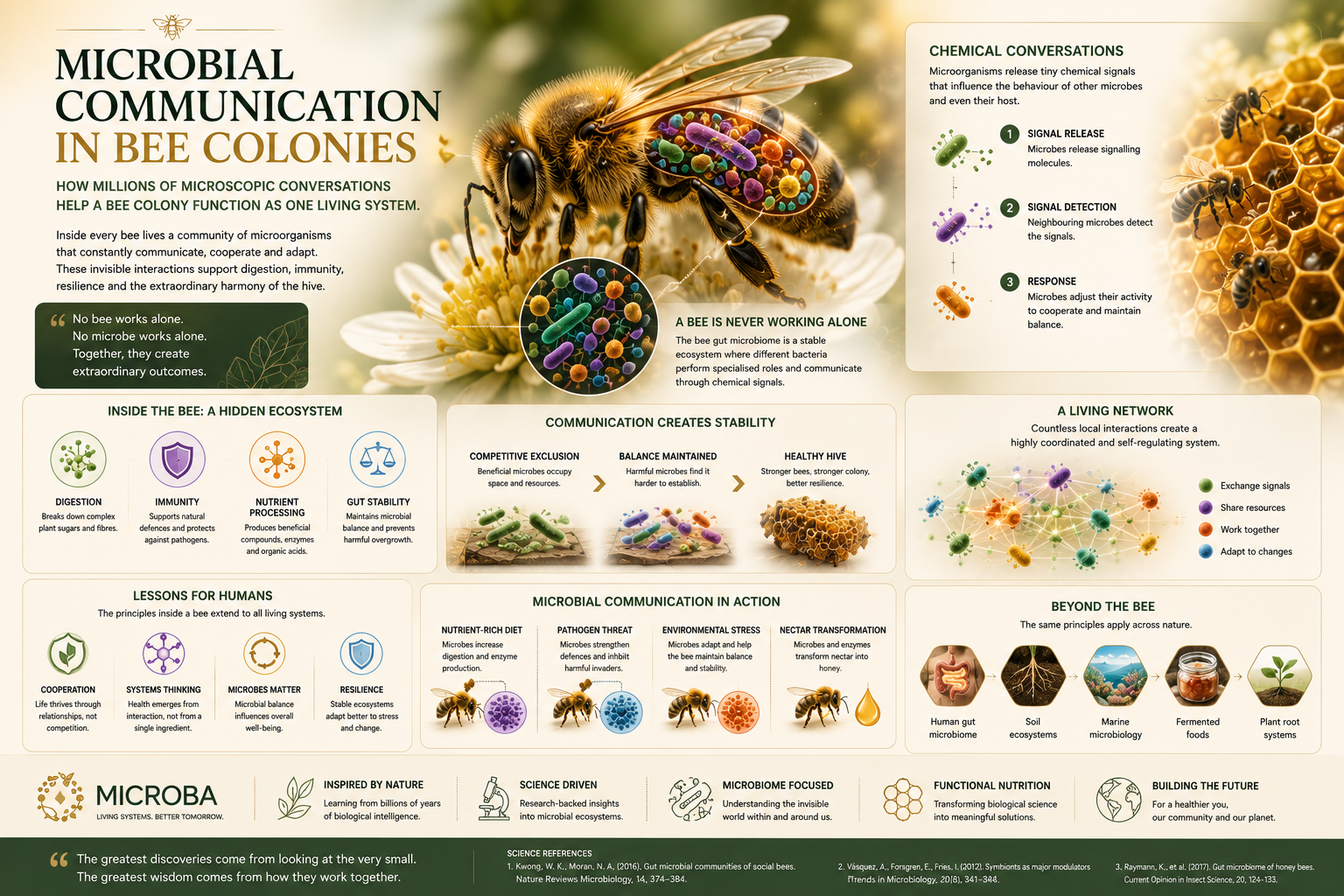
How millions of microscopic conversations help a bee colony function as one living system.
The Hive Never Sleeps
A healthy beehive is in constant motion.
Thousands of bees leave to forage.
Others care for developing larvae.
Some repair damaged honeycomb.
Others defend the colony.
To human eyes, this appears chaotic.
Yet every movement follows an invisible order.
This remarkable coordination depends not only on bees communicating with one another—but also on countless microscopic interactions taking place within every individual bee.
Nature is constantly communicating.
Even at the microbial level.
Communication Beyond Words
Humans communicate through language.
Bees communicate through movement, pheromones and vibration.
Microorganisms communicate differently.
They exchange chemical signals.
These tiny molecules influence the behaviour of neighbouring microbes and sometimes even the cells of their host.
Scientists refer to this continuous exchange as microbial communication.
Although invisible, these interactions help regulate biological systems throughout nature.
A Bee Is Never Working Alone
Inside every healthy bee lives a stable microbial community.
These microorganisms do not simply coexist.
They cooperate.
Different bacterial species perform specialised tasks while responding to changes inside the bee’s digestive system.
Research has shown that the bee gut microbiome is organised into specialised communities whose members complement one another rather than compete randomly.
Like musicians in an orchestra, each contributes to a larger performance.
Chemical Conversations
Microbes release small signalling molecules into their environment.
Nearby microorganisms detect these signals and adjust their own activity.
Depending on the situation they may:
- increase metabolic activity,
- slow their growth,
- strengthen biofilm formation,
- cooperate in nutrient processing,
- respond to environmental stress.
No central controller exists.
Order emerges through countless local interactions.
Nature builds intelligence from cooperation.
A Living Network
Imagine a city where every citizen instantly shares useful information with nearby neighbours.
No single individual controls the entire city.
Yet together the whole community responds efficiently.
This is remarkably similar to microbial ecosystems.
Inside a bee, microorganisms constantly adapt to:
- available nutrients,
- changing pH,
- enzyme activity,
- oxygen levels,
- host physiology.
The result is a dynamic but remarkably stable ecosystem.
Communication Creates Stability
Why does the bee microbiome remain so consistent?
Because balance is actively maintained.
Beneficial microorganisms help occupy available ecological space.
This limits opportunities for harmful organisms to establish themselves.
Scientists describe this as competitive exclusion.
Healthy microbial communities protect themselves simply by working together.
This is one reason healthy bee colonies demonstrate remarkable resilience against many environmental challenges.
Nature Builds Systems, Not Individuals
One of biology’s greatest lessons is that no organism functions entirely alone.
Flowers depend on pollinators.
Trees depend on soil fungi.
Humans depend on gut microbes.
Bees depend on their microbiome.
Life succeeds because systems cooperate.
Not because individuals dominate.
What Humans Can Learn
The bee microbiome reminds us that health is rarely determined by one molecule or one organism.
Instead, health emerges from interaction.
Modern microbiome research increasingly focuses on:
- microbial networks,
- ecological balance,
- communication pathways,
- systems biology,
- host–microbe relationships.
This represents a shift away from viewing biology as isolated parts.
Instead, researchers increasingly study living systems as integrated networks.
The MICROBA Perspective
At MICROBA, microbial communication represents one of nature’s most elegant principles.
A living system is not defined solely by what it contains.
It is defined by how its components interact.
This philosophy influences how we think about:
- controlled fermentation,
- microbial ecosystems,
- biological transformation,
- functional nutrition.
Nature demonstrates that meaningful outcomes emerge through relationships—not isolation.
Beyond the Bee
The principles observed inside bee colonies extend throughout biology.
The same concepts are increasingly recognised in:
- the human gut microbiome,
- soil ecosystems,
- marine microbiology,
- plant root systems,
- fermented foods.
Different organisms.
The same underlying principle.
Communication creates coordination.
Coordination creates resilience.
Looking to the Future
As science advances, researchers are beginning to map the invisible conversations occurring between microorganisms.
Understanding these microbial networks may help improve:
- agriculture,
- food science,
- fermentation,
- environmental restoration,
- microbiome-based nutrition.
Perhaps the greatest discovery is not that microbes exist.
It is that they work together.
Key Takeaways
- Bee microbiomes consist of highly cooperative microbial communities.
- Microorganisms communicate through chemical signalling rather than words.
- Microbial communication helps maintain stability, resilience and efficient nutrient transformation.
- Healthy ecosystems emerge through interaction rather than isolated activity.
- Bee colonies provide a natural model for studying systems biology and microbial cooperation.
Continue Reading
Next Article
➡ Controlled Fermentation Explained
Discover how nature’s oldest biotechnology transforms ordinary ingredients into biologically active systems—and why control makes all the difference.
Continue reading
Related articles
Return to Origin
Explore the science behind nature’s intelligence.
Discover MICROBA research on microbiome ecosystems, controlled fermentation and personalised formulation.
Explore Research