
Why Bee Microbiome Matters
 hikayatempat
MICROBA Editorial
hikayatempat
MICROBA Editorial
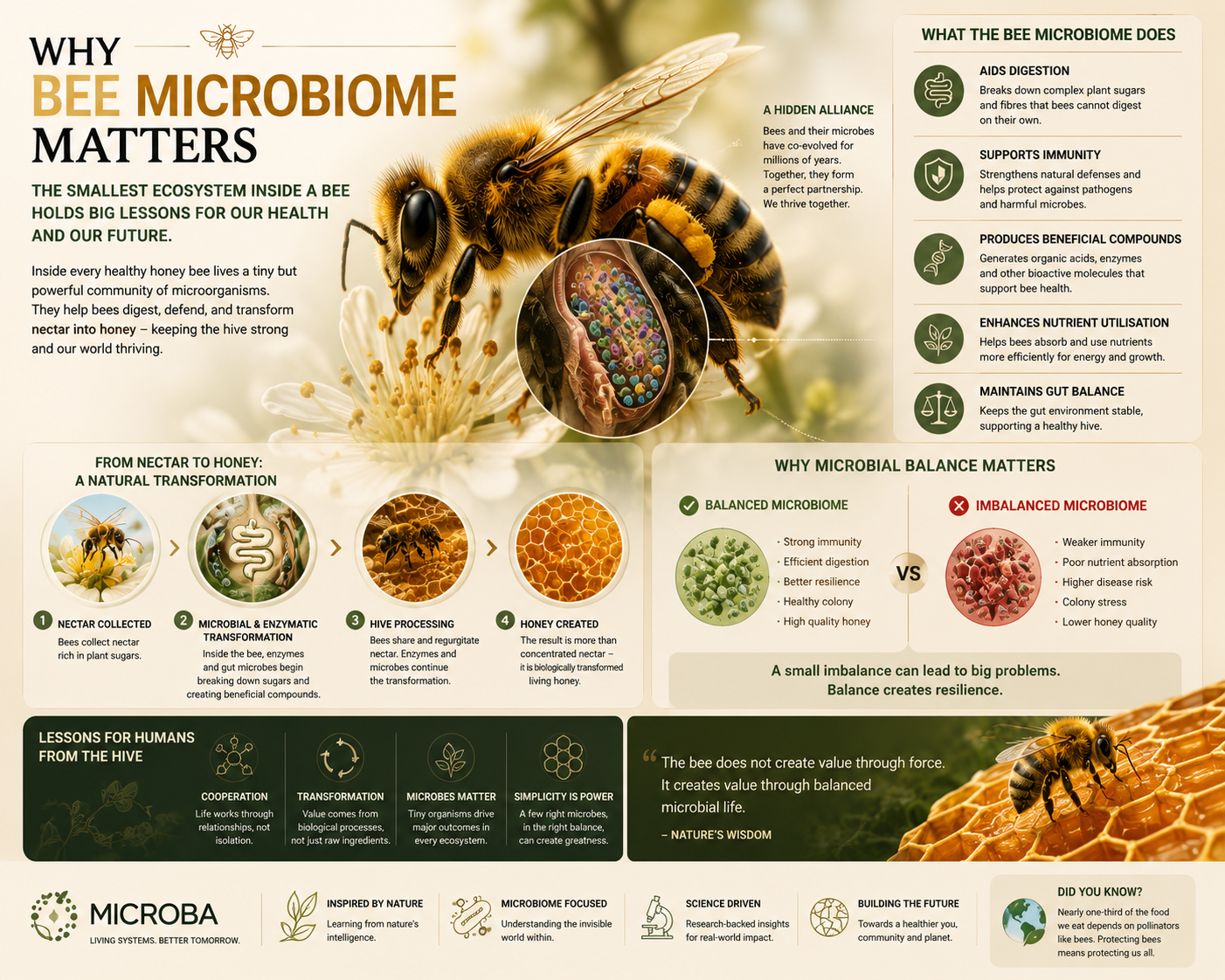
The smallest ecosystem inside a bee may hold some of the biggest lessons for biology, resilience, and the future of functional nutrition.
Tiny Organisms. Extraordinary Impact.
A honey bee is one of nature’s smallest workers.
Yet without bees, ecosystems around the world would begin to collapse.
Nearly one-third of global food production depends directly or indirectly on pollination.
For decades, scientists focused primarily on the bee itself.
Today, another discovery is attracting growing attention.
Hidden inside every healthy bee is an invisible microbial community that quietly supports almost every aspect of its life.
This community is known as the bee microbiome.
A Healthy Bee Depends on Healthy Microbes
Just like humans, bees are not solitary organisms.
They live in partnership with trillions of microscopic allies.
Research has shown that these microorganisms help bees:
- digest complex plant sugars,
- defend against pathogens,
- regulate immune responses,
- process nutrients,
- maintain gut stability,
- support colony health.
Without this microbial partnership, bees become far more vulnerable to disease and environmental stress.
The Hive Is More Than a Colony
A beehive is often described as a superorganism.
Thousands of bees cooperate as though they were one living body.
Inside this system:
- worker bees collect nectar,
- nurse bees care for larvae,
- guard bees protect the entrance,
- queen bees reproduce,
- microorganisms quietly support every stage of the process.
Nature demonstrates that resilience comes from cooperation—not isolation.
The Invisible Workforce
When nectar enters the bee’s digestive system, microorganisms immediately begin their work.
These microbes:
- metabolise carbohydrates,
- assist enzymatic reactions,
- produce organic acids,
- influence bioactive compounds,
- prepare nectar for further transformation.
Without these microscopic workers, honey would not possess the same biological characteristics.
The visible product begins with an invisible process.
Simplicity Can Be Powerful
One fascinating feature of the bee microbiome is its simplicity.
Unlike the human gut, which contains thousands of microbial species, healthy bees rely on a relatively small number of specialised bacteria.
Each species performs highly efficient tasks.
Instead of complexity for its own sake, nature favours:
- stability,
- cooperation,
- specialisation,
- efficiency.
Scientists increasingly recognise the bee microbiome as an elegant model of functional symbiosis.
Microbial Balance Is Everything
A healthy microbiome is not defined by having the greatest number of microorganisms.
It is defined by balance.
When microbial balance is disrupted, bees become more susceptible to:
- pathogens,
- nutritional stress,
- environmental toxins,
- reduced colony performance.
The same principle increasingly appears throughout biology.
Whether in forests, oceans, soils, or humans, healthy ecosystems depend on balanced microbial communities.
Lessons Beyond the Hive
Why should humans care about microorganisms living inside bees?
Because nature often solves problems using universal principles.
The bee microbiome teaches us that:
- living systems depend on cooperation,
- biological transformation creates value,
- microorganisms regulate much more than digestion,
- resilience begins at the microscopic level.
These are principles that extend well beyond insects.
A Blueprint for Functional Biology
Researchers now study bee microbiomes not only to protect bee populations but also to better understand:
- microbial ecology,
- host–microbe relationships,
- biological resilience,
- controlled microbial systems,
- natural biochemical transformation.
The bee has become more than an agricultural species.
It has become a biological teacher.
The MICROBA Perspective
At MICROBA, we believe the bee microbiome represents one of nature’s clearest demonstrations of biological intelligence.
The bee does not create value through force.
It creates value through carefully balanced microbial activity.
This observation inspires an important research perspective:
Healthy biological systems are built upon balanced microbial ecosystems.
Understanding these systems may help us design better approaches to fermentation, nutrition, and microbiome-focused research.
Nature has already written the blueprint.
Science is only beginning to read it.
Looking Ahead
The next frontier is not simply identifying microorganisms.
It is understanding how they communicate, cooperate, and transform their environment.
This shift—from studying individual microbes to studying microbial ecosystems—may redefine the future of biology.
Key Takeaways
- The bee microbiome is essential for digestion, immunity, and nutrient transformation.
- Healthy bee colonies rely on balanced microbial ecosystems.
- Bee microbiomes provide a natural model of cooperation and biological efficiency.
- Studying these systems offers insights into microbiology, fermentation, and functional nutrition.
- Nature demonstrates that the smallest organisms often produce the greatest biological impact.
Continue Reading
Next Article
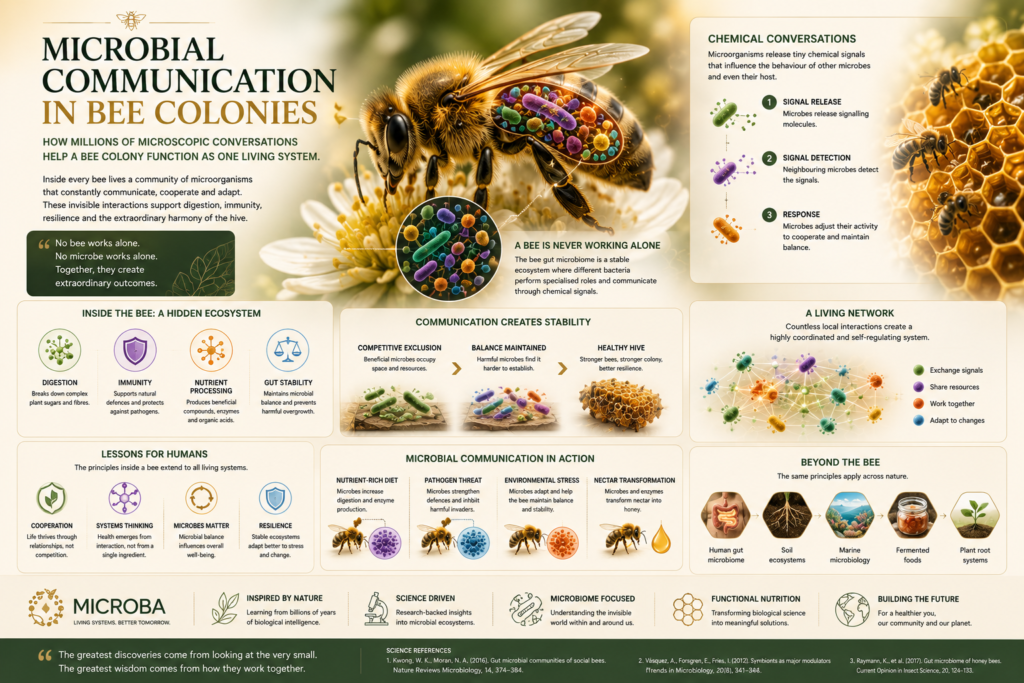
➡ Microbial Communication in Bee Colonies
Discover how bees and their microscopic partners communicate, cooperate, and function as one of nature’s most remarkable living networks.
Continue reading
Related articles
Return to Origin
Explore the science behind nature’s intelligence.
Discover MICROBA research on microbiome ecosystems, controlled fermentation and personalised formulation.
Explore Research