
Controlled Fermentation Explained
 hikayatempat
MICROBA Editorial
hikayatempat
MICROBA Editorial
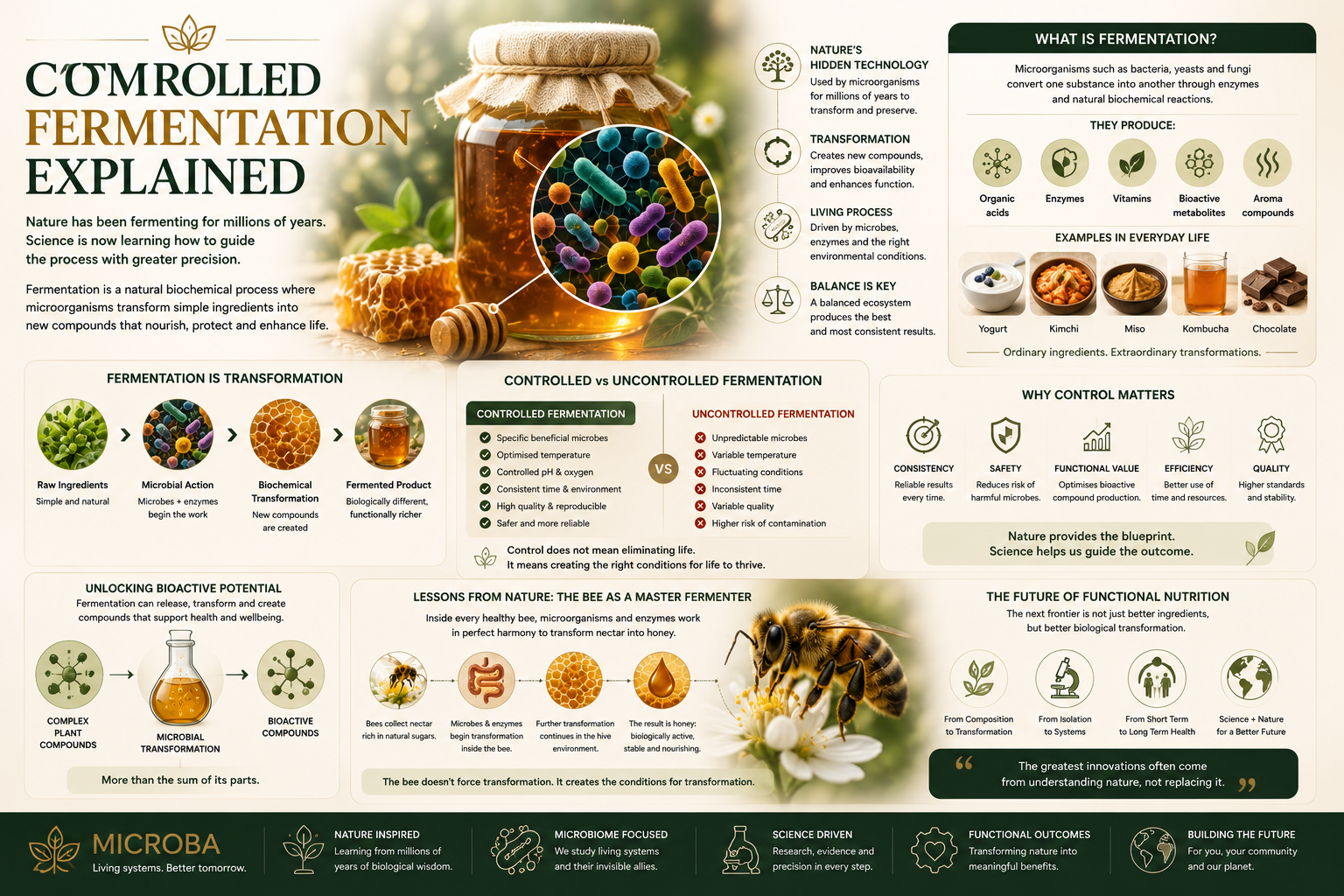
Nature has been fermenting for millions of years. Science is now learning how to guide the process with greater precision.
One of Nature’s Oldest Technologies
Long before humans built cities, wrote books, or invented laboratories, nature had already mastered fermentation.
Leaves decomposed into fertile soil.
Fruit naturally transformed over time.
Microorganisms recycled nutrients across forests, oceans, and grasslands.
Even inside living organisms, microbes continuously transformed nutrients into compounds essential for life.
Fermentation is not an invention.
It is one of nature’s oldest biological technologies.
What Is Fermentation?
Fermentation is a natural biochemical process in which microorganisms convert one substance into another.
Using enzymes, bacteria and yeasts transform simple nutrients into entirely new compounds.
During fermentation they may produce:
- Organic acids
- Enzymes
- Vitamins
- Bioactive metabolites
- Aroma compounds
- Functional molecules
The ingredients may appear similar before and after fermentation.
Biologically, however, they can be very different.
Modern food science recognises fermentation as a process that enhances bioavailability, generates bioactive compounds, and changes the functional characteristics of foods.
Fermentation Is Transformation
Imagine fresh milk becoming yogurt.
Fresh cabbage becoming kimchi.
Soybeans becoming miso.
Tea becoming kombucha.
Raw cacao becoming chocolate.
Each begins with ordinary ingredients.
The transformation occurs because microorganisms are doing what they have evolved to do for millions of years.
Nature does not simply preserve food.
Nature transforms it.
Why Microbes Matter
Microorganisms are the true engineers of fermentation.
Different species perform different biological tasks.
Some produce beneficial acids.
Others generate enzymes.
Some create aromatic compounds.
Others produce molecules that support microbial balance.
Without microorganisms, fermentation simply does not occur.
They are the invisible workforce behind every successful fermentation.
Not All Fermentation Is the Same
The word “fermentation” is often used as though every fermented food is identical.
It is not.
The outcome depends entirely on:
- the microorganisms involved,
- the raw ingredients,
- temperature,
- moisture,
- oxygen,
- time,
- environmental conditions.
Small changes can produce very different biological outcomes.
Controlled vs Uncontrolled Fermentation
This is where modern science becomes important.
Natural fermentation can be unpredictable.
Different microorganisms may dominate from one batch to another.
Environmental changes may alter the final result.
Controlled fermentation seeks to guide these variables.
Rather than leaving the process entirely to chance, important conditions are carefully managed.
Scientific literature consistently distinguishes controlled fermentation from uncontrolled fermentation because it improves reproducibility, safety, and functional consistency.
Controlled Fermentation
A controlled system aims to optimise:
- microbial activity,
- temperature,
- pH,
- oxygen,
- fermentation duration,
- biological stability.
The objective is not to fight nature.
It is to create conditions where beneficial biological processes can occur consistently.
Uncontrolled Fermentation
When fermentation proceeds without sufficient control:
- microbial populations may vary,
- unwanted organisms may dominate,
- functional compounds become unpredictable,
- consistency decreases,
- quality may fluctuate.
Nature itself demonstrates that successful ecosystems depend upon balance.
Fermentation is no different.
Why Control Matters
Control is often misunderstood.
Control does not mean eliminating life.
It means supporting the right biological conditions.
Consider a greenhouse.
Plants still grow naturally.
But temperature, humidity, water and light are carefully managed.
Controlled fermentation follows the same principle.
Nature remains the foundation.
Science improves consistency.
Unlocking Bioactive Potential
One of the most exciting discoveries in modern fermentation research is the production of bioactive compounds.
During fermentation microorganisms may:
- release bound plant compounds,
- transform existing molecules,
- generate new metabolites,
- improve nutrient availability,
- increase antioxidant activity.
The value therefore comes not only from the original ingredient, but from the biological transformation itself.
Learning From Nature
Perhaps the best example of controlled biological transformation already exists in nature.
Honey bees.
Inside every healthy bee, microorganisms and enzymes work within a remarkably stable environment.
Nectar is gradually transformed through coordinated biological processes.
The bee does not force transformation.
It creates the conditions for transformation.
Nature teaches that biology works best under balance.
The MICROBA Perspective
At MICROBA, controlled fermentation is viewed as more than a manufacturing process.
It is a biological system.
The objective is not simply producing fermented food.
The objective is understanding how microorganisms transform natural ingredients into biologically active systems.
This philosophy is inspired by three principles:
- Nature provides the model.
- Microorganisms drive transformation.
- Control enables consistency.
The Future of Functional Nutrition
For many years nutrition focused primarily on ingredients.
Today researchers increasingly study biological processes.
Future innovation may depend less on discovering new ingredients and more on understanding how microorganisms transform the ingredients we already have.
This shift—from composition to transformation—represents one of the most exciting frontiers in microbiome science.
Key Takeaways
- Fermentation is one of nature’s oldest biological processes.
- Microorganisms transform raw ingredients into biologically different products.
- Controlled fermentation improves consistency, safety and functional outcomes.
- The value of fermented systems comes from biological transformation rather than raw ingredients alone.
- Nature provides the blueprint, while science helps guide the process with precision.
Continue Reading
Next Article
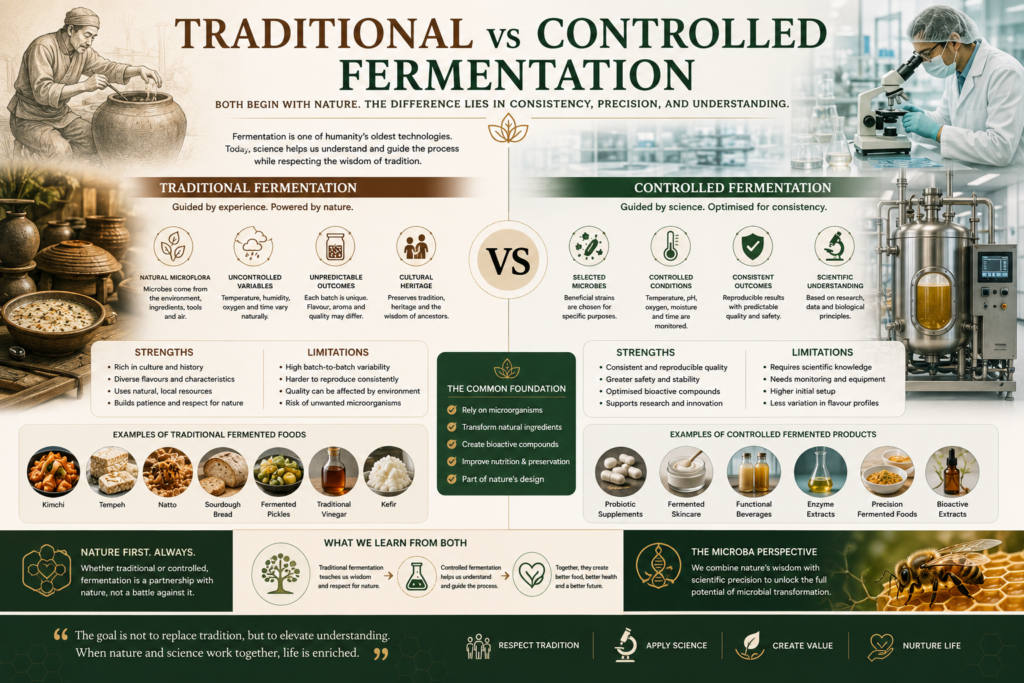
➡ Traditional vs Controlled Fermentation
Explore how ancient fermentation practices compare with modern controlled systems—and why both continue to shape the future of food, microbiome science, and functional nutrition.
Continue reading
Related articles
Return to Origin
Explore the science behind nature’s intelligence.
Discover MICROBA research on microbiome ecosystems, controlled fermentation and personalised formulation.
Explore Research