
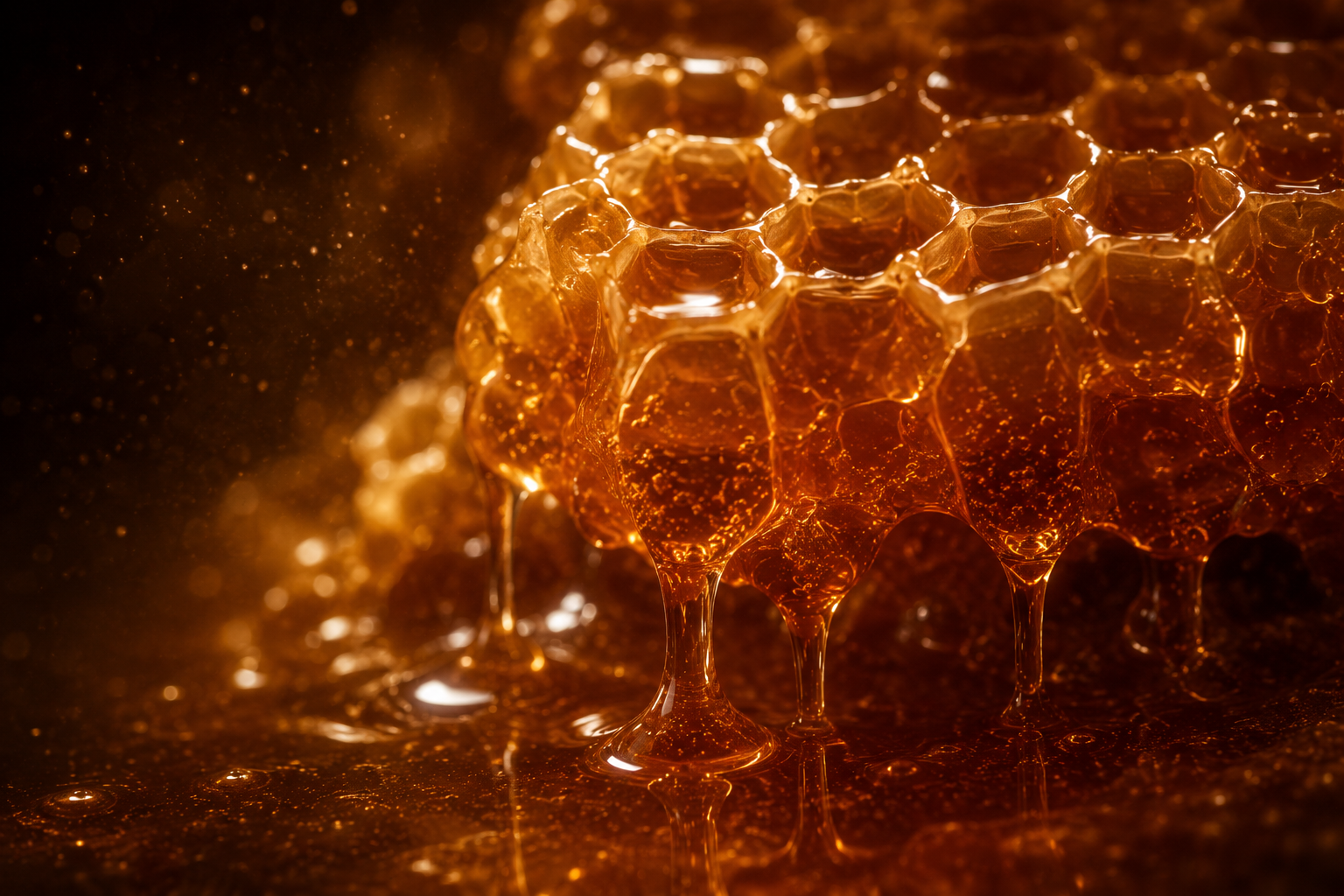
Water Becomes Less Available
Concentrated sugars reduce water activity, limiting the biologically available water needed by many microorganisms for growth and reproduction.

MICROBA — DORMANCY
PERSPECTIVE 01 OF 04
A restrictive environment can preserve life by limiting activity.
Mature honey combines high sugar concentration, low available water, acidity and other antimicrobial factors. For many microorganisms these conditions sharply constrain growth, while some viable cells or resistant forms may persist in a low-activity state.
ENTER THE PROTECTED INTERVALOBSERVATION
The honeycomb environment has changed since TRANSITION. Once honey is concentrated and mature, its physical and chemical conditions become difficult for unrestricted microbial growth.
Concentrated sugars reduce water activity, limiting the biologically available water needed by many microorganisms for growth and reproduction.
Acidity and other antimicrobial properties create additional environmental stress beyond the osmotic effect of concentrated sugars.
Some microorganisms lose viability, some may persist without active growth, and specialized stress-tolerant forms can respond differently from the majority.
THE PROTECTED INTERVAL
The MICROBA perspective is not defined by visible multiplication. It is defined by what the mature honey environment permits to remain while active growth is strongly restricted.
The mature-honey environment limits the water and chemistry available for ordinary microbial proliferation.
Persistence does not require active multiplication. Viable cells or resistant forms may remain present through the protected interval.
If moisture, temperature or surrounding chemistry changes, the biological possibilities can also change.
SCIENTIFIC DISTINCTION
MICROBA uses “Dormant in Honey” as the stage title because the central pattern is preservation with greatly reduced outward activity. It should not imply that every microorganism in honey enters the same physiological dormancy mechanism.
Different organisms respond differently. Some may die, some remain viable without detectable growth, and osmotolerant yeasts or other adapted organisms can behave differently when moisture and other conditions permit.
STAGE BOUNDARY
DORMANCY remains the low-activity or preserved interval. The page ends before environmental change produces renewed microbial activity associated with the AWAKEN stage.
The defining condition is preservation under strong environmental restriction rather than active microbial growth.
AWAKEN begins when changing conditions allow microbial metabolism and fermentation-related activity to become expressed again.
MICROBA PERSPECTIVE
In MICROBA’s framework, honey shows that continuation does not always look active. A habitat can preserve viable potential precisely because it restricts what can happen immediately.
The lesson is not that all microbes become dormant in exactly the same way. The lesson is that life can remain held through time until environmental conditions change.
What appears still may remain biologically possible.