Nectar Enters the Hive
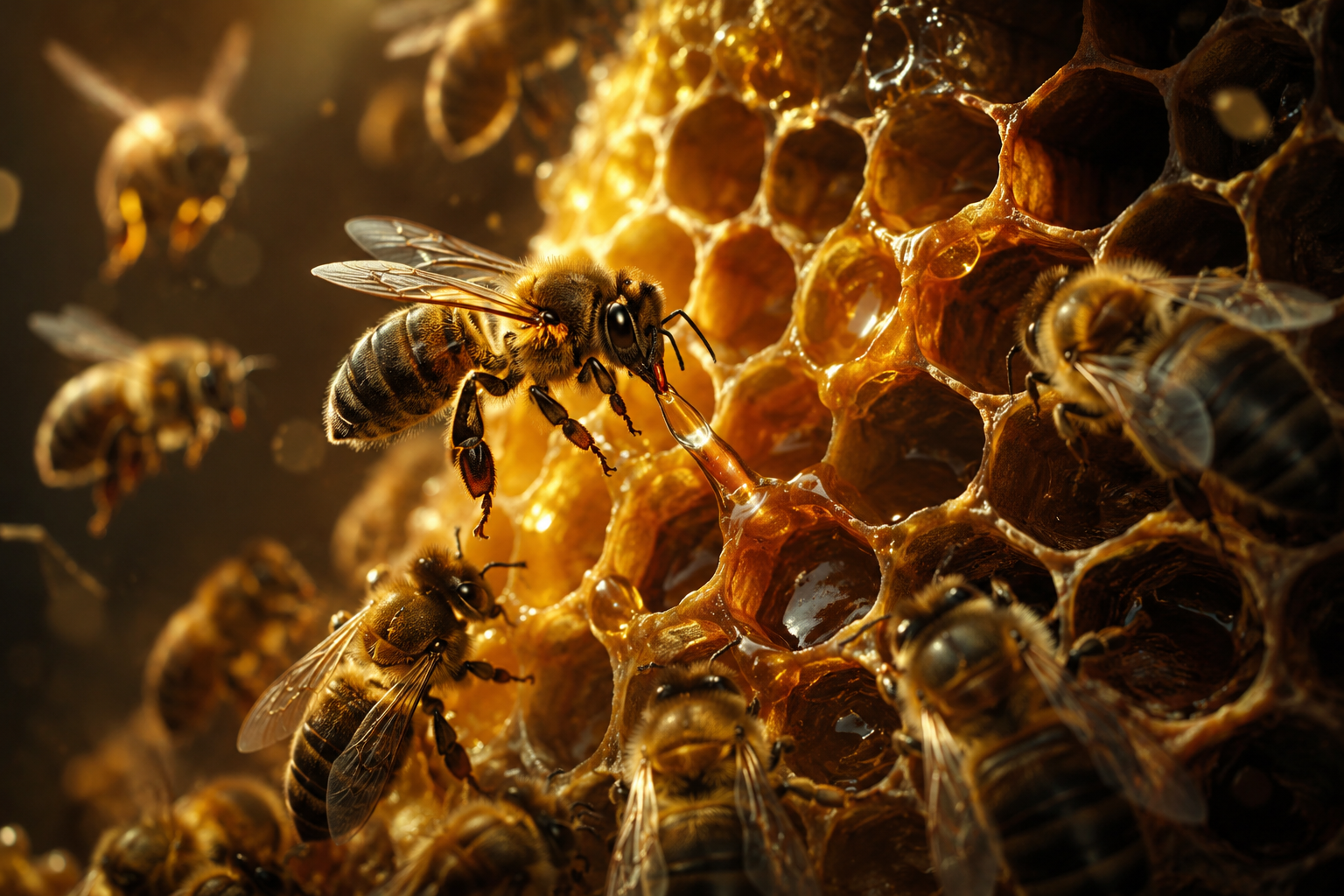
Foraging bees return with nectar. During collection and handling, the material encounters bee-associated, floral and environmental microorganisms.

MICROBA — TRANSITION
PERSPECTIVE 01 OF 04
From bee contact into a new storage environment.
Nectar carried and processed by bees enters the comb together with microorganisms from bee contact, floral sources and the hive environment. The honeycomb is not a copy of the mature bee gut; it is a distinct ecological condition.
OBSERVE THE TRANSITIONOBSERVATION
The transition is not simply movement from one place to another. Collection, repeated bee handling, enzymatic processing, water loss and storage reshape the material and the conditions experienced by microorganisms.
Foraging bees return with nectar. During collection and handling, the material encounters bee-associated, floral and environmental microorganisms.
Repeated handling, enzyme addition and evaporation progressively change sugar concentration, water availability and chemistry before mature honey is formed.
Stored nectar and honey present conditions very different from the bee hindgut, favouring some microorganisms while constraining the activity of many others.
THE TRANSITION
The shared TRANSITION pattern appears here as a transfer into a new material and habitat, followed by progressive environmental change.
Nectar is no longer held only at the flower or in the bee during transport.
Bee handling moves the material into cells where concentration and chemistry continue to change.
The resulting honeycomb environment becomes its own selective microbial habitat.
STAGE BOUNDARY
TRANSITION ends when the material and its associated microbial life have entered the honeycomb environment. The later suppression, persistence or dormancy of microbial activity belongs to the next stage.
The ecological context is changing as nectar is handled, concentrated and stored in comb cells.
The next page examines how the mature honey environment can strongly limit microbial activity while still permitting persistence of some viable forms.
MICROBA PERSPECTIVE
In MICROBA’s living-continuation framework, this page represents movement from one living condition into another. What matters is not that the new condition is identical to the old one, but that it becomes the context for what follows.
The honeycomb therefore represents a transition of relationship: material, organisms and environment are brought together and transformed into a new ecological setting.
Transition is not a copy of origin. It is entry into the condition where the next stage becomes possible.
Scientific boundary: honey and stored nectar may contain microorganisms from multiple bee, floral, hive and environmental sources. They should not be described as a direct copy of the mature worker hindgut microbiota.