A bee can lead us to a flower.
A flower can lead us to a landscape.
A landscape can lead us to soil, water, climate and microbial life.
A human microbiome can lead us to food, medicine, environment, behaviour and time.
The living world refuses to stay inside one category.
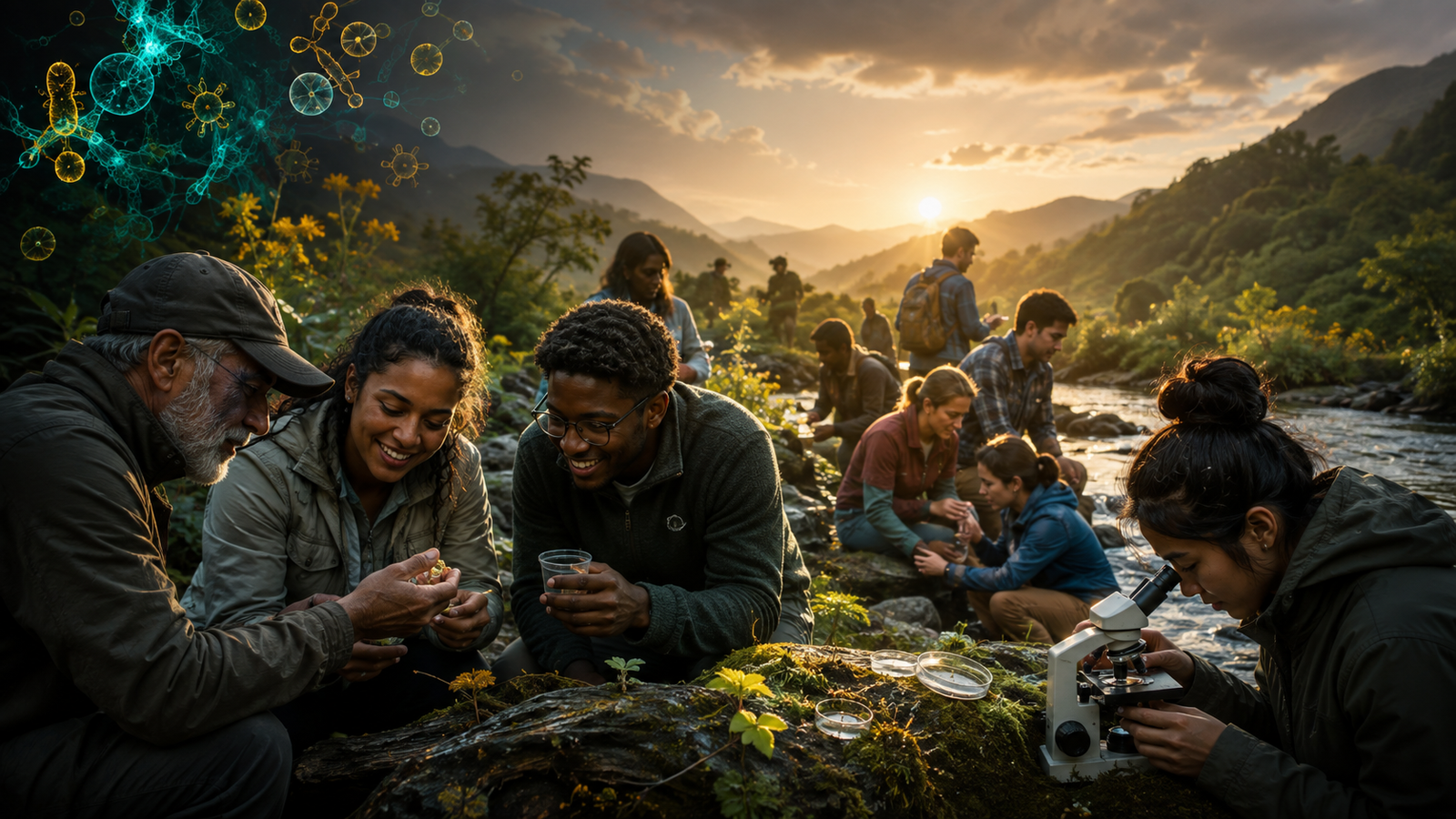
Community allows the connections to continue
One person may arrive through science.
Another through food.
Another through beekeeping, fermentation, ecology, health, photography or simple curiosity.
These are different entry points into the same living reality.
Community becomes useful when those perspectives can meet without being collapsed into one voice.
Different kinds of knowledge should keep their names
A scientific paper is not the same as a personal experience.
A traditional practice is not the same as a controlled experiment.
A hypothesis is not the same as a demonstrated mechanism.
Community does not become stronger by blurring these distinctions.
It becomes stronger when people can place different forms of knowledge beside one another and understand what each contributes.
Questions can travel farther than answers
An answer often belongs to a defined context.
A good question can move between disciplines.
How does habitat shape continuation?
What changes when water becomes available?
How do communities reorganize after disturbance?
What relationships are invisible when we study one organism alone?
These questions can be explored through microbiology, ecology, fermentation, experience and observation.
Community lets the question continue its journey.
Participation should deepen attention
MICROBA does not want participation to mean constant posting or noise.
Participation can be quiet.
Reading an article carefully.
Recording an observation.
Comparing two experiences.
Asking for the source behind a claim.
Returning months later with a new question.
Community is valuable when it increases attention.
Shared discovery needs humility
Living systems are complex.
Even experts work within uncertainty.
A healthy learning community should therefore make room for correction, revision and disagreement.
Changing our mind after better evidence is not failure.
It is part of learning.
What we know
Research on collaborative and citizen observation shows that:
- participation can expand the scale of ecological recording;
- diverse observers can contribute complementary information;
- structured methods improve comparison and validation;
- bias remains possible and should be measured;
- shared data can generate questions for formal research.
What remains uncertain
Community quality depends on culture as much as technology.
A platform can provide tools, but it cannot guarantee curiosity, respect or careful interpretation. Those qualities must be practiced.
MICROBA Perspective
MICROBA Community is not a destination after knowledge.
It is part of how knowledge continues.
Discover something.
Experience it.
Follow the evidence.
Share the question.
Return with new understanding.
We explore the living world together because every living system extends beyond the view of one observer.
References
- MICROBA. Return to Origin. https://microba.co/
- MICROBA. Experience. https://microba.co/experience/
- Piera J, et al. Revealing biases in insect observations: A comparative analysis between academic and citizen science data. 2024. https://pmc.ncbi.nlm.nih.gov/articles/PMC11257294/