
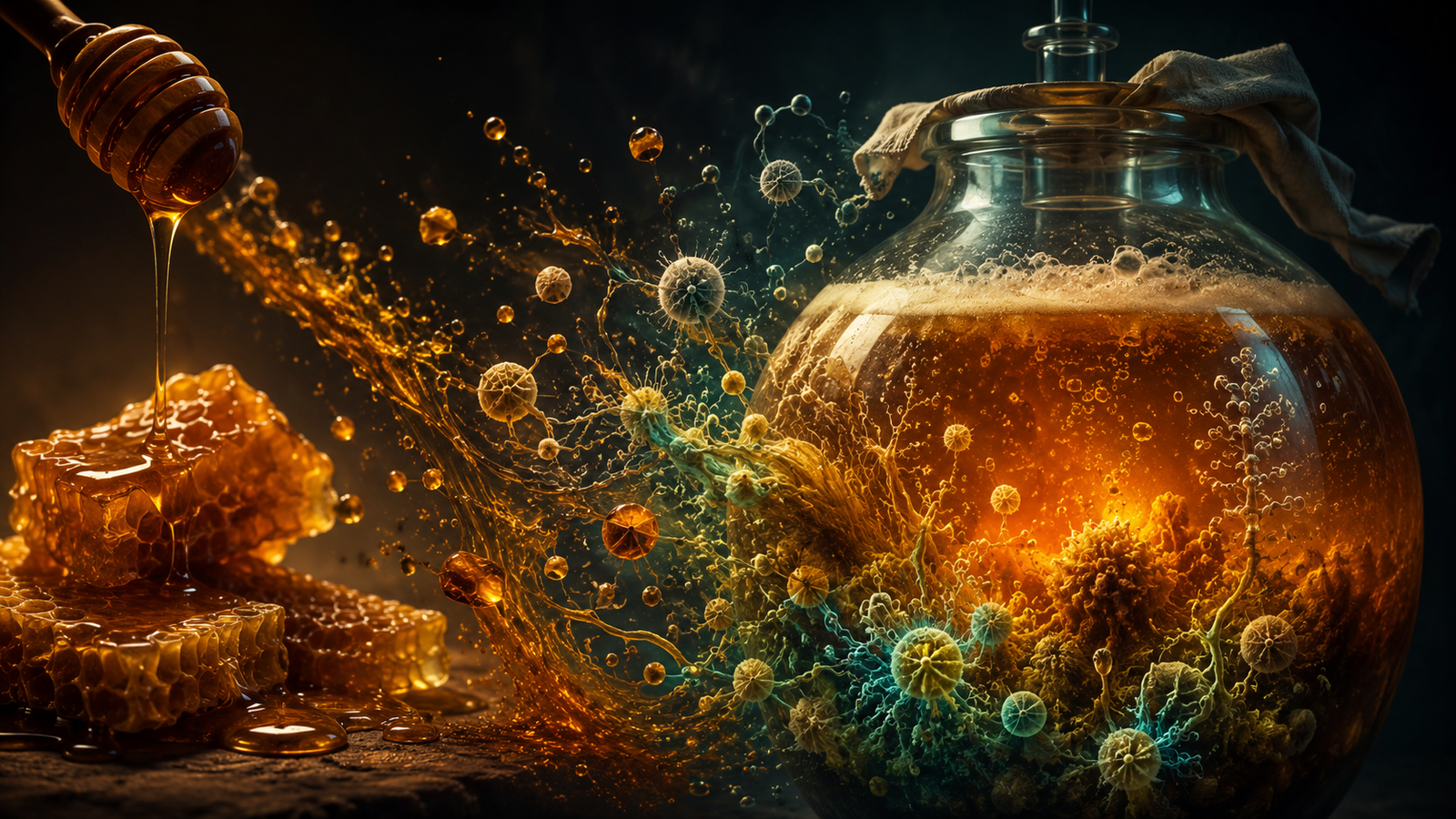
Honey looks still.
Its surface does not reveal the journeys that produced it.
Nectar moved from flower to bee. Bees transformed and concentrated it. Hive conditions shaped storage. Microorganisms arrived through bees, pollen, plants, air and the wider environment.
Honey is a product of relationships before we ever open the container.
Honey contains a microbial history
Studies of raw honey detect bacterial and fungal DNA from a range of sources.
That does not mean honey is a freely growing microbial culture.
Its high sugar concentration, acidity and relatively low water activity restrict the growth of many microorganisms.
This combination makes honey an interesting ecological state: biological material and microbial traces are present, while active growth is constrained.
Changing the habitat changes the possibilities
When the physicochemical environment changes, the microbial possibilities can change too.
Water availability is particularly important. So are temperature, acidity, oxygen, nutrient concentration and the organisms present.
The important lesson is ecological rather than procedural:
the same starting material can behave differently when its habitat changes.
Fermentation makes transformation visible
In a controlled fermentation, microorganisms transform available substrates and generate metabolites.
The material changes because living activity changes the environment.
New acids, gases, aromas or other compounds can appear. Those products then influence what can grow next.
Fermentation is therefore not simply something done to honey.
It is a change in the relationship between material, microorganisms and conditions.
Experience adds a different kind of understanding
Reading about water activity can explain the concept.
Watching a validated fermentation process unfold can make the relationship tangible.
A person can observe that time alone is not enough, that conditions matter, that the material changes and that the sequence has stages.
This is the role of experience within MICROBA: not replacing evidence, but allowing knowledge to be encountered directly.
Safety remains a separate requirement
Microbial transformation is not automatically safe or desirable.
Uncontrolled home fermentation can create food-safety risks. The presence of bubbles, acidity or aroma does not validate a product for consumption.
MICROBA's educational discussion of fermentation should therefore be separated from any specific preparation protocol, which requires appropriate process controls and validation.
What we know
Research supports that:
- raw honey can contain diverse microbial signatures;
- honey's sugar concentration and water activity strongly constrain growth;
- changing water and environmental conditions can alter microbial activity;
- fermentation involves microbial metabolism and environmental feedback;
- community succession can occur as the fermenting habitat changes.
What remains uncertain
The organisms present in one honey sample cannot be assumed to represent every honey.
Microbial composition varies with floral source, geography, processing and physicochemical properties. Detection does not prove activity, and activity does not establish safety.
MICROBA Perspective
For MICROBA, the journey from honey to fermentation is a way of seeing habitat change.
The origin remains present.
But the conditions are different.
Different conditions allow different biological possibilities to emerge.
Experience makes that transition visible.
The material continues, but its living context has changed.
References
- Nguyen HTL, et al. Microbiome analysis of raw honey reveals important factors influencing the bacterial and fungal communities. Frontiers in Microbiology. 2023. https://pmc.ncbi.nlm.nih.gov/articles/PMC9877413/
- Zamora MC, Chirife J. Relationship between Water Activity and Moisture Content in Floral Honey. Foods. 2019. https://pmc.ncbi.nlm.nih.gov/articles/PMC6352288/
- MICROBA. Bee Microbiome. https://microba.co/bee-microbiome/
- MICROBA. Experience. https://microba.co/experience/