
Experience is personal.
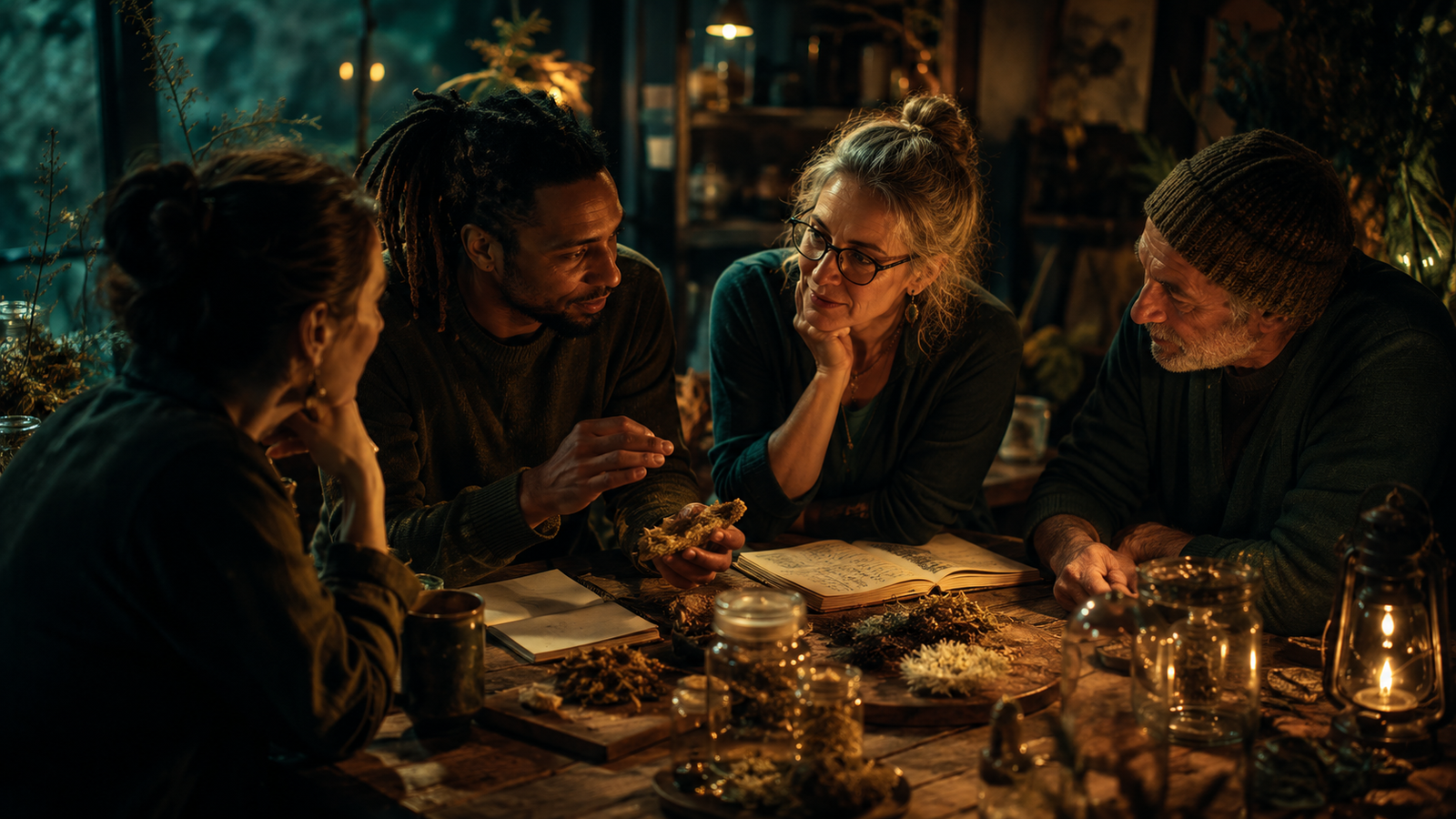
What one person notices depends on where they are, what they know, what they expect and what happened before.
That individuality gives experience richness.
It also gives experience limits.
Sharing can expand what becomes visible.
Different observers see different parts
One person may notice timing.
Another notices smell, weather, insects, texture or a repeated environmental pattern.
A third may recognize something familiar from another location.
When these observations are shared, they can reveal questions that did not exist in any one account.
Community widens the field of view.
Shared does not automatically mean scientific
Ten people repeating the same belief does not make the belief true.
A collection of stories can contain selection bias, memory errors and common expectations.
This is why MICROBA distinguishes shared experience from scientific evidence.
The value of sharing is not that every story becomes proof.
The value is that patterns can be noticed, compared and, when appropriate, tested.
Structure makes comparison possible
Shared observation becomes more useful when context is recorded.
Where did it happen?
When?
Under what conditions?
What exactly was observed?
What changed?
Was the observation repeated?
Citizen-science projects show how structured participation can produce biodiversity records at scales that would be difficult for professional researchers alone to achieve.
They also show that participation patterns and reporting biases must be evaluated.
Community can generate better questions
The strongest outcome of shared experience may be a better research question.
If observers in different places report the same pattern, we can ask whether a common mechanism exists.
If observations disagree, the disagreement may reveal an important environmental variable.
Difference becomes information.
Learning is reciprocal
Community learning is not only the flow of information from expert to participant.
Researchers can learn what people repeatedly encounter. Participants can learn how evidence is evaluated. Local knowledge can reveal context that a remote dataset misses.
The exchange becomes most useful when each form of knowledge keeps its identity and limitations.
What we know
Research on participatory observation supports that:
- distributed observers can collect information across large areas and times;
- structured recording improves comparability;
- community data can complement professional research;
- participation can introduce spatial and taxonomic biases;
- validation and transparent methods improve usefulness.
What remains uncertain
Shared experience varies enormously in quality.
A platform with clear protocols and verification is different from an informal collection of anecdotes. Community observations should therefore be interpreted according to how they were recorded and checked.
MICROBA Perspective
MICROBA wants community to create curiosity, not certainty by repetition.
Share what you observed.
Keep the context.
Listen for differences.
Ask what should be tested next.
Shared experience becomes knowledge when it helps us see more clearly and ask better questions together.
References
- MICROBA. Experience. https://microba.co/experience/
- MICROBA. Return to Origin. https://microba.co/
- Piera J, et al. Revealing biases in insect observations: A comparative analysis between academic and citizen science data. 2024. https://pmc.ncbi.nlm.nih.gov/articles/PMC11257294/