

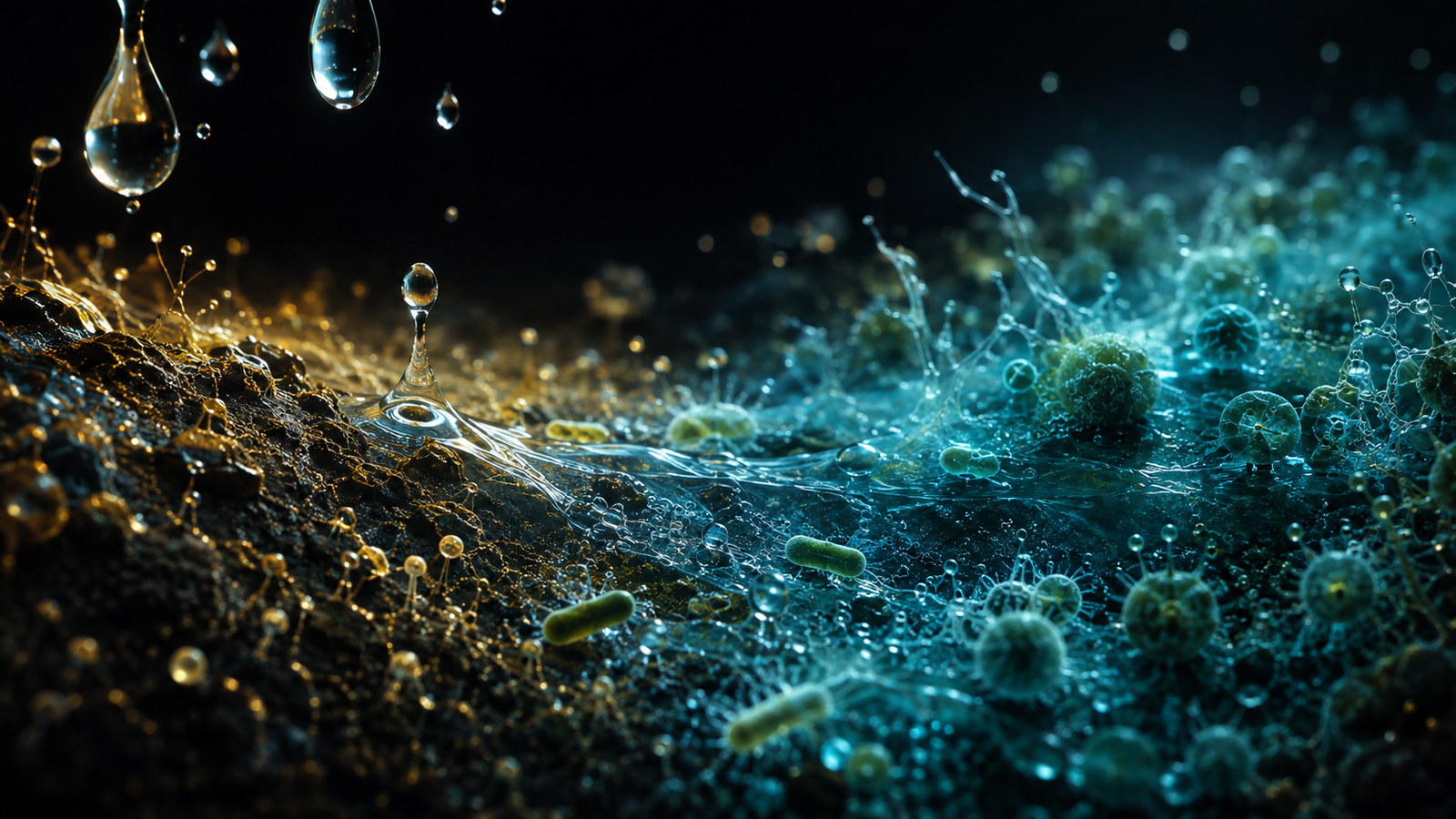
Water makes biological movement possible.
Molecules dissolve and diffuse. Enzymes encounter substrates. Cells maintain internal chemistry. Nutrients move toward microorganisms and metabolic products move away.
But the presence of water is not a simple yes-or-no condition.
Moisture and water activity are different
A food can contain water while making much of that water difficult for microorganisms to use.
Microbiologists describe this using water activity, commonly written as aw.
Water activity reflects the thermodynamic availability of water rather than the total amount of moisture in a material.
Sugars, salts, proteins and the physical structure of a food can all influence it.
This distinction is central to understanding why some concentrated foods resist microbial growth even though they are not completely dry.
Honey is a useful example
Raw honey contains microorganisms from bees, flowers, pollen, dust and the wider environment.
Yet honey is also highly concentrated in sugars and usually has relatively low water activity.
Those conditions limit active growth for many organisms.
Studies of honey show relationships among moisture, water activity and fermentation risk, while microbiome studies show that microbial DNA can still be detected across honey types.
Presence and active growth are therefore different questions.
Adding water changes more than concentration
When water availability increases, diffusion and microbial physiology can change.
Osmotic stress may decrease. Previously inaccessible substrates may become more available. Enzymatic reactions may proceed differently. Organisms that could persist but not grow may gain new possibilities.
The community can reorganize because the habitat has changed.
This does not mean that all microorganisms respond in the same direction.
Different species have different water-activity limits and stress responses.
Water interacts with other conditions
Temperature, acidity, salt, sugar concentration and oxygen remain important.
A microorganism near its minimum water-activity limit may be further constrained by low temperature or low pH. Conversely, a favourable temperature cannot compensate indefinitely for insufficient available water.
Microbial growth therefore depends on combined conditions.
Single variables should be interpreted within the whole environment.
Water can restart ecosystem activity
Outside food systems, rewetting experiments show how strongly microbial activity can respond to moisture.
Dry soils can contain large reservoirs of low-activity organisms. Rewetting can rapidly change which organisms are metabolically active and can produce measurable pulses of carbon and nitrogen cycling.
Water changes the ecological state of the system.
What we know
Research supports that:
- water activity is a major control on microbial growth;
- total moisture and water availability are not identical measurements;
- sugar and salt concentrations can reduce available water;
- honey combines microbial presence with physicochemical conditions that limit growth of many organisms;
- changes in water availability can reorganize microbial activity.
What remains uncertain
Water activity alone cannot predict every microbial outcome.
Food structure, nutrient composition, temperature, pH, preservatives and strain-level differences also matter. Some microorganisms can survive under conditions in which they cannot multiply.
For this reason, water activity is one part of food-safety and fermentation control, not a standalone guarantee.
MICROBA Perspective
Water is one of the clearest examples of how a small environmental change can alter living possibility.
The organism may be the same.
The habitat may look almost the same.
But when water becomes biologically available, relationships, movement and metabolism can change.
Water does not simply fill a habitat. It changes what the habitat can support.
References
- Nguyen HTL, et al. Microbiome analysis of raw honey reveals important factors influencing the bacterial and fungal communities. Frontiers in Microbiology. 2023. https://pmc.ncbi.nlm.nih.gov/articles/PMC9877413/
- Zamora MC, Chirife J. Relationship between Water Activity and Moisture Content in Floral Honey. Foods. 2019. https://pmc.ncbi.nlm.nih.gov/articles/PMC6352288/
- Leong SL, et al. Single-Cell Growth Probability of Listeria monocytogenes at Suboptimal Temperature, pH, and Water Activity. Applied and Environmental Microbiology. 2012. https://pmc.ncbi.nlm.nih.gov/articles/PMC3334821/
- Aanderud ZT, et al. Resuscitation of the rare biosphere contributes to pulses of ecosystem activity. Frontiers in Microbiology. 2015. https://pmc.ncbi.nlm.nih.gov/articles/PMC4311709/