

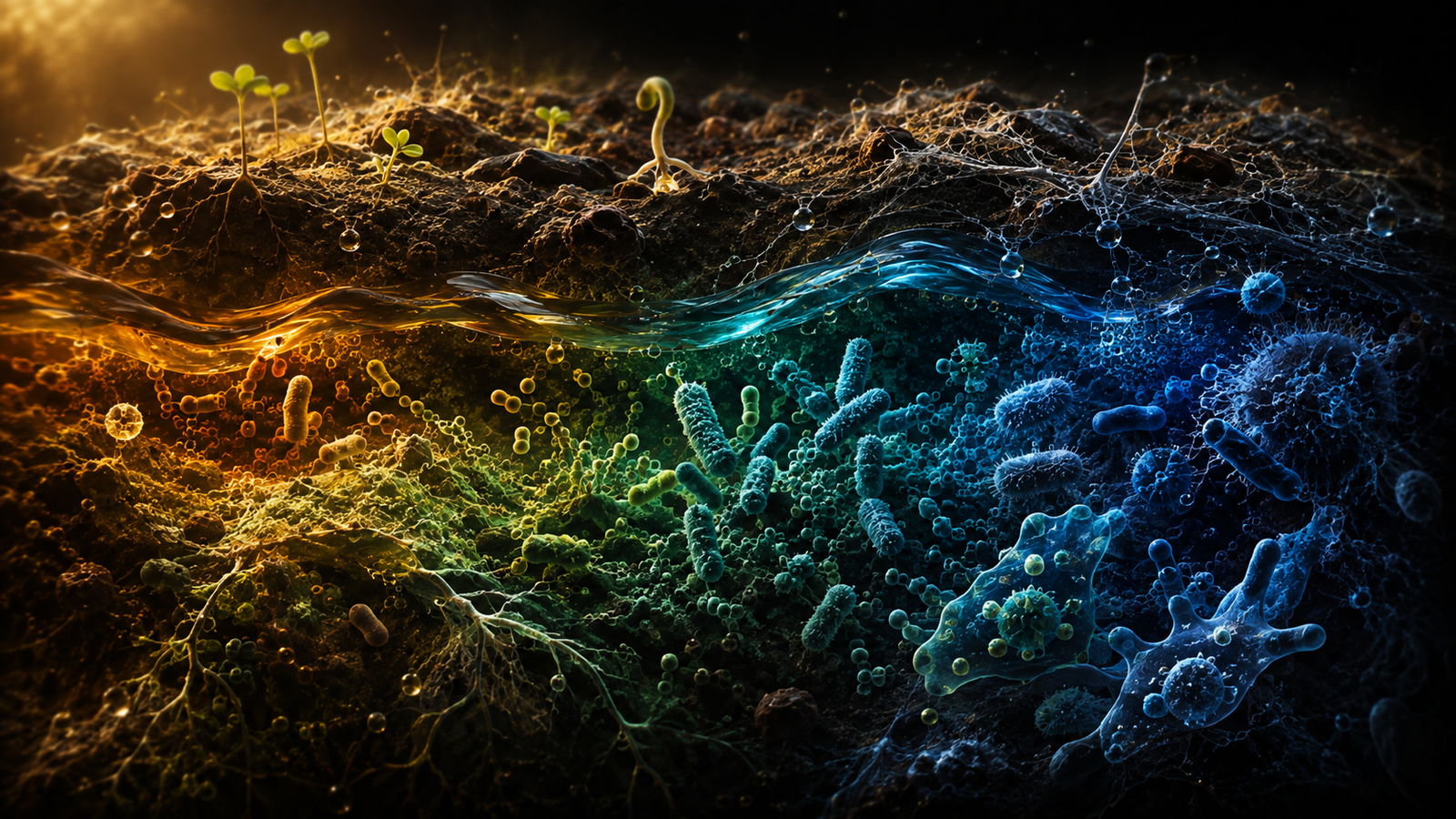
A living system can look stable.
A forest remains a forest from one day to the next. A human body remains recognizable. A fermentation remains in the same vessel. A microbial community can appear to have a characteristic structure.
Yet beneath that continuity, change is constant.
Stability is dynamic
Cells divide and die.
Molecules enter and leave.
Microorganisms rise and fall in abundance. Diet changes. Temperature changes. Hosts age. New organisms arrive. Others disappear below detection.
Stability in living systems is therefore not the same as stillness.
It can mean that important functions, relationships or broad patterns are maintained while individual components fluctuate.
Disturbance reveals resilience
Researchers often learn about living systems by observing what happens after disturbance.
Longitudinal studies of the human gut microbiome show that communities can change substantially after perturbation and then recover to varying degrees. Recovery is not always exact, and different individuals can respond differently.
This is one way ecologists think about resilience: the capacity of a system to absorb disturbance and reorganize while retaining important aspects of its identity or function.
Resilience does not mean nothing changed.
It means continuation occurred through change.
Succession is organized change
Fermentation offers another visible example.
At the beginning of a spontaneous fermentation, one set of organisms may be abundant. As acids, gases, metabolites and available nutrients change, other organisms can become more competitive.
The community therefore moves through a succession.
Time matters, but the change is not driven by a clock alone. It is driven by organisms altering the conditions experienced by those that come next.
Change can be reversible or irreversible
Some disturbances are temporary.
Others push a system into a different state.
A microbial community can recover some features while losing others. A habitat can cross a threshold after which the previous community no longer re-establishes easily.
This is why one snapshot is not enough to understand resilience.
We need trajectories.
Individuality matters
Two similar systems may not respond identically to the same change.
History, strain composition, host biology, initial abundance and environmental context can all influence recovery.
Variation is not always experimental noise.
Sometimes it is part of the biology we are trying to understand.
What we know
Research supports that:
- microbial communities vary over time;
- disturbances can cause large but sometimes temporary changes;
- recovery trajectories can differ among individuals and systems;
- succession is common in developing and fermenting microbial communities;
- resilience can involve reorganization rather than exact return.
What remains uncertain
It is often difficult to define which level of a living system should count as "the same" after change.
Taxonomic composition may shift while some functions remain. A community may look recovered at one scale and altered at another. Long-term consequences may take longer than a study period to appear.
This makes resilience a question that must be defined carefully.
MICROBA Perspective
MICROBA does not treat change as the opposite of continuation.
Change is often how continuation happens.
Living systems persist by responding, reorganizing and entering new stages.
The important question becomes:
What is changing, what is being preserved, and what relationships allow the next stage to emerge?
References
- Gibbons SM, et al. Multidomain analyses of a longitudinal human microbiome intestinal cleanout perturbation experiment. PLoS Computational Biology. 2017. https://pmc.ncbi.nlm.nih.gov/articles/PMC5576755/
- Relman DA. The human microbiome: ecosystem resilience and health. Nutrition Reviews. 2012. https://pmc.ncbi.nlm.nih.gov/articles/PMC3422777/
- Wang X, et al. Unraveling microbial community diversity and succession of Chinese Sichuan sausages during spontaneous fermentation. Journal of Food Science and Technology. 2019. https://pmc.ncbi.nlm.nih.gov/articles/PMC6582033/
- Liu Y, et al. Temperature-Induced Annual Variation in Microbial Community Changes and Resulting Metabolome Shifts in a Controlled Fermentation System. mSystems. 2020. https://pmc.ncbi.nlm.nih.gov/articles/PMC7566281/