
Scientific isolation is powerful.
A microorganism can be grown in pure culture. A gene can be studied individually. A chemical reaction can be measured under controlled conditions.
These approaches allow researchers to identify mechanisms that would be difficult to see inside a complex natural system.
But living systems are more than isolated mechanisms.
Reduction reveals capability
When a microorganism is studied alone, researchers can ask precise questions.
Which substrates can it use?
Which genes are required for a pathway?
How does it respond to temperature or pH?
What compounds can it produce?
This is essential knowledge.
It tells us what the organism can do under defined conditions.
Reconnection reveals ecology
The next question is different:
What happens when the organism returns to a community?
A metabolic product may be consumed immediately by a neighbour. A nutrient may become limiting because another species competes for it. A host cell may change gene expression in response to microbial molecules. A surface may create a biofilm structure that alters oxygen diffusion.
The mechanism still matters.
But its consequences now depend on relationship.
Community properties can emerge
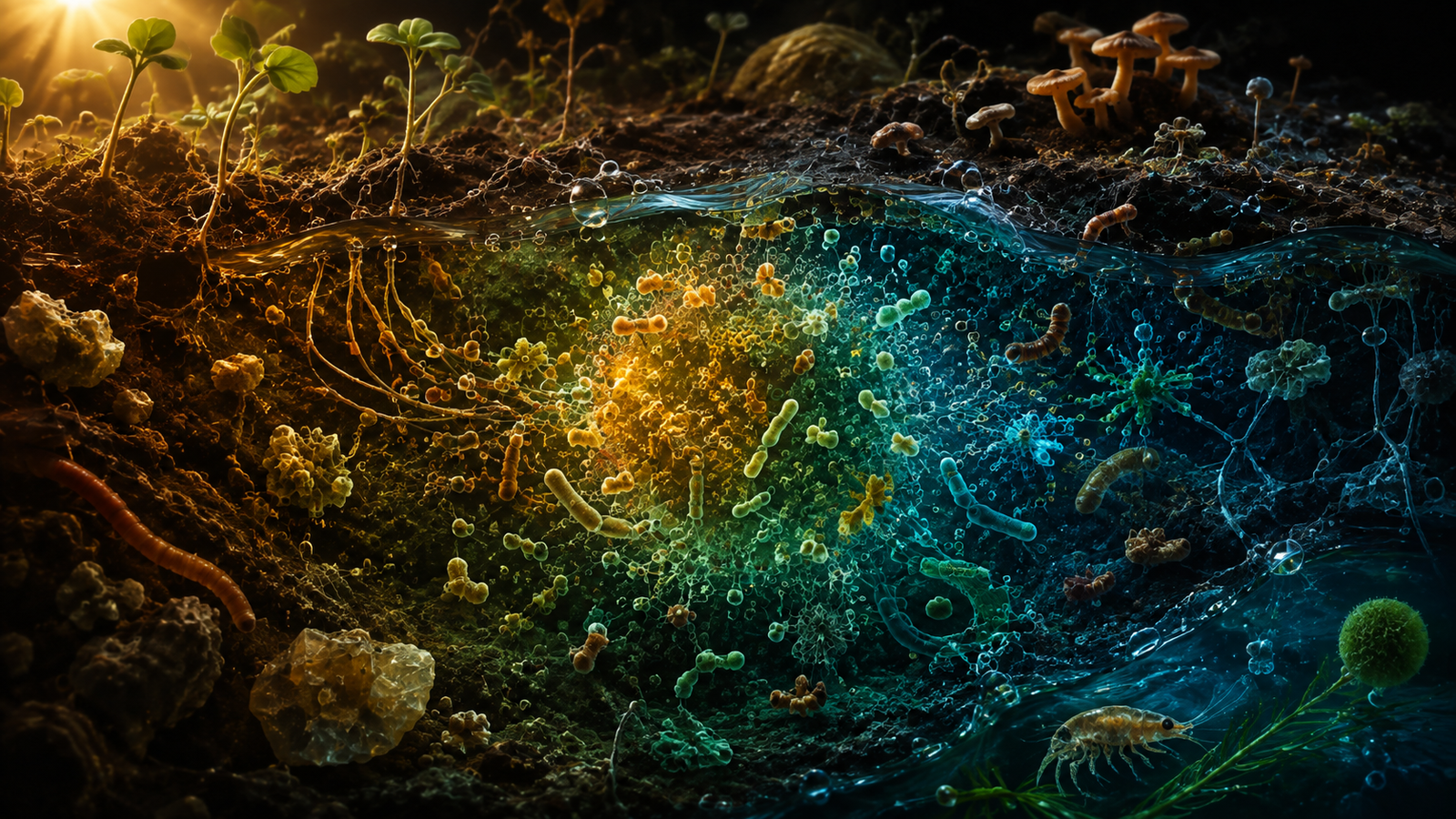
Mixed microbial communities can show properties that are not obvious from monocultures.
Cross-feeding can create metabolic chains. Competition can stabilize or destabilize abundance. Spatial organization can allow organisms with different requirements to occupy neighbouring micro-sites.
In multispecies biofilms, researchers have observed community-level biomass and spatial patterns associated with both cooperative and competitive interactions.
These are not arguments against reductionism.
They are arguments for completing it.
Hosts add another layer
Human and animal microbiomes include microbial cells, host tissues, immune systems, diet, physical structures and environmental exposures.
A microorganism identified in a sequencing result is therefore one component within a larger system.
Its meaning can depend on body site, abundance, strain, host state and community context.
This is why microbiome interpretation becomes misleading when a single organism is treated as a complete explanation.
The environment is part of the system
Living systems exchange materials with their surroundings.
Water, gases, nutrients, temperature and physical boundaries affect what organisms can do. The organisms then alter those conditions.
Separating the system from its environment may be useful experimentally, but it should not make us forget that the boundary is biologically active.
What we know
Research supports that:
- isolated studies can reveal microbial capabilities and mechanisms;
- microbial interactions can change growth and metabolism;
- community properties can emerge from multiple species living together;
- spatial organization can influence interaction;
- host and environmental context can alter the meaning of microbial observations.
What remains uncertain
No experiment can reproduce every aspect of a natural system.
Simplified communities improve control but remove complexity. Natural observations preserve complexity but make causal interpretation harder.
The strongest understanding often comes from moving between scales: mechanism, community, host and environment.
MICROBA Perspective
MICROBA values isolation as a scientific tool.
We simply do not confuse the isolated part with the whole living reality.
To understand capability, isolate.
To understand relationship, reconnect.
To understand continuation, watch what happens through time.
A living system becomes visible when the parts are returned to the relationships that make their activity meaningful.
References
- Seth EC, Taga ME. Nutrient cross-feeding in the microbial world. Frontiers in Microbiology. 2014. https://pmc.ncbi.nlm.nih.gov/articles/PMC4086397/
- Fritts RK, McCully AL, McKinlay JB. Extracellular Metabolism Sets the Table for Microbial Cross-Feeding. Microbiology and Molecular Biology Reviews. 2021. https://pmc.ncbi.nlm.nih.gov/articles/PMC7849352/
- Liu W, et al. Deciphering links between bacterial interactions and spatial organization in multispecies biofilms. ISME Journal. 2019. https://pmc.ncbi.nlm.nih.gov/articles/PMC6864094/
- MICROBA. Human Microbiome - The Living Ecosystem Within. https://microba.co/human-microbiome/