
A microbiome is often described as a list of microorganisms.
But a list can hide something important.
Where an organism lives matters.
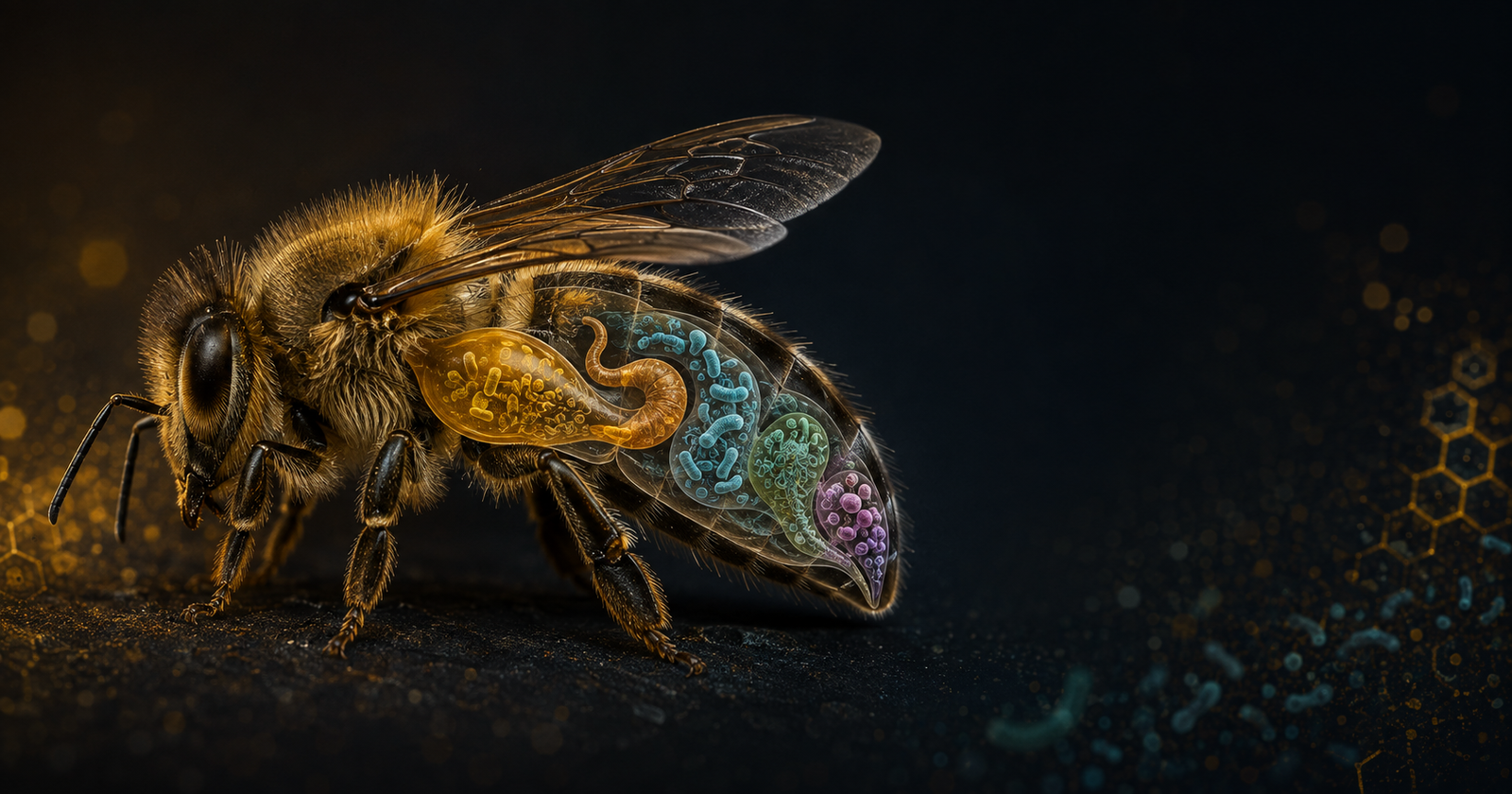
Inside an adult honey bee, the crop, midgut, ileum and rectum differ in structure, chemistry, oxygen availability and available nutrients. Studies examining these compartments have shown that microbial communities are not distributed evenly along the digestive tract.
The bee gut is therefore better understood not as one microbial container, but as a sequence of connected habitats.
One bee. Different environments.
Early work mapping characteristic honey bee gut bacteria showed that most of the abundant core community is concentrated in the hindgut. In adult workers, the ileum and rectum together contained the great majority of the characteristic bacterial community examined, while the crop and midgut contained far fewer of those bacteria.
Later research examining bacteria and fungi along the digestive tract reinforced this spatial picture. Different gut compartments contain different microbial abundances and community structures, alongside changes in physicochemical conditions such as oxygen, pH and redox potential.
This means that asking:
Which bacteria are present in a bee?
is only the beginning.
We also need to ask:
Where are they present?
The ileum is not the rectum
Some of the best-known members of the honey bee microbiome show strong spatial organization.
Snodgrassella and Gilliamella are particularly associated with the ileum, where dense microbial communities can form along the gut wall. Other characteristic groups, including bee-associated lactobacilli and Bifidobacterium, are especially abundant in the rectum.
These distributions are not simply decorative patterns.
Different locations offer different resources and constraints. Oxygen availability, acidity, host tissue, food residues and metabolites produced by neighbouring microorganisms can all influence which organisms are able to establish themselves and how they behave.
The habitat helps shape the community.
And the community, through its metabolism and interactions, may in turn help shape the local environment.
Identity alone is not enough
Knowing that a microorganism belongs to a particular species does not automatically tell us what it is doing at a particular moment.
Function depends on context.
A microorganism's activity can be influenced by:
- where it is located;
- what nutrients are available;
- oxygen and other chemical conditions;
- neighbouring microorganisms;
- the physiological state of the host;
- age, diet and environmental exposure.
Research on honey bee microbiomes also shows that environmental or less abundant organisms may occur alongside the characteristic core community, and that their distribution can differ among gut compartments and conditions.
This is one reason microbiome science increasingly needs ecological thinking.
The organism matters.
The habitat matters too.
A community with structure
The adult honey bee microbiome is comparatively specialized, with a recurring set of characteristic bacterial lineages. But even within this relatively compact community, there is spatial organization, strain diversity and functional differentiation.
The simplicity of the bee microbiome therefore does not mean that the system itself is simple.
It gives researchers an unusually clear opportunity to investigate a deeper question:
How do hosts, microorganisms and habitats organize themselves into a functioning living system?
That is one reason bees have become valuable models for studying host-microbe relationships.
What we know
Evidence supports several broad observations:
- characteristic honey bee gut microorganisms are spatially organized;
- the hindgut contains the densest populations of many core bacteria;
- the ileum and rectum support distinct microbial communities;
- physical and chemical conditions differ along the digestive tract;
- microorganisms do not encounter one uniform environment inside the bee.
What remains uncertain
Knowing where microorganisms occur does not resolve every question about what they do.
Microbial function can vary between strains and conditions, and the consequences of particular community changes for whole-colony health are still active areas of investigation. Researchers continue to study how diet, season, geography, host genetics, environmental stress and microbial interactions influence bee microbiomes.
The map is becoming clearer.
The relationships are still being explored.
MICROBA Perspective
MICROBA views the honey bee gut as a useful reminder that life happens in place.
A microorganism does not exist independently of its surroundings.
Its possibilities emerge within a habitat through nutrients, neighbouring organisms, the host and the conditions around it.
To understand the microorganism, we therefore return to the environment that makes its life possible.
Identity tells us who is there. Habitat helps us understand what can happen.
References
- Martinson VG, Moy J, Moran NA. Establishment of Characteristic Gut Bacteria during Development of the Honeybee Worker. Applied and Environmental Microbiology. 2012. PMC
- Callegari M, et al. Compartmentalization of bacterial and fungal microbiomes in the gut of adult honeybees. npj Biofilms and Microbiomes. 2021. PMC
- Kwong WK, Moran NA. Genomics of the honey bee microbiome. Current Opinion in Insect Science. 2015. PMC
- Engel P, et al. The bee microbiome: impact on bee health and model for evolution and ecology of host-microbe interactions. mBio. 2016. USGS