

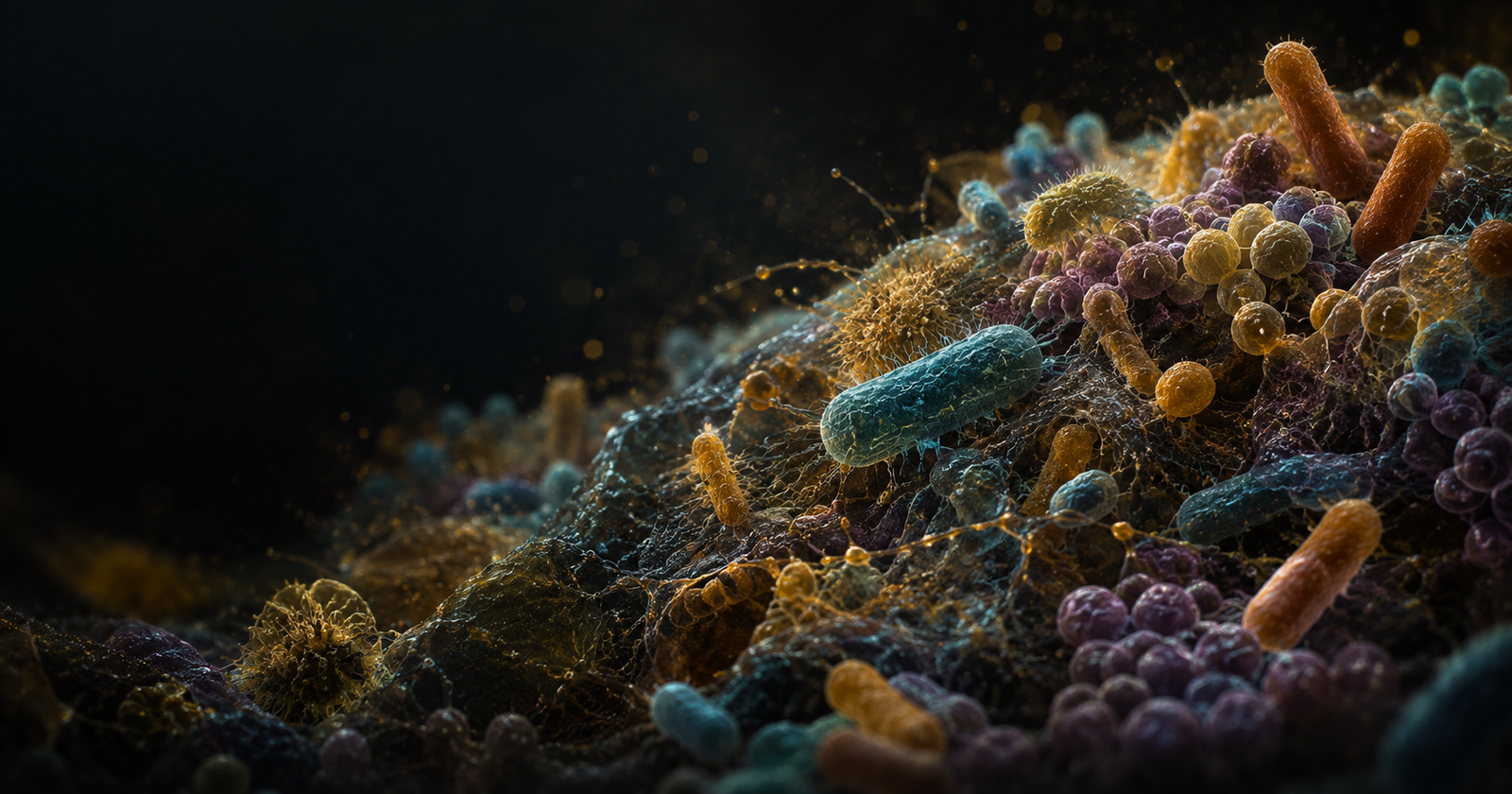
A laboratory can isolate a microorganism.
Nature rarely does.
Microorganisms commonly inhabit environments alongside other microorganisms, host cells, nutrients, surfaces and changing physical conditions.
Within these communities, one organism may consume a resource produced by another.
Two organisms may compete for the same nutrient.
One may change the acidity or oxygen concentration of its surroundings.
Another may produce compounds that inhibit neighbours.
Microorganisms can communicate, attach to surfaces, organize into biofilms and participate in metabolic networks.
The behaviour of the community therefore cannot always be predicted simply by studying each member alone.
A community creates new possibilities
Consider metabolism.
One microorganism transforms a molecule and releases a product.
For that organism, the product may be waste.
For another organism, it may be food.
This kind of metabolic exchange is known as cross-feeding and occurs in many microbial systems. It can link organisms together through chains of resource production and consumption.
Cross-feeding is only one relationship among many.
Microbial communities can also involve:
- competition for nutrients;
- competition for physical space;
- chemical inhibition;
- cooperative metabolism;
- signalling;
- biofilm formation;
- modification of the surrounding habitat.
These interactions can affect community structure and function.
Relationship does not always mean cooperation
It is tempting to describe microbial communities as harmonious collaborations.
That would be too simple.
Microorganisms can cooperate.
They can also compete.
A relationship may benefit one organism while disadvantaging another. Its outcome may even change when the environment changes or when a third organism enters the community.
Living together does not mean living without conflict.
It means that organisms influence one another.
Space changes the relationship
Microbial communities are also spatial.
Who lives next to whom can matter.
Spatial studies of microbial communities show that community organization can have structure even at very small scales.
Biofilms provide another clear example.
Cells growing together on a surface encounter gradients of nutrients, oxygen and metabolic products. Different species may occupy different positions, exchange molecules or alter the local conditions experienced by their neighbours.
The community exists not only because its members are present.
It exists because they are present in relationship and in space.
The environment participates too
Microbial relationships are never completely separate from their habitat.
Temperature, moisture, acidity, oxygen, nutrients, host physiology and physical structure can all change which interactions are possible.
The same two microorganisms may behave differently under different environmental conditions.
This is why microbial ecology cannot be reduced to a list of species plus a list of interactions.
The environment is part of the system.
Why isolation is still useful
None of this makes laboratory isolation unimportant.
Studying microorganisms individually allows researchers to investigate:
- metabolism;
- genetics;
- growth requirements;
- physiology;
- sensitivity to environmental conditions;
- potential mechanisms.
Isolation helps us understand the parts.
Community studies help us understand what happens when those parts meet.
Both views are necessary.
What we know
Microbial ecology has established that:
- microorganisms can exchange metabolites;
- microorganisms compete for resources and space;
- community members can alter one another's growth and activity;
- spatial organization can influence community behaviour;
- biofilms can show properties that emerge from interactions among their members.
What remains uncertain
Microbial communities are complex enough that knowing which organisms are present does not automatically reveal every interaction between them.
Relationships can be context-dependent and may change through time.
Observations of co-occurrence also do not by themselves prove direct biological interaction.
Researchers therefore combine cultivation, microscopy, genomics, metabolomics, experimental communities and computational approaches to investigate how microbial relationships actually work.
The closer we look, the more important context becomes.
MICROBA Perspective
MICROBA begins with a simple observation:
Nothing living exists alone.
For microorganisms, this is not merely philosophy.
It is ecology.
Life unfolds through contact with nutrients, neighbouring organisms, hosts, surfaces, water, gases and changing conditions.
To isolate something can help us understand its capabilities.
To return it to relationship helps us understand its life.
The organism is real. The community is real. The relationship between them is where the living system emerges.
References
- Morris BEL, Henneberger R, Huber H, Moissl-Eichinger C. Microbial syntrophy: interaction for the common good. FEMS Microbiology Reviews.
- Seth EC, Taga ME. Nutrient cross-feeding in the microbial world. Frontiers in Microbiology. 2014. PMC
- Fritts RK, McCully AL, McKinlay JB. Extracellular Metabolism Sets the Table for Microbial Cross-Feeding. Microbiology and Molecular Biology Reviews. 2021. PMC
- Microbial interaction research overview. PMC
- Recent micron-scale mapping of human gut community structure. Nature Microbiology