
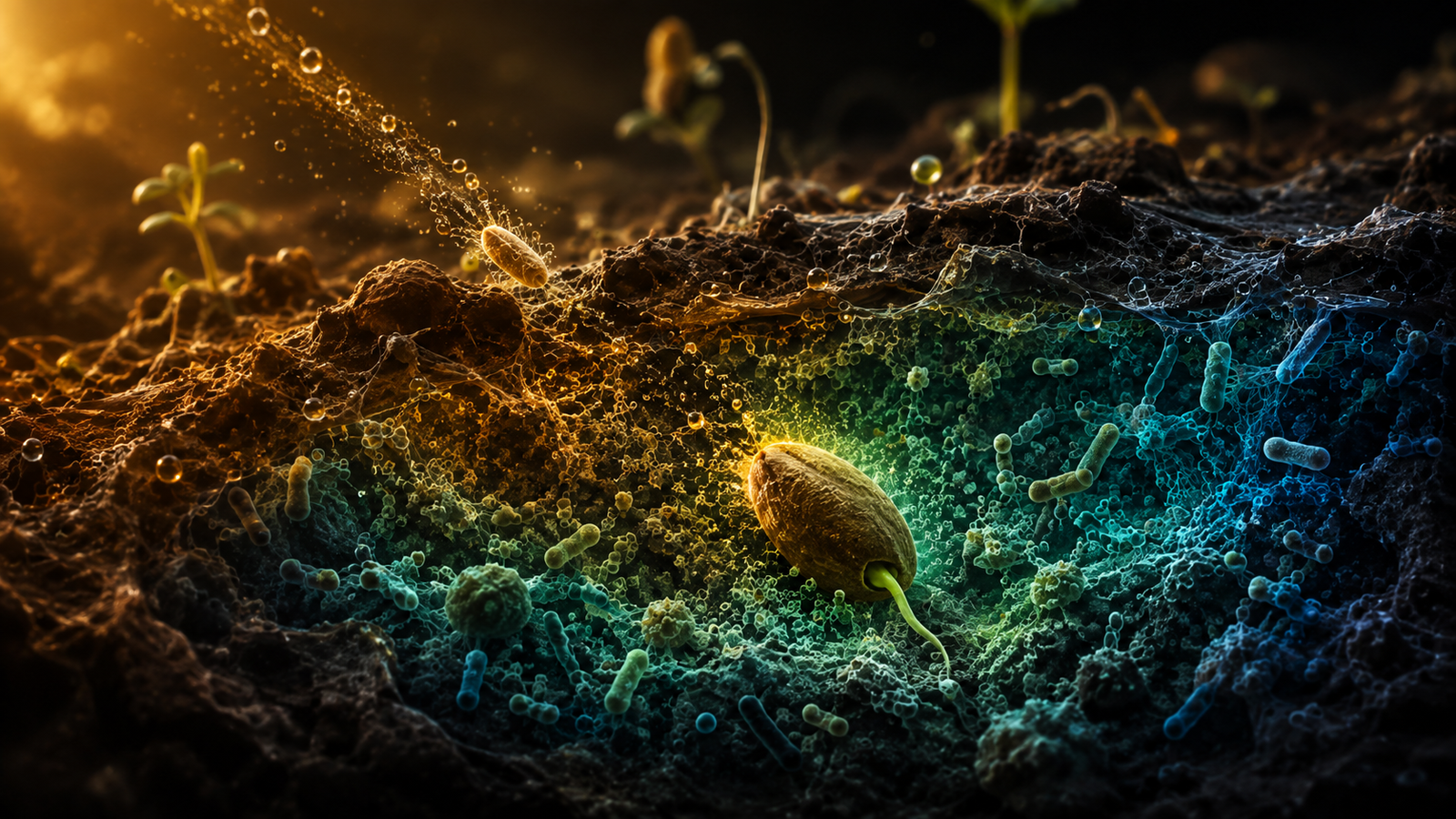
A seed can remain a seed for a long time.
It can carry the biological potential to germinate, grow and reproduce.
But potential is not continuation.
Continuation begins when the seed encounters conditions in which life can proceed.
This is the relationship between life and habitat.
Potential needs conditions
Living organisms contain capabilities shaped by genetics and previous history.
Those capabilities are real.
But whether they are expressed depends on the environment.
A microorganism may survive a dry period with very low metabolic activity and become active again when moisture and other suitable conditions return. A microbial community introduced into a new environment may establish, fail to establish or reorganize depending on resources, chemistry, temperature and neighbouring organisms.
The organism carries possibility.
The habitat determines which possibilities can become active.
Establishment is more than arrival
To arrive somewhere is not the same as establishing there.
A microorganism can pass through a habitat without growing. A seed can land on a surface that cannot support germination. A species can enter a community but fail to persist.
Continuation requires more than presence.
It requires a workable relationship between organism and environment.
Habitats are not passive containers
The phrase "suitable habitat" can sound static.
In reality, habitats change.
Organisms also modify them.
Microbes consume nutrients and oxygen. Plants alter soil and shade. Animals move materials. Communities create structure. Fermenting microorganisms generate acids and metabolites that change which organisms can grow later.
A habitat can therefore be both condition and consequence.
Life settles into conditions, then changes those conditions as it continues.
Return does not mean going backwards
Within MICROBA, Return to Origin is not a command to reproduce the past.
It is a question about conditions.
What is the habitat in which this living process belongs?
What relationships sustain it?
What must be restored, protected or recreated for continuation to become possible again?
The origin is meaningful because it contains the relationships from which life became possible.
What we know
Ecology and microbiology show that:
- environmental conditions influence whether organisms can grow or remain inactive;
- habitat filters which organisms can establish;
- microbial communities can modify their own local environment;
- changes in moisture, nutrients, temperature and chemistry can reorganize activity;
- persistence depends on both organismal capability and environmental fit.
What remains uncertain
There is rarely one universally "correct" habitat state.
Living systems vary, adapt and contain multiple possible trajectories. A condition that supports one organism may constrain another. Historical events and community composition can change how the same environment is experienced.
The principle is therefore not a formula.
It is an ecological orientation.
MICROBA Perspective
MICROBA describes continuation through a simple sequence:
Potential meets habitat.
Habitat allows establishment.
Establishment enables activity.
Activity changes the habitat.
The cycle continues.
This is why Return to Origin is not the end of the journey.
It is the act of returning to the conditions and relationships that allow life to continue.
Continuation begins when life finds where it can live.
References
- Lennon JT, Jones SE. Microbial seed banks: the ecological and evolutionary implications of dormancy. Nature Reviews Microbiology. 2011.
- Aanderud ZT, et al. Resuscitation of the rare biosphere contributes to pulses of ecosystem activity. Frontiers in Microbiology. 2015. https://pmc.ncbi.nlm.nih.gov/articles/PMC4311709/
- Human Microbiome Project Consortium. Structure, function and diversity of the healthy human microbiome. Nature. 2012. https://www.nature.com/articles/nature11234
- MICROBA. Return to Origin. https://microba.co/