
A living organism has boundaries.
A cell membrane separates one cell from its surroundings. Skin separates a body from the outside world. A colony has edges. A forest has recognizable structure.
But boundaries do not mean independence.
Life continues through exchange.
Every organism receives and releases
Living organisms take in materials and energy.
They transform them.
They release heat, gases, metabolites, waste products, signals and new biological material back into their surroundings.
Those outputs can become inputs for something else.
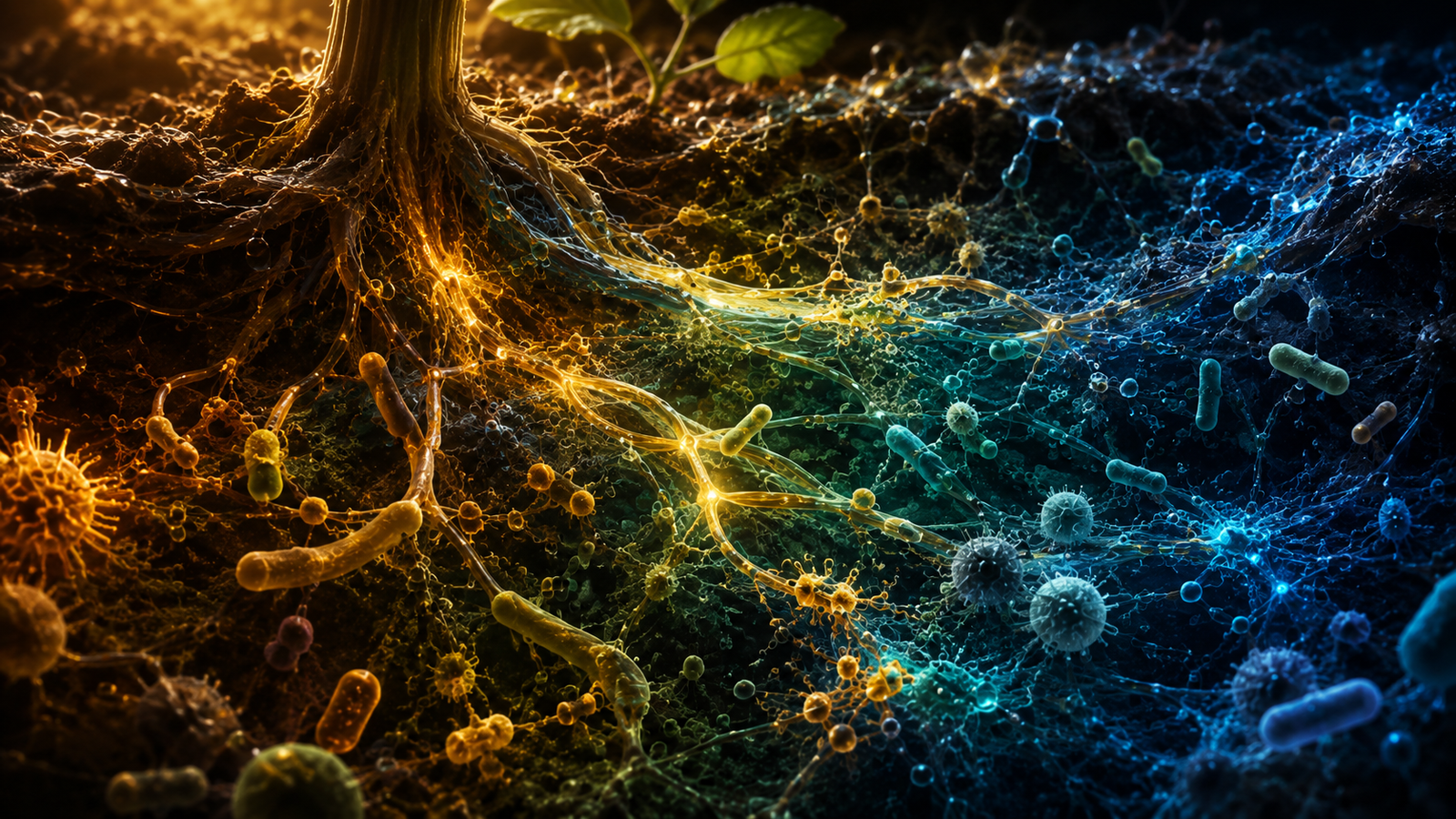
In microbial communities, this can be observed directly through cross-feeding. One microorganism transforms a resource and releases a compound that another organism can use.
The second organism may then release something that changes the first organism's environment.
A relationship appears through metabolism.
Relationship includes competition
It is easy to hear the word relationship and imagine cooperation.
Ecology is more complicated.
Organisms can compete for the same nutrient or surface. One organism can inhibit another. Predation, parasitism and exclusion are also relationships.
The important point is not that living systems are always harmonious.
It is that organisms affect one another.
The possibilities available to one member often depend on what the others are doing.
Hosts are ecosystems of exchange
Host-associated microbiomes make this especially visible.
Human and animal bodies provide habitats, nutrients and physical surfaces for microorganisms. Microorganisms in turn transform dietary compounds, produce metabolites and interact with host tissues.
This does not mean every microbial effect is beneficial or that every host-microbe relationship is necessary.
It means the biological system includes exchange across the boundary between host and microorganism.
The host is not ecologically empty.
Relationships can create new properties
A group can sometimes do something that its members cannot do alone.
In microbial communities, division of metabolic labour can allow complex substrates to be transformed through several steps. Biofilms can create gradients and structures that change stress tolerance, nutrient access and local chemistry.
These are examples of emergent properties: patterns that arise from interactions among parts.
Emergence does not make the parts irrelevant.
It means the parts must be understood together as well as separately.
Relationships change with conditions
The same two organisms may interact differently under different environmental conditions.
Abundant nutrients can reduce competition. Scarcity can intensify it. Oxygen, temperature, pH and physical structure can change whether exchange is possible.
Relationships are therefore conditional.
They have context.
What we know
Research in microbial ecology demonstrates that:
- organisms exchange metabolites and resources;
- competition and cooperation can occur in the same community;
- hosts and microorganisms influence one another through biological exchange;
- spatial structure can change microbial interactions;
- community-level properties can emerge from relationships among members.
What remains uncertain
Complex communities contain many interactions that are difficult to measure directly.
Co-occurrence does not automatically prove interaction. Laboratory communities can reveal mechanisms but may simplify natural systems. Even known relationships can change with environmental conditions.
Understanding living systems therefore requires both reduction and reintegration: studying parts carefully, then asking what changes when the parts meet.
MICROBA Perspective
MICROBA begins with relationship because relationship is where continuation becomes visible.
Food connects organisms to landscapes.
Microorganisms connect chemistry to biological transformation.
Hosts create habitats while being changed by the life they carry.
Communities inherit the consequences of previous interactions.
Life has identity, but life also has relationship. Both are real.
References
- Seth EC, Taga ME. Nutrient cross-feeding in the microbial world. Frontiers in Microbiology. 2014. https://pmc.ncbi.nlm.nih.gov/articles/PMC4086397/
- Fritts RK, McCully AL, McKinlay JB. Extracellular Metabolism Sets the Table for Microbial Cross-Feeding. Microbiology and Molecular Biology Reviews. 2021. https://pmc.ncbi.nlm.nih.gov/articles/PMC7849352/
- Liu W, et al. Deciphering links between bacterial interactions and spatial organization in multispecies biofilms. ISME Journal. 2019. https://pmc.ncbi.nlm.nih.gov/articles/PMC6864094/
- MICROBA. Human Microbiome - The Living Ecosystem Within. https://microba.co/human-microbiome/