

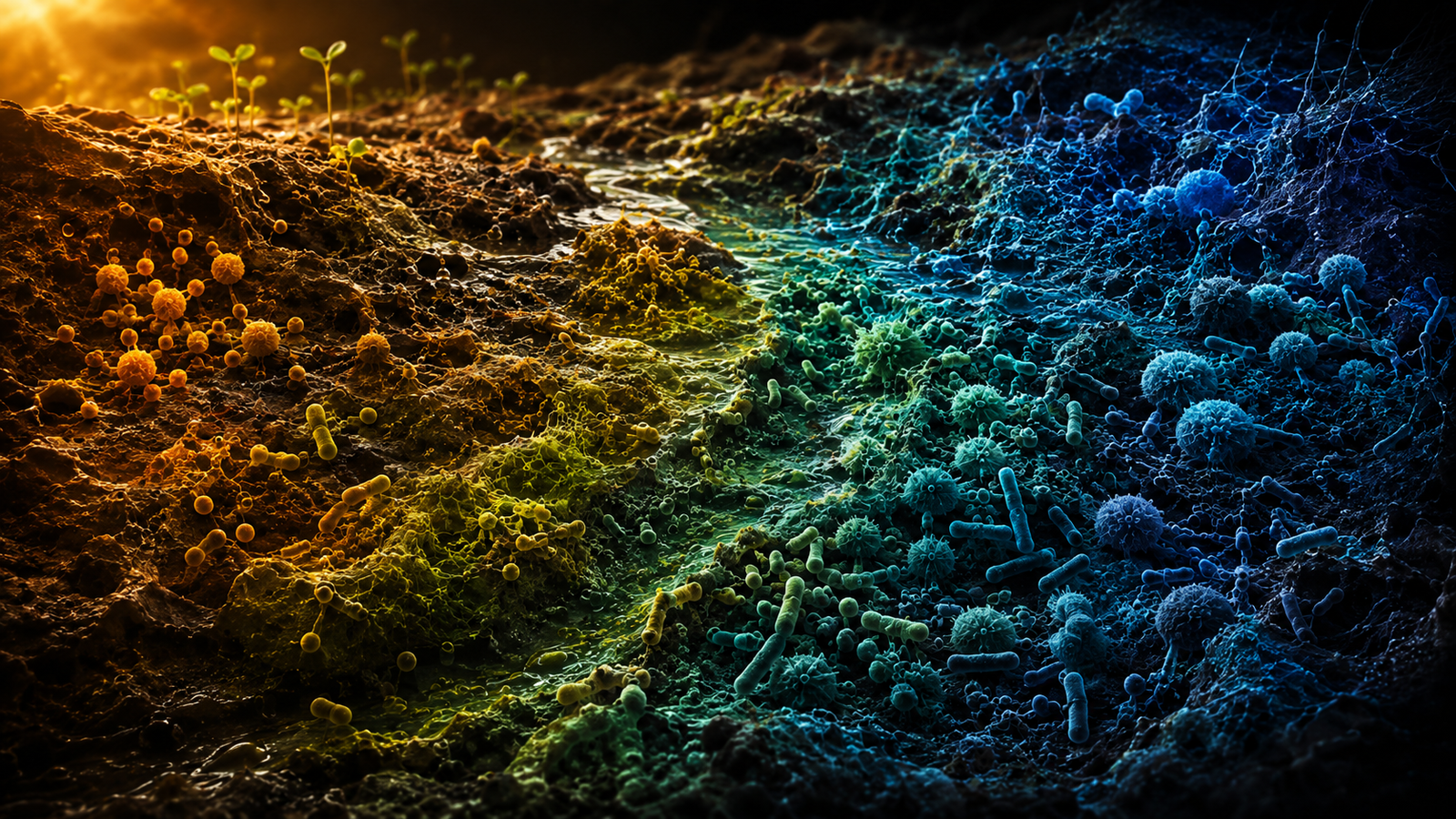
Microbial communities are often represented as charts.
A sample becomes a set of percentages: this organism is abundant, another is rare, a third is absent.
But every sample came from somewhere.
And where it came from can change the meaning of what was measured.
Space is an ecological variable
Human microbiome research provides a clear demonstration.
The oral cavity, skin, intestine and other body sites support characteristic microbial communities. Even within one broad body region, smaller microenvironments can differ.
This means a sample from one place cannot automatically represent another.
The same principle is visible in insects. In the honey bee digestive tract, core microbes are concentrated in particular regions rather than distributed evenly from front to back.
Space is not an empty coordinate.
It represents differences in oxygen, nutrients, surfaces, flow, host tissue and neighbouring organisms.
Microbial life creates gradients
Spatial differences can occur at scales much smaller than an organ.
In a biofilm, cells near the surface may receive more oxygen or fresh nutrients than cells deeper inside. Metabolic products can accumulate locally. One species may establish near a surface while another occupies a neighbouring layer.
These gradients can produce micro-sites with different biological possibilities.
Recent multispecies biofilm studies show that interactions among organisms can influence spatial organization, while spatial organization can in turn influence transcription and community behaviour.
Distance changes exchange
Many microbial interactions depend on molecules moving through space.
A metabolite released by one cell has to reach another cell before it can be used. An inhibitory compound may be strongest close to its producer. Oxygen is consumed as it diffuses. Nutrients can become depleted along a path.
The distance between organisms can therefore influence whether an interaction is important.
This is one reason a list of community members cannot fully describe community function.
We also need to understand arrangement.
Sampling can flatten a three-dimensional system
When researchers homogenize a sample, they often gain a powerful average view of the community.
But averaging can remove spatial information.
Two samples may contain similar organisms overall while having very different internal organization. Conversely, two adjacent micro-sites may look different even though they belong to one larger community.
Methods such as microscopy, fluorescence imaging and spatially resolved molecular analysis help recover this missing dimension.
Space changes through time
Spatial organization is not fixed.
As cells grow, die, move, attach, detach and modify their environment, the arrangement of a community can change.
A developing biofilm may create new oxygen gradients. A fermentation can shift as acids accumulate. A host tissue can change with diet, age or physiology.
Space and time therefore interact.
What we know
Evidence across many microbial systems supports that:
- microbial communities are spatially structured;
- local environmental conditions can vary over very short distances;
- body sites and gut compartments can support distinct communities;
- biofilms can contain organized micro-sites and gradients;
- spatial arrangement can influence metabolic exchange and competition.
What remains uncertain
Spatial measurements are technically difficult.
Many sequencing studies still rely on mixed samples that cannot show exact cell-to-cell arrangement. Imaging provides location but may identify fewer functions or organisms. Different methods answer different parts of the question.
Researchers are increasingly combining approaches to connect identity, activity and location.
MICROBA Perspective
MICROBA sees spatial biology as a reminder that life is always situated.
A microorganism exists somewhere specific.
It has neighbours at particular distances, resources arriving from particular directions and boundaries that shape movement.
To understand a living community, we therefore ask not only who is present, but also:
Where are they, what surrounds them, and what changes as we move through the habitat?
References
- Costello EK, et al. Bacterial community variation in human body habitats across space and time. Science. 2009. https://pubmed.ncbi.nlm.nih.gov/19892944/
- Human Microbiome Project Consortium. Structure, function and diversity of the healthy human microbiome. Nature. 2012. https://www.nature.com/articles/nature11234
- Callegari M, et al. Compartmentalization of bacterial and fungal microbiomes in the gut of adult honeybees. npj Biofilms and Microbiomes. 2021. https://pmc.ncbi.nlm.nih.gov/articles/PMC8105395/
- Liu W, et al. Deciphering links between bacterial interactions and spatial organization in multispecies biofilms. ISME Journal. 2019. https://pmc.ncbi.nlm.nih.gov/articles/PMC6864094/