

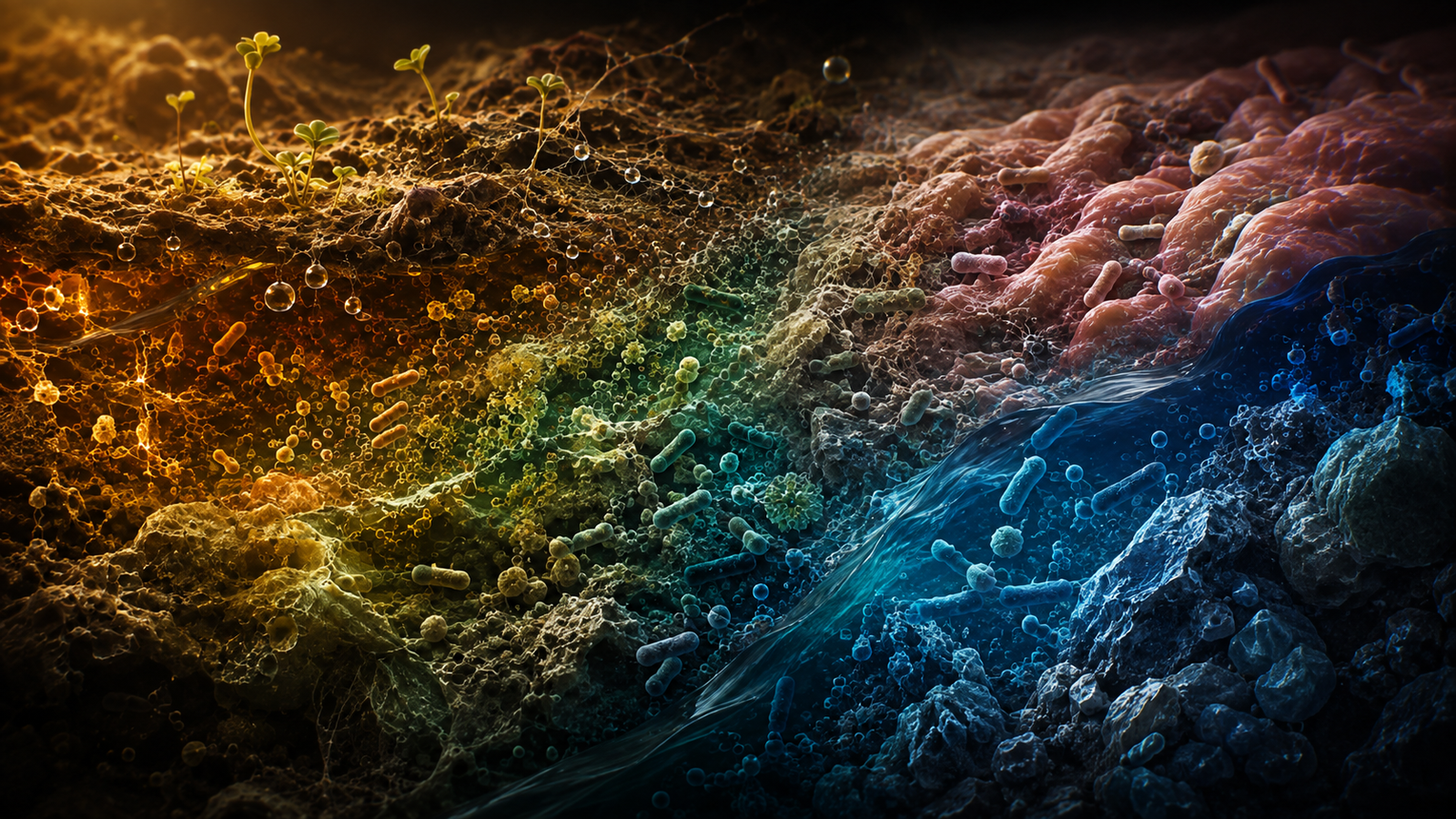
A microorganism has an identity.
It has genes, cellular structures and physiological capabilities that make it distinguishable from other organisms.
But identity does not operate alone.
The activity we observe depends on the conditions in which that organism is living.
This is why context matters so much in microbiology.
Capability is not the same as activity
A genome may contain genes for a metabolic pathway.
That tells us something important: the organism may have the capability to perform that function.
It does not tell us that the pathway is active at every moment.
Gene expression, substrate availability, oxygen, temperature, pH and interactions with other organisms can influence whether a capability becomes an observed activity.
A microorganism can therefore carry a potential that remains unused in one environment and becomes important in another.
The host changes the question
Host-associated microbiomes make context especially visible.
A bacterial species found in the mouth is living within a different ecological system from the same or a related organism found in the intestine. Host tissues, immune activity, nutrients, fluid movement and physical surfaces all differ.
Large human microbiome studies repeatedly show strong body-site structure. The result is not merely a catalogue of different organisms. It is evidence that local habitat helps organize microbial communities.
The honey bee gut offers a compact example of the same principle. Core bacterial groups show distinct spatial distributions across gut regions.
Neighbours can change behaviour
Microorganisms also respond to one another.
A neighbour may remove oxygen, release a vitamin, transform a carbohydrate, produce an acid, generate an inhibitory compound or occupy a surface.
Cross-feeding can make a resource available that was not directly accessible before. Competition can make an otherwise suitable habitat limiting. Biofilm structure can change diffusion and create new microenvironments.
The behaviour of one microorganism may therefore depend on who is nearby.
History matters too
Microbial communities have histories.
The order in which organisms arrive can influence later community structure. Previous exposure to disturbance can change recovery. A fermentation that begins with one set of organisms and conditions can follow a different path from a system that looks similar at a later snapshot but began differently.
This creates a scientific challenge.
A single measurement tells us what was detected at one point.
It may not tell us how the system arrived there.
Context protects us from overclaiming
Microbiome research often produces associations.
A microorganism may be more abundant in one group than another. A metabolite may correlate with a community pattern. A laboratory experiment may show that an organism can produce a compound under controlled conditions.
Each observation can be valuable.
But each belongs to a context.
Moving from association to mechanism, and from mechanism to real-world effect, requires additional evidence.
What we know
Microbiology strongly supports the idea that:
- microbial activity responds to environmental conditions;
- body site is a major organizer of host-associated microbial communities;
- microorganisms can change one another's local environment;
- community interactions can alter growth and metabolism;
- temporal history and disturbance can influence community trajectories.
What remains uncertain
Context is complex enough that we cannot always identify which variable is most important.
Many studies measure only a subset of the relevant conditions. Laboratory systems can isolate mechanisms but may not reproduce the full ecology of a natural system. Observational studies can reveal patterns without proving why they occurred.
The answer is not to reject evidence.
It is to describe precisely what the evidence can support.
MICROBA Perspective
MICROBA treats context as part of understanding.
A result becomes more meaningful when we know:
- where it was observed;
- under what conditions;
- in which host or environment;
- over what period of time;
- with which neighbouring organisms;
- using which method.
This is not hesitation for its own sake.
It is respect for living systems.
The closer we come to the conditions of life, the more carefully we can interpret what we see.
References
- Human Microbiome Project Consortium. Structure, function and diversity of the healthy human microbiome. Nature. 2012. https://www.nature.com/articles/nature11234
- Fritts RK, McCully AL, McKinlay JB. Extracellular Metabolism Sets the Table for Microbial Cross-Feeding. Microbiology and Molecular Biology Reviews. 2021. https://pmc.ncbi.nlm.nih.gov/articles/PMC7849352/
- Liu W, et al. Effects of Temperature on Bacterial Communities and Metabolites during Fermentation of Myeolchi-Aekjeot. Applied and Environmental Microbiology. 2016. https://pmc.ncbi.nlm.nih.gov/articles/PMC4792383/
- Callegari M, et al. Compartmentalization of bacterial and fungal microbiomes in the gut of adult honeybees. npj Biofilms and Microbiomes. 2021. https://pmc.ncbi.nlm.nih.gov/articles/PMC8105395/