
We commonly say:
the human microbiome.
The phrase is useful.
But it can also be misleading.
There is no single microbial community spread uniformly across the human body.
The mouth is not the skin.
The skin is not the colon.
The colon is not the nasal cavity.
Each body site presents microorganisms with a different habitat, and microbial communities reflect those differences. Large Human Microbiome Project studies found strong patterns of community structure associated with major body habitats including the oral cavity, skin, gut and vagina.
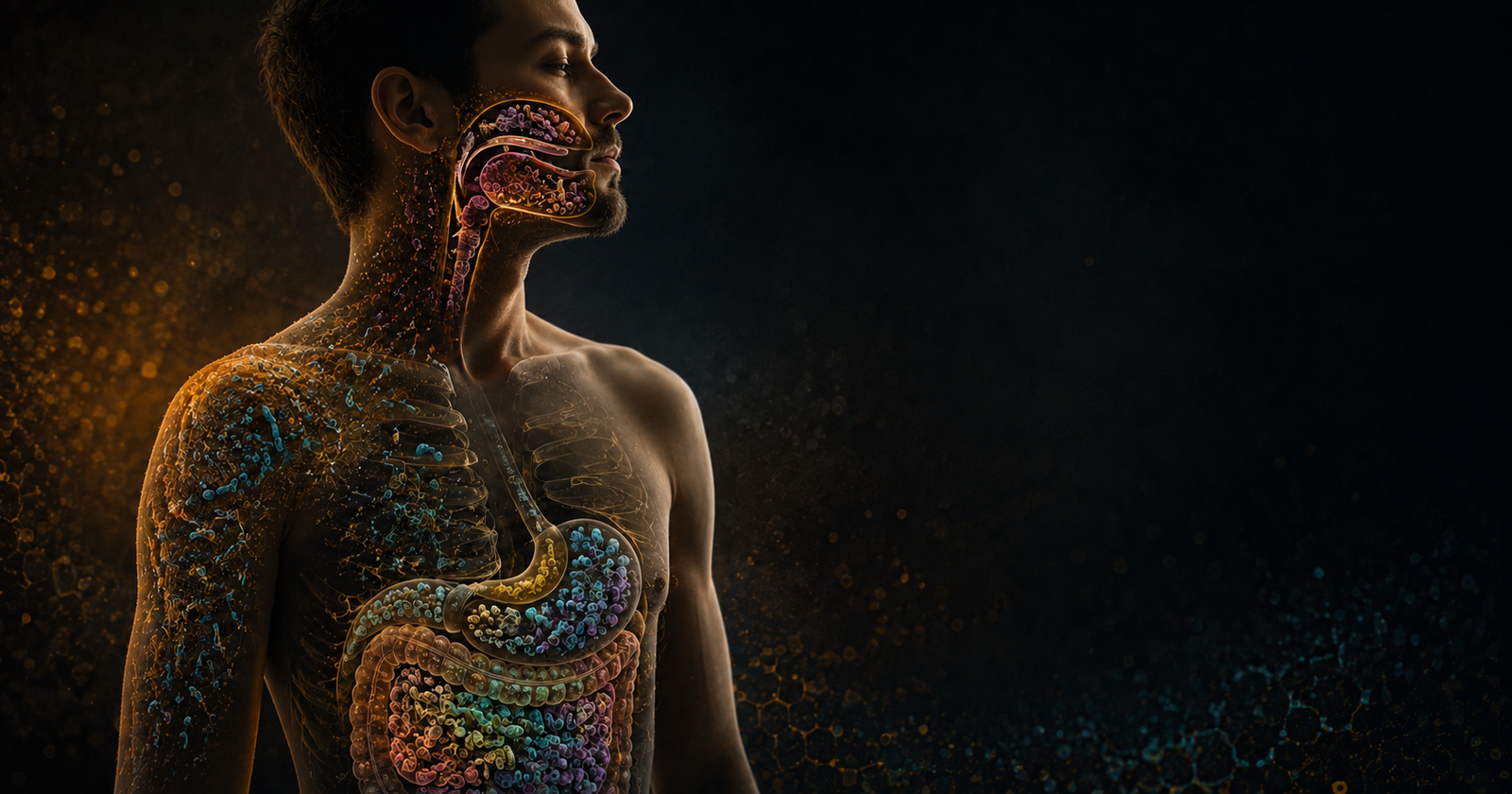
The human microbiome is therefore better understood as many connected microbial ecosystems.
The body creates different habitats
Every part of the body presents its own conditions.
Microorganisms living there encounter differences in:
- moisture;
- oxygen;
- acidity;
- temperature;
- nutrients;
- host secretions;
- physical surfaces;
- immune activity;
- patterns of exposure to the outside world.
These conditions help select which organisms can persist and how communities are structured.
Large-scale studies of healthy adults have shown that body habitat is one of the strongest organizing features of human-associated microbial communities.
Even relatively nearby sites can support different microbial populations.
Human skin, for example, contains distinct microenvironments, and studies across multiple skin sites have found strong site-specific patterns in both taxonomic and functional composition.
There is no single normal microbiome
Another important lesson emerges when researchers compare people.
Microbiomes can differ substantially between individuals while still being associated with health.
The Human Microbiome Project demonstrated extensive interpersonal variation, even while body sites retained recognizable ecological patterns.
Longitudinal work also shows that microbial communities can change over time while retaining aspects of site-specific and individual structure.
This makes simplistic ideas of a single perfect microbiome difficult to defend.
A microorganism that is common in one body habitat may be unusual in another.
A community pattern observed in one person may not define an ideal target for everyone else.
Context matters.
Composition is only part of the story
Microbiome research initially gained enormous power from identifying which organisms were present.
Today, researchers increasingly examine additional layers:
- strains;
- genes;
- metabolic pathways;
- microbial products;
- spatial organization;
- interactions with human cells;
- changes through time.
Studies extending the Human Microbiome Project have shown substantial strain-level and functional variation between body sites and individuals.
This means two communities can differ taxonomically yet still share some functional capabilities.
The reverse can also occur: closely related microorganisms may behave differently because their strains carry different genes or encounter different environmental conditions.
The question is therefore not simply:
Which microorganisms are there?
It also becomes:
What are they capable of doing here?
The gut is an ecosystem, but not the whole microbiome
The intestinal microbiome receives enormous attention, and for good reason.
The digestive tract supports dense microbial communities whose metabolic products can interact with host tissues and physiological processes.
But the gut should not become shorthand for the entire human microbiome.
Microbial ecosystems also occur on the skin, in the mouth, airways and other body habitats.
Each deserves to be understood in its own ecological context.
What we know
Research strongly supports several principles:
- human-associated microbial communities differ across body sites;
- local habitat conditions help structure those communities;
- substantial variation exists between healthy individuals;
- microbiomes change over time;
- composition alone does not fully describe microbial function.
What remains uncertain
Microbiome research continues to reveal associations between microbial patterns and human health.
But association is not automatically causation.
For many conditions, researchers are still working to determine whether particular microbiome changes contribute to disease, result from disease, reflect treatment or diet, or arise through several processes at once.
Individual variation also makes universal interpretations difficult.
The field is becoming more precise partly because it is becoming more careful about context.
MICROBA Perspective
MICROBA does not see the human microbiome as one invisible organ with one ideal composition.
We see a living landscape.
Different places create different conditions.
Different conditions support different communities.
And those communities participate in relationships with the body, food, environment and time.
Understanding begins when we stop asking for one universal microbial answer and start asking:
What is happening, where is it happening, and within what relationship?
References
- Human Microbiome Project Consortium. Structure, function and diversity of the healthy human microbiome. Nature. 2012. Nature
- Ding T, Schloss PD. Dynamics and associations of microbial community types across the human body. Nature. 2014. Nature
- Costello EK, et al. Bacterial community variation in human body habitats across space and time. Science. 2009. PubMed
- Oh J, et al. Biogeography and individuality shape function in the human skin metagenome. Nature. 2014. Nature
- Lloyd-Price J, et al. Strains, functions and dynamics in the expanded Human Microbiome Project. Nature. 2017. Nature