

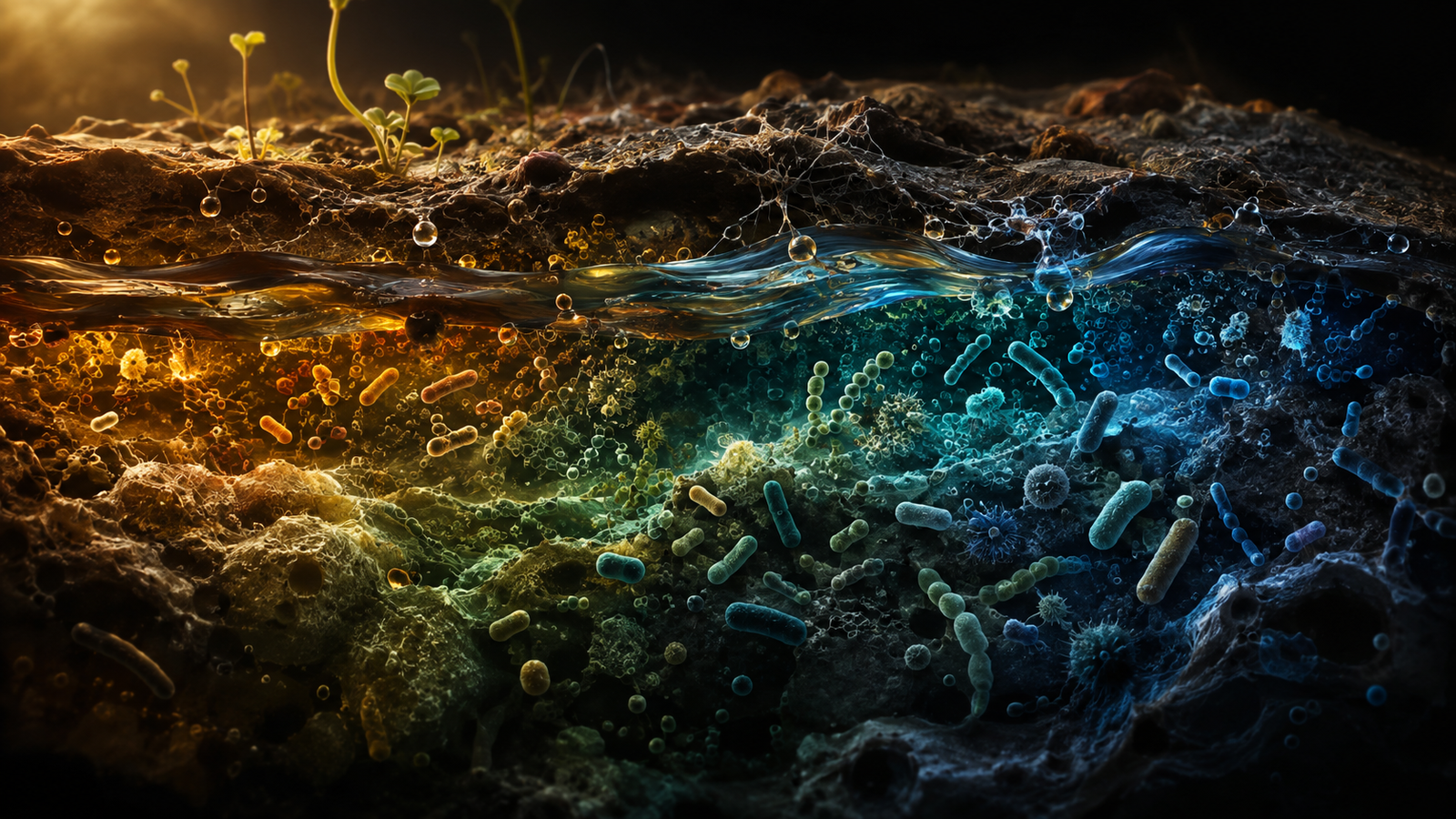
A habitat is often imagined as a place on a map.
For microorganisms, place is only the beginning.
A microbial habitat is also a set of conditions: the water that is available, the molecules that can be used as nutrients, the amount of oxygen present, the acidity of the environment, the temperature, the physical surface, the movement of materials and the organisms already living nearby.
Two locations separated by only a few millimetres can therefore be very different microbial worlds.
Habitat is physical and chemical
Microorganisms experience their surroundings at very small scales.
A change in oxygen concentration near a surface, a shift in pH inside a gut compartment, or a difference in moisture within a food matrix can change which organisms are able to grow and what metabolic pathways are useful.
This is one reason microbial communities are strongly associated with body sites in the human microbiome. The mouth, skin and intestine are all part of one body, but they provide very different combinations of moisture, nutrients, oxygen, host secretions and physical structure.
The same principle appears in the honey bee gut. The crop, midgut, ileum and rectum are connected, yet their physicochemical conditions and microbial populations differ.
Resources help define the niche
Every growing microorganism needs access to usable energy and materials.
The important question is not simply whether a nutrient exists somewhere in the system. It is whether that nutrient is available where the organism lives and whether the organism has the machinery to use it.
This creates ecological niches.
One microorganism may specialize in a molecule that another cannot use. A second organism may consume a metabolic product released by the first. A third may compete for the same limiting resource.
The habitat therefore includes both the original resources and the resources created by life already present.
Water changes what is possible
Water is central to microbial activity, but the total amount of water is not the whole story.
Microbiologists often use water activity to describe how available water is for biological and chemical processes. Foods with similar moisture content can differ in water activity because sugars, salts, proteins and other components bind water differently.
In honey, for example, high sugar concentration and relatively low water activity contribute to an environment in which many microorganisms do not actively grow, even though microorganisms may still be detected in the product.
Changing the water environment can therefore change the ecological possibilities.
Temperature and time interact
Temperature influences enzyme activity, membrane behaviour and microbial growth rates. It also changes competition between organisms.
Fermentation studies provide clear examples. When otherwise similar fermentations are held at different temperatures, community succession and metabolite production can follow different trajectories.
This means time cannot be interpreted independently of conditions.
Ten days in one environment are not biologically equivalent to ten days in another.
Neighbours are part of the habitat
For microorganisms, neighbouring organisms are not background scenery.
They can consume oxygen, produce acids, release enzymes, generate metabolites, occupy surfaces or inhibit competitors. In biofilms, these activities can create gradients and micro-sites that did not exist before the community formed.
The habitat is therefore partly inherited and partly constructed.
Organisms respond to their environment while also changing it.
What we know
Research across human microbiomes, insect microbiomes, biofilms and food fermentations supports several broad principles:
- microbial communities respond strongly to local physical and chemical conditions;
- nearby locations can contain different communities when their conditions differ;
- nutrients, oxygen, pH, water availability and temperature can influence growth and metabolism;
- microorganisms can modify the habitat experienced by their neighbours;
- habitat and community structure can change together through time.
What remains uncertain
Knowing the major environmental variables does not let us predict every microbial outcome.
Strain-level differences, historical events, immigration, host biology and interactions among organisms can all alter the trajectory of a community. Measurements such as pH or water activity are informative, but they do not capture the whole living system.
Microbial ecology remains difficult precisely because many conditions operate at the same time.
MICROBA Perspective
MICROBA uses the word habitat in a practical sense.
A habitat is not just where life is found. It is the set of conditions that makes particular forms of life possible.
This changes the way we ask questions.
Instead of asking only, "Which microorganism is present?" we can also ask:
What conditions is it living within, what relationships surround it, and what possibilities do those conditions create?
Returning to habitat does not simplify life into one variable.
It restores the context that gives life meaning.
References
- Human Microbiome Project Consortium. Structure, function and diversity of the healthy human microbiome. Nature. 2012. https://www.nature.com/articles/nature11234
- Costello EK, et al. Bacterial community variation in human body habitats across space and time. Science. 2009. https://pubmed.ncbi.nlm.nih.gov/19892944/
- Callegari M, et al. Compartmentalization of bacterial and fungal microbiomes in the gut of adult honeybees. npj Biofilms and Microbiomes. 2021. https://pmc.ncbi.nlm.nih.gov/articles/PMC8105395/
- Liu W, et al. Effects of Temperature on Bacterial Communities and Metabolites during Fermentation of Myeolchi-Aekjeot. Applied and Environmental Microbiology. 2016. https://pmc.ncbi.nlm.nih.gov/articles/PMC4792383/